TRANSMISSION // 2611.32459v1
A learning-based cleanup for noisy quantum simulations
Source published
A study on IBM hardware finds that machine-learning error mitigation can improve small nuclear-system simulations, but results depend strongly on training data and model choice.
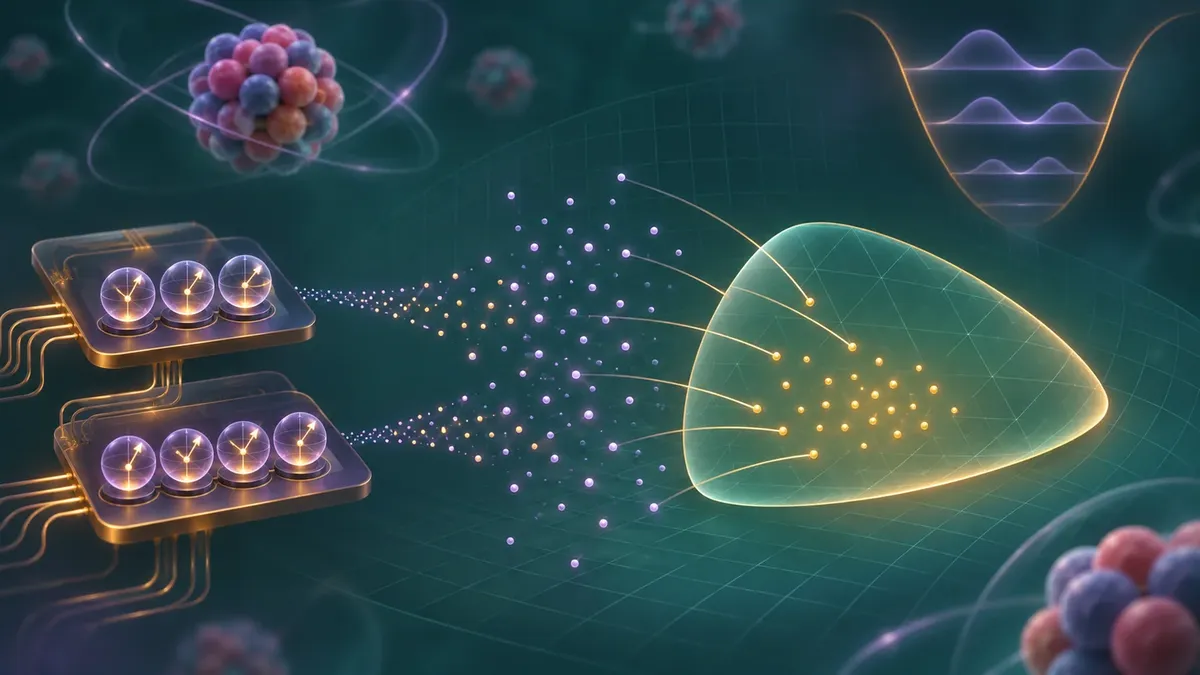
Quantum devices make errors, and correcting them without full fault-tolerant hardware is a major challenge. A new preprint tests a machine-learning method that learns to adjust noisy measurements while keeping reconstructed quantum states physically valid.
Quantum computers do not return perfectly clean results. Imperfect gates, measurement errors and loss of quantum coherence can distort the quantities researchers want to calculate. Quantum error mitigation tries to correct those distortions using measurements from noisy devices, without the full machinery of quantum error correction.
In this study, Sumit Choudhary and colleagues ask whether machine learning can improve estimates of the ground-state energies of two small, bound hypernuclear systems: a Λ-deuteron system represented with three qubits, and a Λ-α system represented with four. Their proposed method addresses two related problems: a learned correction can depend heavily on what examples it sees, and its reconstructed quantum state may not obey the mathematical rules that every physical state must satisfy.
Learning from examples, then enforcing physical rules
The team ran variational quantum eigensolver (VQE) circuits on IBM quantum hardware. They trained regression models to predict the difference between noisy measurements and ideal values. The ideal training labels came from a statevector simulator; noisy measurements came from the quantum processor.
They compared two kinds of training examples. Haar-random states sample broadly across the possible quantum states, while VQE-ansatz states are generated by the same family of circuits used in the target calculation. Each dataset contained 2,000 states. The researchers tested ridge regression, a linear model, and radial-basis-function kernel ridge regression, which can learn nonlinear relationships.
Their key addition is a mathematical projection step. A quantum state is represented by a density matrix, which must be Hermitian, have unit trace and have no negative eigenvalues. Noise and finite measurement statistics can violate the last condition. The researchers project reconstructed matrices onto the set of valid density matrices, both before model training and after applying the learned correction. In plain terms, the method prevents the reconstruction from describing an impossible quantum state.
The authors compared this approach with conventional machine-learning error mitigation, readout error mitigation and zero-noise extrapolation. The latter estimates a noise-free result by measuring circuits at different noise levels and extrapolating back toward zero noise.
Strong results in small, specific tests
The clearest results came when the training examples matched the target circuit family. For the three-qubit Λ-deuteron calculation, ridge regression trained on VQE-ansatz states estimated the energy at −0.134 MeV, close to the ideal reference of −0.135 MeV. The reported state fidelity was 0.999, where fidelity measures how closely the reconstructed state matches the reference.
For the four-qubit Λ-α system, the best reported results used kernel ridge regression trained on VQE-ansatz states. For two alternative nuclear interaction models, the estimated energies were −3.014 MeV and −3.045 MeV, with fidelities of 0.995 and 0.998. These are results for the particular Hamiltonians, circuits and hardware runs studied—not a general demonstration that the method will work equally well on other quantum simulations.
The training-data comparison is important. Haar-random examples generally gave much weaker corrections for the target ground states, especially in the four-qubit case. The study also shows that no single regression model was best for both systems: the linear model performed best in the three-qubit example, while the nonlinear kernel model led in the four-qubit energy estimates. More training examples did not automatically make every method better.
What the results do—and do not—establish
The findings suggest that physically constrained reconstruction and task-relevant training data can help machine-learning error mitigation in these small hardware experiments. But the approach depends on having suitable training data, including ideal values generated by simulation. The authors tested only three- and four-qubit mapped systems and identify extension to larger, more realistic many-body nuclear Hamiltonians as future work. The evidence therefore does not establish scalability to larger problems or performance on other devices and tasks.
The paper is an arXiv preprint, a research manuscript that may not yet have undergone peer review. Its reported results should be treated as provisional until independently assessed and reproduced. They demonstrate a promising method in a limited setting, not a solution to quantum-device noise in general.
Source: Choudhary, Kaur, Kaur and Singh, “Machine Learning-Based Quantum Error Mitigation for Bound-State Simulations,” arXiv:2611.32459v1.
- quantum computing
- quantum error mitigation
- machine learning
- quantum simulation
- hypernuclear physics
- IBM quantum hardware
- preprint
Reviewed cross-references
These connections were reviewed by a model, not independently fact-checked by a human. Similarity does not imply agreement; consult the original papers and the evidence below.
A small learned model tackles larger quantum circuits
Shared method: Both studies use learned models for quantum error mitigation, but the approaches differ: Choudhary et al. combine regression, residual learning and convex projection to reconstruct physically valid density matrices, while Kyaw et al. train a graph neural network on small circuits and reuse it on fragments of larger circuits. The first reports IBM-hardware results for three- and four-qubit bound-state simulations; the second’s larger-circuit findings are primarily numerical and depend on circuit cutting and its associated sampling costs. These preprint excerpts support a broad shared-method link, not a direct performance comparison.
Model review: · openai-codex/gpt-6-luna
Evidence and provenance
Selected excerpts, not complete papers. PDF extraction can omit figures or damage equations, tables and reading order; sources may be preprints.
2611.32459v1 — Original paper
Excerpt reference:
static/papers/2611.32459v1.md:12-73
Basis: Paper text
Source SHA-256:77040d505105b2c17bfba789c2b12e7357b1f6839c32b9fc9290a9fce119a6152611.28261v1 — Original paper
Excerpt reference:
static/papers/2611.28261v1.md:129-181
Basis: Paper text
Source SHA-256:aa4860444896eee869189c993e30f8138a601e359e88522eb3e40418ba59a3032611.28261v1 — Original paper
Excerpt reference:
static/papers/2611.28261v1.md:1547-1637
Basis: Paper text
Source SHA-256:aa4860444896eee869189c993e30f8138a601e359e88522eb3e40418ba59a303
Related reading
Automatically matched by shared topic keywords. These links do not imply that the sources agree or establish a consensus.
Learning when quantum error mitigation is worth the cost
Source published
Shared keywords: quantum computing, quantum error mitigation
A small learned model tackles larger quantum circuits
Source published
Shared keywords: machine learning, quantum computing, quantum error mitigation
A Fourier neural network tries to recover Shor’s signal from quantum noise
Source published
Shared keywords: quantum computing, quantum error mitigation
Teaching quantum circuits to grow
Source published
Shared keywords: machine learning, quantum computing, quantum simulation
A hybrid quantum-classical route to electron dynamics
Source published
Shared keywords: quantum simulation