TRANSMISSION // 2611.32451v1
Silicon-carbide vacancy spins show transition-dependent coherence
Source published
EPR measurements in one 4H-SiC sample found different relaxation and coherence times for central and satellite transitions. The reasons for the differences remain unresolved.
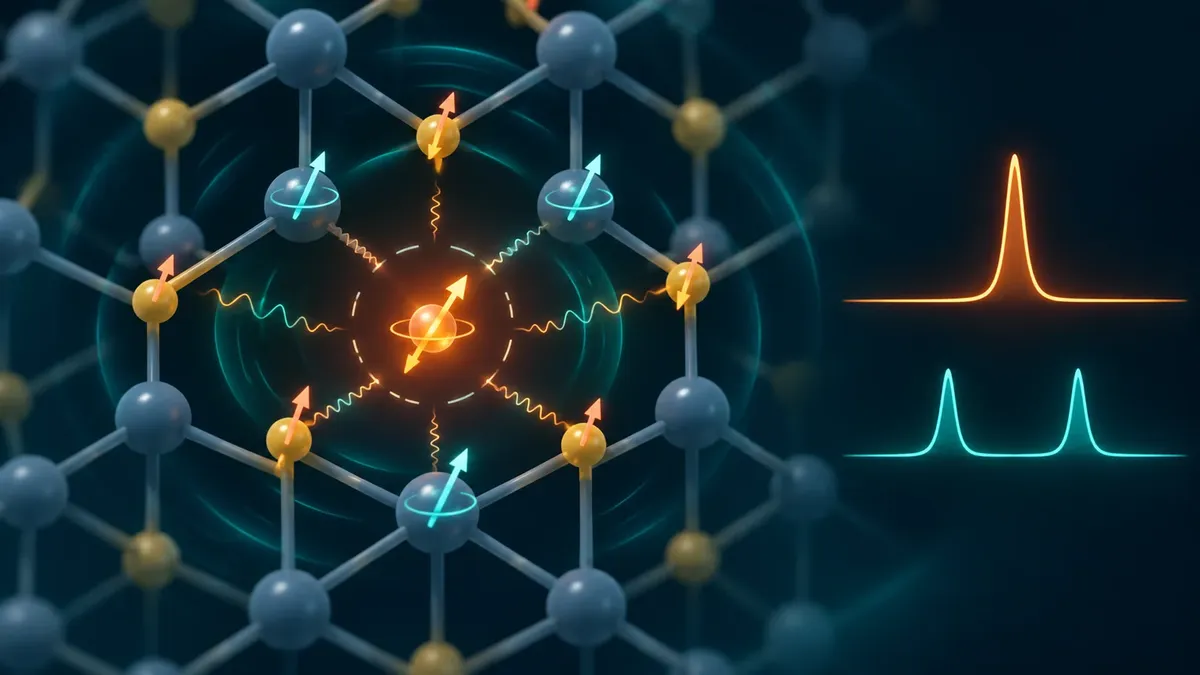
How long can an electron spin at a silicon vacancy retain its quantum state? Researchers measured relaxation and coherence in irradiated 4H-silicon carbide across temperatures from 80 to 300 K. The satellite transition generally had longer measured times at lower temperatures, but the gap narrowed and the coherence times were nearly equal—with the satellite value slightly shorter—at 300 K.
A crystal defect can act like a tiny spin, a possible building block for quantum sensors and qubits. But interactions with nearby spins can disturb it and shorten the time it preserves a coherent quantum state. This study measures relaxation and coherence at silicon vacancies in 4H silicon carbide (4H-SiC), and tracks how those times vary with temperature.
Silicon carbide is of interest partly because it is compatible with established semiconductor technology. The researchers studied two silicon-vacancy centers, called V1 and V2, each with electron spin S = 3/2. They also found a signal from a third defect, labelled X, whose structure is not fully understood.
Measuring spins in a crystal
The team used electron paramagnetic resonance (EPR), which detects how spins respond to microwave radiation in a magnetic field. They examined a commercial 4H-SiC sample after electron irradiation and annealing, over temperatures from 80 to 300 kelvin. Continuous-wave EPR measurements helped estimate the concentrations of the spin species. Pulsed EPR measurements tracked T1, the time associated with spin-energy relaxation, and T2, a measure of how long spin coherence persists under the experiment’s measurement protocol.
The spectrum contained a central line and satellite lines. The central signal included contributions from V1, V2 and X; the satellite transitions were attributed to V2. Since the central line combines several species, comparing it with the satellite transition is not a simple comparison of otherwise identical signals.
The estimated concentrations were 1.47 ± 0.30 × 10¹⁴ spins/cm³ for V1, 5.6 ± 1.12 × 10¹³ spins/cm³ for V2, and 1.03 ± 0.21 × 10¹³ spins/cm³ for X. Including X helped reproduce the spectrum, but the defect’s microscopic identity remains uncertain.
The transition and temperature matter
At 80 K, the satellite transition had a T1 of 42.8 ± 1.3 milliseconds and a T2 of 0.708 ± 0.004 milliseconds. The corresponding central-transition values were 26.6 ± 0.3 milliseconds and 0.407 ± 0.008 milliseconds. The measured T1 values fell as temperature rose. T2 showed an overall decline, though not a strictly step-by-step decrease at every temperature. The difference between transitions narrowed with increasing temperature: at 300 K, T1 values were nearly equal, and T2 was 0.126 milliseconds for the satellite transition versus 0.14 milliseconds for the central transition.
The researchers considered several possible sources of decoherence. Nearby nuclear spins can change the magnetic environment experienced by an electron spin. Other electron spins can also produce fluctuating fields; spectral diffusion describes fluctuations from spins not directly driven by the measurement pulses. The authors identify nuclear and electron spin diffusion as important contributors to decoherence.
That explanation is incomplete. Their simplified model reproduces measured T2 values only within about an order of magnitude, and it does not explain either the transition-dependent difference or how that difference varies with temperature. In particular, the model predicts a longer T2 for the central transition, opposite to the observed ordering over most of the measured range. Further work is needed to account for these results.
A result tied to one sample
These are ensemble measurements in an irradiated and annealed sample using X-band EPR. They do not establish how an individually addressed vacancy would perform in a finished device, or whether the same times would be observed in other samples and conditions. The mixed contributions to the central signal also complicate interpretation.
The work is posted as an arXiv preprint. The available source does not establish its peer-review status or independent confirmation, so those questions should not be assumed either way. The findings are best read as measurements of these particular transitions in this sample: the satellite transition had longer T1 and T2 at 80 K, while by 300 K the relaxation times were nearly equal and the satellite T2 was slightly shorter than the central T2.
- silicon carbide
- silicon vacancy
- electron paramagnetic resonance
- spin coherence
- quantum sensing
- 4H-SiC
Related reading
Automatically matched by shared topic keywords. These links do not imply that the sources agree or establish a consensus.
Voltage brings silicon-carbide quantum emitters into tune
Source published
Shared keywords: quantum sensing, silicon carbide
When diamond’s vacancies combine, a qubit may keep its coherence longer
Source published
Shared keywords: quantum sensing, spin coherence
What gives a silicon-carbide defect its strong spin signal?
Source published
Shared keywords: silicon carbide
A quieter diamond spin bath—if the magnetic field is low
Source published
Shared keywords: quantum sensing, spin coherence
How moving nitrogen spins reshape diamond’s quantum echo
Source published
Shared keywords: quantum sensing, spin coherence