TRANSMISSION // 2611.32406v1
How BEACON changes the starting point for microscopy restoration
Source published
BEACON learns an observation-conditioned distribution for the starting noise in a microscopy restoration model. Across ten datasets, it had the best median rank under the paper’s four metric-pair rankings, though results varied across measures and tasks.
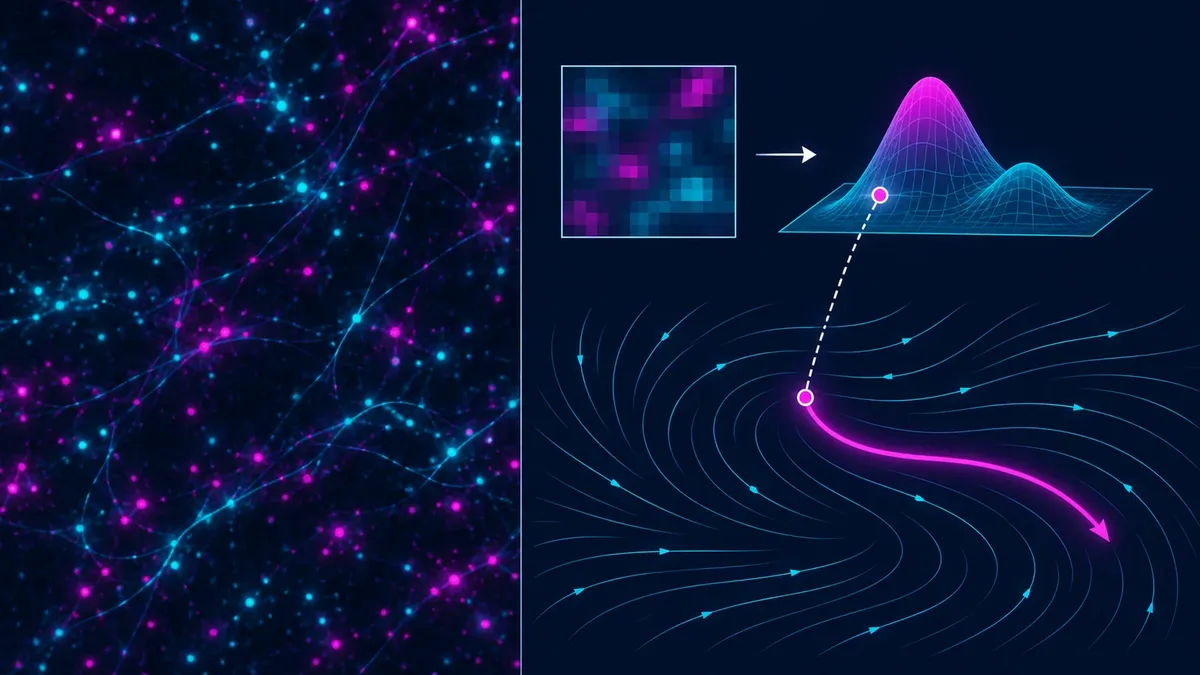
Microscopy restoration models must infer detail from imperfect measurements, without mistaking plausible-looking structures for verified biology. BEACON changes how one such model is initialized: it learns a distribution of starting points conditioned on the degraded image. The reported advantage is an aggregate ranking, not a win on every dataset or metric.
Fluorescence microscopy images can be degraded by out-of-focus light, limited resolution and signal-dependent noise. Restoration methods aim to recover useful detail from these measurements, but the task is ambiguous: one degraded image can be consistent with several possible high-quality images. A realistic-looking reconstruction is not, by itself, evidence that every detail matches the specimen.
Anirban Ray and Florian Jug introduce BEACON, a method for guided conditional flow matching, a generative approach to image restoration. In this framework, a model learns a velocity field—a rule for how a latent starting sample changes over time—while using the degraded observation as context. The authors’ motivation is that standard guided flow matching pairs each clean training target with an independent sample of Gaussian noise. They argue that this arbitrary pairing can create conflicting training directions. That is the rationale for BEACON, not evidence that the same difficulty applies to every restoration method.
BEACON adds a lightweight network that predicts a Gaussian distribution of starting samples conditioned on the degraded image. During training, it proposes multiple candidate starting points for each paired degraded image and clean target. The method scores the resulting paths by flow-matching loss and uses the lowest-loss candidate to train the flow model and proposal network. A KL regularization term penalizes departure from the standard Gaussian prior; it does not guarantee that the learned proposal, across observations, matches that prior exactly.
At inference, the clean target is unavailable. BEACON draws a single starting sample from the learned, observation-conditioned proposal and transports it along the learned velocity field. It does not choose the best of several candidates at this stage. Multiple possible restorations can be generated by repeating the process with new samples.
The authors evaluated BEACON on ten datasets: five for microscopy dehazing and five for computational super-resolution under heavy noise. They compared it with 13 baseline families. Their evaluation paired PSNR and MicroMS-SSIM, used as fidelity metrics, with LPIPS and FID, used as perceptual metrics. These measures capture different aspects of image quality; none alone establishes that reconstructed structures are biologically correct.
In the authors’ aggregate analysis, BEACON had the best median rank across datasets for all four fidelity–perception metric pairings. This ranking summarizes performance using a normalized score designed to balance the two metrics in each pair. It depends on the methods included and the normalization, and does not mean BEACON improved both metrics in every comparison. BEACON and its direct guided flow-matching baseline were evaluated across all ten datasets, while some other baselines had results on fewer.
The paper’s direct comparison with the task-specific guided flow-matching baselines—HazeMatching for dehazing and ResMatching for super-resolution—shows mixed results. PSNR improved on six datasets, was within 0.02 dB on three and was lower on one. FID improved on seven datasets and was worse on the other three: Neuron, ER and F-actin. LPIPS was lower on four datasets and higher on six. The authors describe gains as more consistent for dehazing, while super-resolution results were mixed. BEACON’s mean rank was slightly worse than the guided baseline for the MicroMS-SSIM–FID pairing, despite its best median rank.
The uncertainty results also call for care. The authors assess calibration on selected datasets, finding that the relationship between predicted variability and reconstruction error differs by dataset. Linear calibration brings some curves closer to agreement but leaves deviations in the examples discussed; these tests do not establish uniformly calibrated uncertainty across all ten datasets. Some image tiling artifacts also remain visible.
BEACON’s best-of-many candidate scoring adds computation and memory use during training as the number of candidates grows. At inference, the paper reports 20 flow-integration steps plus one proposal-network evaluation. Its runtime comparison with HazeMatching was conducted on Organoids1 and showed a marginal difference; this single benchmark does not establish equal inference cost in general. The experiments likewise do not establish performance across every microscope, specimen or acquisition condition.
This work is an arXiv preprint, which may not have undergone peer review. The authors say code and pretrained models will be released, but the source does not confirm that they are already available. Independent replication and testing on additional data remain important for assessing how well the reported results generalize.
- fluorescence microscopy
- microscopy image restoration
- computational super-resolution
- guided conditional flow matching
- generative models
- BEACON
Reviewed cross-references
These connections were reviewed by a model, not independently fact-checked by a human. Similarity does not imply agreement; consult the original papers and the evidence below.
FlowAlign uses learned paths to align different kinds of data
Shared method: Both papers use conditional flow matching, but for different purposes: BEACON uses it to model microscopy restorations and adapts observation-conditioned starting points, while FlowAlign repurposes a learned flow field as a training-time signal for aligning representations in a fixed target space. This is a methodological connection, not evidence that either paper validates the other’s results.
Model review: · openai-codex/gpt-6-luna
Evidence and provenance
Selected excerpts, not complete papers. PDF extraction can omit figures or damage equations, tables and reading order; sources may be preprints.
2611.32406v1 — Original paper
Excerpt reference:
static/papers/2611.32406v1.md:94-142
Basis: Paper text
Source SHA-256:9668f7ac9e509e4b8a1fd3c7e57702d3628ae0f7f3f76543d304e52a914be1b32611.09863v1 — Original paper
Excerpt reference:
static/papers/2611.09863v1.md:76-122
Basis: Paper text
Source SHA-256:0ff405d40a8cb3cf1ae34aebd776c0de1a703a30435f530725783ce40859f8d5
Related reading
Automatically matched by shared topic keywords. These links do not imply that the sources agree or establish a consensus.
Where Do Diatoms Get Silicon When Their Supply Runs Low?
Source published
Shared keywords: fluorescence microscopy
When AI Memorizes—and When It Makes Something New
Source published
Shared keywords: generative models
When can a generative model be edited like a simulator?
Source published
Shared keywords: generative models
A faster way to search enormous design spaces
Source published
Shared keywords: generative models
Teaching AI to Generate Event-Camera Signals
Source published
Shared keywords: generative models