TRANSMISSION // 2611.32399v1
When Audio and Video Don’t Tell the Same Story
Source published
A caption-guided method adjusts how much audio–video pairs shape contrastive training when their content only partly matches. Tests report higher overall retrieval scores, with limits.
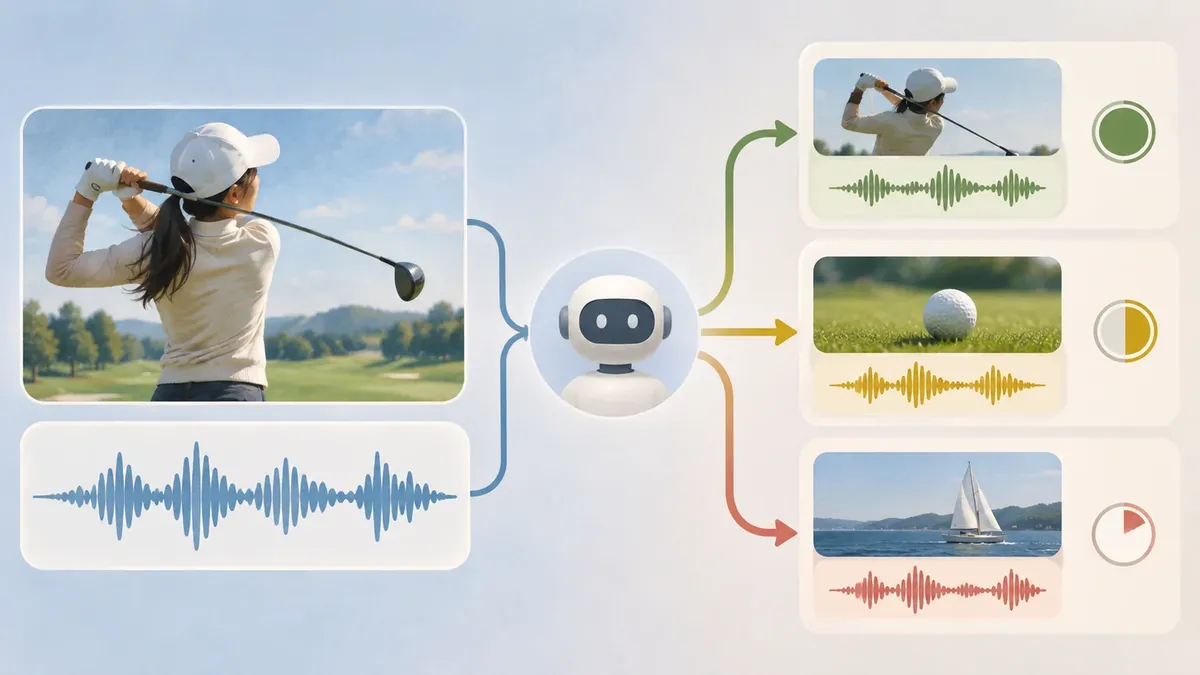
A video’s soundtrack can describe something outside the camera’s view. AI systems trained to treat every paired sound and image as equally related may learn misleading associations. A new preprint proposes using separate captions to estimate how closely audio and video match, then adjusting each pair’s influence during training.
The problem with assuming every pair matches
Audio–visual learning often uses contrastive training: a model brings representations of a clip’s audio and video closer together while pushing representations from different clips apart. The approach relies on a useful shortcut—that sound and image appearing together usually share meaningful content.
But co-occurrence is not the same as correspondence. A video might show a golf swing while its audio contains unrelated speech, or capture someone walking while a dog barks off-screen. Treating all such pairs as equally strong matches can encourage a model to associate details that do not correspond.
In Not All Pairs Align: Caption-Guided Audio-Visual Contrastive Learning, Omar Emara, Nan Lu, Dima Damen and Hazel Doughty propose a way to soften that assumption. Their method, Caption Guided Alignment Aware Loss (CGAAL), estimates how much meaning an audio–video pair shares and uses that estimate to adjust how strongly the model aligns it.
Captions become a training signal
The researchers describe each modality separately: video with a visual caption and audio with an audio caption. A language model compares the captions and assigns an alignment score from zero (no semantic correspondence) to one (complete correspondence). In the main setup, each sample has five captions for each modality. The scores for all 25 possible caption pairings are averaged into one score for that sample.
That score weights the pair’s contribution to the contrastive loss. A low-scoring pair puts less pressure on the model to bring its audio and video representations together; a higher-scoring pair puts more. CGAAL first trains with ordinary equal weighting during a warm-up. Afterward, it gradually introduces the scores using a threshold: pairs below the current threshold are down-weighted, and the threshold rises over time. This is not simply a process of ranking pairs and discarding the weakest ones; the method retains them with reduced influence.
Captions and the language model provide a training signal, not a requirement for retrieving clips later. At inference, the method uses audio and video representations without captions or alignment scores.
Retrieval results, with qualifications
The team tested CGAAL on a randomly selected subset of VAST-27M: 100,000 training samples and 1,927 test samples. They applied it to three contrastive baselines—CLIP, SLIP and CMC—using pretrained audio and vision encoders fine-tuned for the task. They also tested a more difficult training condition by randomly shuffling audio for 15% of training samples. Retrieval was evaluated in both directions: finding video from audio and audio from video.
The paper reports higher overall RSum, a measure combining recall across retrieval directions and ranks, when CGAAL was added to each of these baselines, with and without the extra shuffled audio. This does not mean every individual recall measure improved. For example, some CMC metrics decreased even as its RSum rose. For CLIP, RSum increased from 211.5 to 224.1 without synthetic misalignment, and from 180.7 to 195.2 with it. These results describe the paper’s test setup, not a guarantee of similar gains elsewhere.
The authors also tested transfer without fine-tuning on three datasets not used for training: AVE, DiDeMo and MSR-VTT. They report higher CLIP RSum with CGAAL on all three in both training conditions. In a separate study, human evaluators rated 200 clips, and the caption-based scores correlated with those ratings (Pearson’s r = 0.957). That is evidence of agreement in this study’s setup; correlation alone does not establish that the scores are a generally valid measure of audio–video meaning.
What remains uncertain
Captions compress what happens in sound and image and may omit context or describe content inaccurately. The alignment estimate therefore depends on the captions and scoring method. The paper compares different scoring approaches and reports gains with each, while noting that a BERT-based alternative had smaller gains than the language-model scorers under synthetic misalignment.
The evaluation is bounded, too: the main results use a particular dataset subset, and the artificial mismatch is created by shuffling audio. Tests on three unseen datasets broaden the evidence, but do not establish performance across every kind of video or retrieval task. The study reports retrieval results, not evidence of improvements in other audio–visual AI applications.
This work is an arXiv preprint, so its claims should be considered provisional rather than settled peer-reviewed findings. Its central idea is that paired data can be useful even when its pairs are not equally informative. CGAAL offers one way to represent that difference during training, while leaving open how well caption-based estimates will work in other datasets and settings.
- audio-visual learning
- contrastive learning
- multimodal AI
- audio-video retrieval
- caption-guided alignment
Reviewed cross-references
These connections were reviewed by a model, not independently fact-checked by a human. Similarity does not imply agreement; consult the original papers and the evidence below.
Can one AI encoder handle pictures, video and sound?
Supporting evidence: Both papers report benefits from representing audio–visual correspondence in learning: Emara et al. use caption-estimated semantic agreement to weight contrastive positives and report improved retrieval, while Sun et al. encode audio–video timing and report gains from joint training. These are compatible results for the limited proposition that correspondence-aware supervision can help audio–visual representations; they test different kinds of correspondence and do not validate each other’s specific method.
Model review: · openai-codex/gpt-6-luna
Evidence and provenance
Selected excerpts, not complete papers. PDF extraction can omit figures or damage equations, tables and reading order; sources may be preprints.
2611.32399v1 — Original paper
Excerpt reference:
static/papers/2611.32399v1.md:100-145
Basis: Paper text
Source SHA-256:f6bffbda53c8c3bc93ea078752940e15392476a98d072c1fa8e4d70417800b432611.32399v1 — Original paper
Excerpt reference:
static/papers/2611.32399v1.md:146-280
Basis: Paper text
Source SHA-256:f6bffbda53c8c3bc93ea078752940e15392476a98d072c1fa8e4d70417800b432611.05406v1 — Original paper
Excerpt reference:
static/papers/2611.05406v1.md:147-198
Basis: Paper text
Source SHA-256:7e2d9c854ed2bf093fd47a501d09082699bec8a18b758480be3b333add87b17a2611.05406v1 — Original paper
Excerpt reference:
static/papers/2611.05406v1.md:440-549
Basis: Paper text
Source SHA-256:7e2d9c854ed2bf093fd47a501d09082699bec8a18b758480be3b333add87b17a
Related reading
Automatically matched by shared topic keywords. These links do not imply that the sources agree or establish a consensus.
When image and text directions diverge
Source published
Shared keywords: contrastive learning, multimodal ai
Giving image tokens more building blocks when they need them
Source published
Shared keywords: multimodal ai
Can a Robot Hear a Request, Find an Object and Deliver It?
Source published
Shared keywords: audio visual learning
A language-based bridge between genes and neuron activity
Source published
Shared keywords: contrastive learning
FusionCLIP learns from paired plasma videos and diagnostic signals
Source published
Shared keywords: contrastive learning