TRANSMISSION // 2611.32395v1
What finite quantum links can reliably carry
Source published
A preprint targets finite-block coding limits for quantum and private communication over an erasure channel, but the supplied abstract cuts off before its results.
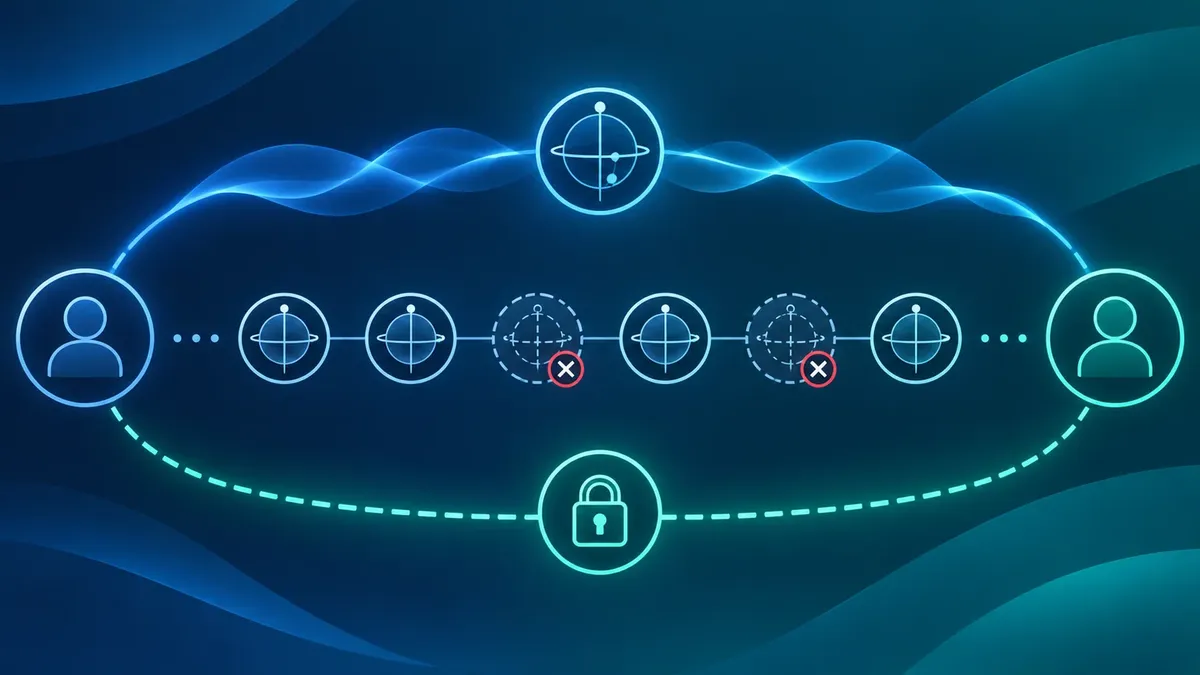
How much quantum information or secret classical information can be sent without assistance through a link that reports when a system is lost? Mark M. Wilde’s preprint addresses this question for finite blocks. But the supplied abstract ends before stating the findings, so its rate formulas and conclusions cannot be reported from the available evidence.
A communication link that sometimes loses a quantum system presents two related questions: how much quantum information can be sent, and how much secret classical information can be sent? In the erasure-channel model described in the abstract, the receiver is told when a system is lost. The abstract does not provide further detail about what that signal reveals.
Mark M. Wilde’s preprint, “Second-order asymptotics for the quantum and private capacities of the erasure channel,” sets out to determine optimal second-order coding rates for input dimension (d\ge2), without assistance. The supplied abstract begins to specify an erasure probability, but is truncated after “0”; it does not give the full probability conditions or the study’s findings.
What the paper sets out to determine
The title and abstract identify the subject as finite-block coding rates for two kinds of communication: quantum information and secret classical information. The abstract characterizes the channel as one that either delivers a quantum system intact or tells the receiver it was lost. It says the work determines optimal second-order coding rates, but the available text does not include the results themselves.
This is a theoretical question about coding limits under a stated channel model, rather than a report of a physical communication experiment. The evidence provided does not explain the exact error criterion, the proof methods, or the coding constructions used. Those details cannot safely be filled in from the title alone.
What remains unknown from the supplied text
The abstract cuts off before giving the complete erasure-probability condition and before presenting any rate formula or conclusion. It therefore does not support claims about the size or form of finite-block corrections, how the two communication tasks compare, or what rates apply at particular probabilities. No numerical results or equations can be reported on this basis.
The search excerpts supplied with the record concern other papers. They do not establish the missing results of Wilde’s work and cannot be used to reconstruct them. The responsible summary is narrower: the manuscript’s stated aim is to determine optimal second-order rates for unassisted quantum and private communication over an erasure channel, but the available abstract does not show what rates it derives.
Source limits
The source record identifies this work as an arXiv preprint, version 1. The supplied material does not establish whether it has undergone peer review or whether a later version exists. Most importantly for this account, the abstract is incomplete. Readers seeking the specific findings should consult the linked source and check the full manuscript and its current status.
- quantum information
- erasure channel
- quantum capacity
- private communication
- second-order asymptotics
- preprint
Related reading
Automatically matched by shared topic keywords. These links do not imply that the sources agree or establish a consensus.
A sharper ceiling for communication through relaxing qubits
Source published
Shared keywords: quantum capacity
Why Incoherent Quantum Codes Struggle with Noise
Source published
Shared keywords: quantum capacity, quantum information
A quantum switch may carry information through loss
Source published
Shared keywords: quantum capacity
How electrode gaps shape Penning traps
Source published
Shared keywords: quantum information
How quantum systems behave over the long run
Source published
Shared keywords: quantum information