TRANSMISSION // 2611.32365v1
Why cheaper AI agents can still cost more
Source published
A preprint finds that specialized decision routing reduced costs in four tested documentation workflows, while some cheaper routers took longer paths that erased savings.
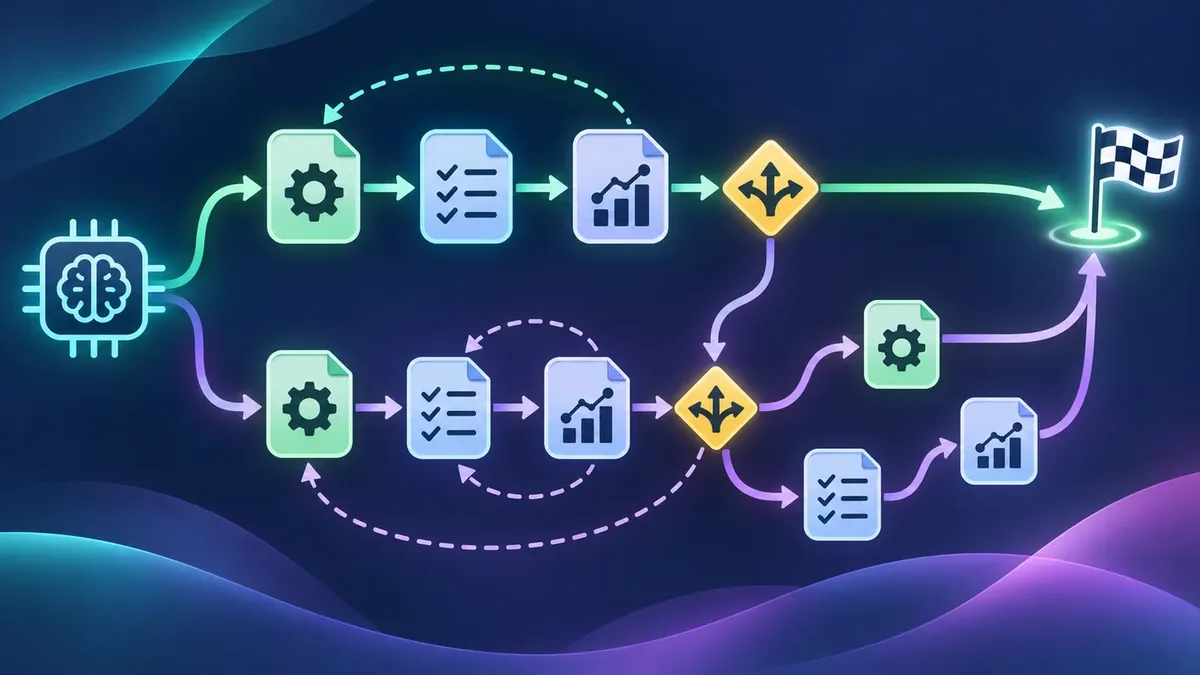
An AI agent does more than generate an answer: it repeatedly decides what to do next. A preprint testing documentation workflows finds that these decisions can carry a substantial cost—and that a cheaper decision-maker does not necessarily make the whole workflow cheaper.
An AI agent that writes documents must repeatedly choose its next move: continue to another step, repair an output, revisit an earlier step, or stop. Those choices may seem like minor overhead. But when each decision involves reviewing the request, files and execution history, routing can consume substantial resources. The decisions also shape how much work the document-generating model is asked to do.
A preprint by Zhikai Cheng, Shuanghu Wang and Li Jiang asks whether assigning these bounded decisions to a specialized model can make an agent workflow more efficient. Their central distinction is between making a decision cheaply and keeping the entire workflow efficient: a low-cost router may not save money if the overall path through the workflow is longer.
A controller for a limited set of choices
The researchers built a documentation agent with three registered steps: write a specification, turn it into a task document, and analyze the documents for consistency. A general-purpose model called Sol generated every document. At decision points, a controller chose among a finite set of actions, including running a step, completing the workflow or abstaining. It also checked whether expected files existed; that check did not establish whether the files were correct or high quality.
The study compared Sol’s decisions with those from Jev, a specialized decision model, and general-purpose alternatives. The researchers tested two arrangements: changing only the simple file-existence check, or changing both that check and the more demanding, content-aware choice of what to do next. Across four software-documentation tasks, they analyzed 480 valid workflow runs. A separate evaluation asked Sol and Jev to choose actions for 100 reviewed customer-service states.
Costs were calculated using fixed reference prices per token, not actual bills. The team also recorded request durations and whole-session elapsed time. Paired runs began with the same inputs, but could produce different documents and take different paths afterward. This captures downstream differences between systems, but does not isolate one component as the cause of the overall savings.
The path through the workflow mattered
On the initial task, routing accounted for 42.5% of the matched Sol workflow’s reference cost. Specializing only the existence check cut the cost of that check substantially, but reduced total workflow cost by just 1.8%. The larger opportunity was the content-aware decision about what to do next.
When Jev handled both decision types, mean reference cost on the initial task was 49.6% lower than in its matched Sol controls. The reported 95% paired-bootstrap interval was 42.9% to 56.3%. Mean elapsed time was 33.2% lower, with an interval of 19.6% to 46.7%.
Across the four authored documentation tasks, Jev took the shortest tested sequence in all 40 runs using full routing: produce the three documents once, then finish. This describes these particular runs, not agent workflows in general.
Other low-priced general-purpose routers did not produce the same pattern on the initial task. All ten Haiku full-routing runs reached the 80-request limit. Across those runs, the system made 270 document-generation calls, repeatedly revisiting the Specify or Tasks steps. The study records this trajectory but does not establish that every extra call resulted from a poor decision. Luna’s full-routing setup used more requests than its matched controls, and its added work erased the routing-cost savings in that task. These results illustrate why the authors measured the entire session rather than decision requests alone.
On the other three tasks, Jev full routing reduced mean reference cost by 40.5% to 42.9% relative to matched Sol controls. Elapsed-time reductions ranged from 12.9% to 14.4%; those measurements were taken under concurrent load. In the separate retail evaluation, both models selected an action in the project-reviewed acceptable set in all 100 cases. Jev’s reference cost was 97.88% lower and its mean request time 72.30% lower. This was a single-decision assessment, not a test of resolving complete customer conversations.
What the evidence does—and doesn’t—show
The tests are narrow. The software tasks were authored documentation exercises, not executable software development, and the initial task was used during system development rather than held out. Workflow completion does not show that the documents were equally useful or correct; the researchers did not independently grade their quality. Retail cases were reviewed by one project-side reviewer. The cases draw on shared source accounts and scenario families, so separation of source accounts does not establish independence of scenario families.
The bootstrap intervals are exploratory and pointwise. Ten paired runs within a task are repeated executions, not ten different tasks, and the intervals are not multiplicity-adjusted tests of superiority. Costs use stated reference tariffs rather than invoices. Timings include gateway effects; expansion-task timings also reflect shared concurrent load. The comparison does not establish that Jev’s architecture or training alone caused the savings.
This work is an arXiv preprint, so it should not be treated as peer-reviewed evidence. Its practical message is a design proposal supported by a limited evaluation: specialize frequent, bounded decisions when that helps preserve efficient paths, while keeping a general-purpose model for open-ended generation. A cheaper decision is useful only if it helps the whole agent avoid unnecessary work.
- AI agents
- language models
- model routing
- agent workflows
- AI efficiency
- preprint
Reviewed cross-references
These connections were reviewed by a model, not independently fact-checked by a human. Similarity does not imply agreement; consult the original papers and the evidence below.
ScopeAct divides smartphone tasks between AI models
Shared method: Both papers divide control between bounded decisions and a more capable model: the origin paper assigns finite workflow-action selection to Jev while Sol generates documents; ScopeAct delegates candidate-action selection within subgoals to a decision model while a VLM plans, handles recovery, and reviews completion. This is an architectural similarity, not a direct performance comparison: the origin evaluates documentation workflows, while ScopeAct evaluates mobile GUI tasks on AndroidWorld.
Model review: · openai-codex/gpt-6-luna
Evidence and provenance
Selected excerpts, not complete papers. PDF extraction can omit figures or damage equations, tables and reading order; sources may be preprints.
2611.32365v1 — Original paper
Excerpt reference:
static/papers/2611.32365v1.md:124-147
Basis: Paper text
Source SHA-256:4cf0673e3c3a55fc990fe0a1f26cb82bdd38de2933e1418cd38713d866bfa0fe2609.30186v2 — Original paper
Excerpt reference:
static/papers/2609.30186v2.md:210-281
Basis: Paper text
Source SHA-256:b8f855654fc167f43c53abb8208c74d4667610b7f14e5ea7fcd559a3bc2efc3d
Related reading
Automatically matched by shared topic keywords. These links do not imply that the sources agree or establish a consensus.
Trace-guided delegation for AI agents
Source published
Shared keywords: ai agents, language models, model routing
ScopeAct divides smartphone tasks between AI models
Source published
Shared keywords: ai efficiency
Choosing when one AI model is enough—and when to ask several
Source published
Shared keywords: model routing
Giving AI agents a shared budget for risky actions
Source published
Shared keywords: ai agents
A Shared Toolkit Helps AI Agents Write More Valid Finance Code
Source published
Shared keywords: ai agents