TRANSMISSION // 2611.32344v1
DiCT tests CT-guided training for X-ray AI
Source published
DiCT uses CT volumes and reports to train X-ray models, then tests X-ray-only performance on radiology benchmarks. Results vary by task.
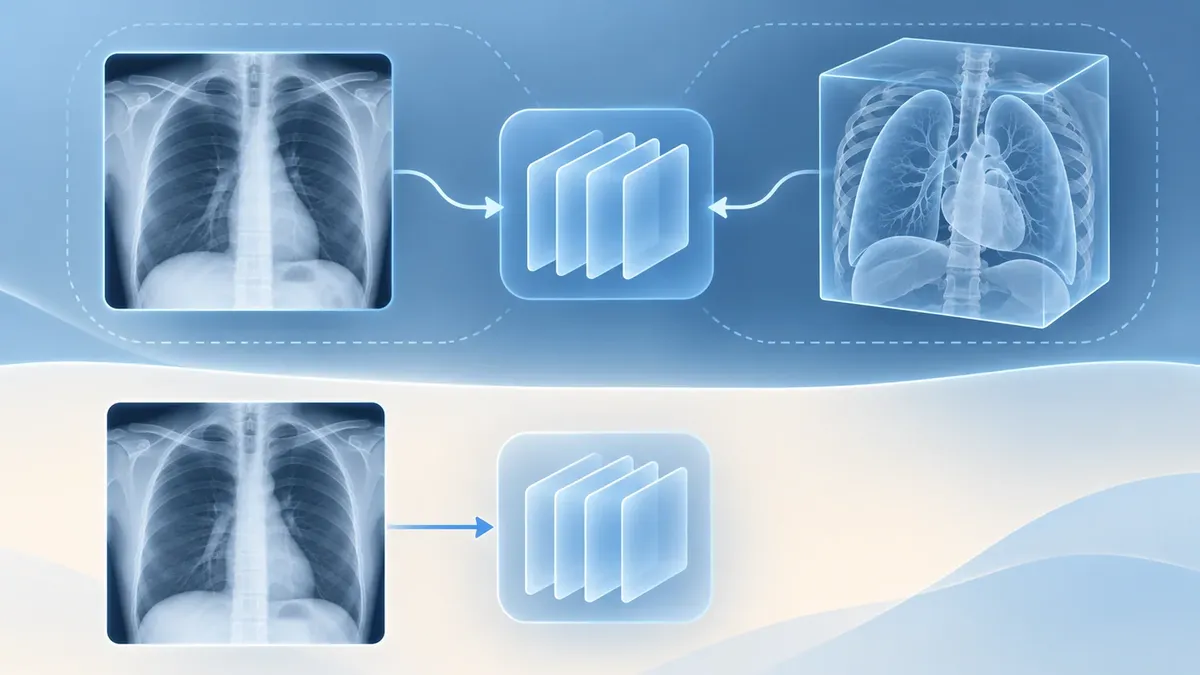
An X-ray flattens three-dimensional anatomy into a projection, where structures can overlap and depth is hidden. DiCT is a proposed training method that uses CT-based guidance to develop X-ray models, then evaluates them on questions answered from X-rays alone. What do its benchmark results show—and what can they not establish?
The challenge of seeing depth in an X-ray
An X-ray is a two-dimensional projection of three-dimensional anatomy. Structures at different depths can overlap, making it difficult to judge where an abnormality lies or how it relates to nearby anatomy. CT provides more detailed 3D information, but generally involves higher radiation exposure, longer acquisition times and less accessibility than X-ray radiography.
In an arXiv preprint, researchers propose Dreaming in CT (DiCT), a framework for transferring CT-informed reasoning to models that answer questions from X-rays. The aim is to use CT guidance during training and X-rays alone at inference—without explicitly reconstructing a CT volume for each prediction. This is a transfer of learned guidance, not a recovery of all the information hidden by an X-ray projection.
Three stages of training
The researchers tested DiCT with two vision-language model backbones, Qwen3-VL-4B and Hulu-4B. The method has three stages, using different forms of supervision.
First, “instruct the dreamer” trains the X-ray model to produce structured responses that separate its X-ray observations from CT-oriented reasoning. Training examples pair digitally reconstructed radiographs (DRRs)—simulated X-ray-like images generated from CT—with reasoning targets. The X-ray observations are generated from the DRRs, while CT-oriented reasoning is generated from corresponding CT reports.
Second, “visualize the dream” uses on-policy distillation: the X-ray model generates its own responses, and a CT teacher provides token-level guidance on those student-generated trajectories using the paired CT volume. The teacher supervises CT-oriented reasoning and answers; X-ray reasoning is regularized toward the student’s earlier supervised model, and format tokens receive separate supervision. This separation is intended to keep the model’s account of what it sees in the X-ray distinct from guidance informed by CT.
Finally, “manifest the dream” adapts the model using real clinical X-rays and task-specific feedback. The researchers use group-relative policy optimization (GRPO), which compares rewards across sampled responses to a question, with rewards tailored to the task. A KL regularization term discourages the model from drifting too far from its earlier, distilled behavior. At inference, the model receives an X-ray and a question, not a reconstructed CT volume.
What the tests found
The evaluation used 3D-RAD, paired with DRRs for controlled CT-to-X-ray experiments, and ReXVQA, which includes real clinical chest X-rays. Tasks included abnormality identification, image questions and measurements. For its main 3D-RAD comparison, the paper reformulated a highly imbalanced yes-or-no task as four-choice abnormality identification; it reports results on the original binary task separately.
On the four-choice 3D-RAD task, DiCT reached 38.36% accuracy with Qwen and 47.53% with Hulu. The corresponding X-ray supervised-fine-tuning-to-GRPO baselines scored 34.69% and 41.37%. Against one reconstruction pipeline—TF-PRDiT followed by ClinFusion-8B-SFT—Hulu-based DiCT scored 1.66 percentage points higher on abnormality identification and used 12.77 times less estimated inference computation. Those figures apply to that task and comparison, not to every reconstruction method or clinical setting. The paper also reports that reconstruction-based methods performed better on some measurement and open-ended interpretation tasks.
On ReXVQA’s real-X-ray abnormality-identification test, DiCT scored 67.74% with Qwen and 83.65% with Hulu, compared with 35.42% and 75.11% for the respective X-ray SFT-to-GRPO baselines. Measurement results were more mixed: on ReXVQA, clinical adaptation reduced mean absolute error relative to the preceding distillation checkpoint for both backbones, but DiCT did not consistently outperform the X-ray SFT-to-GRPO baselines. Changes on 3D-RAD measurements also depended on the backbone and comparison.
What remains uncertain
These are benchmark findings, not evidence that DiCT improves patient care or is ready for clinical use. Results varied by model, task and training stage. The ReXVQA measurement test had 244 questions, of which 223 asked for the distance between an airway-tube tip and the carina, making it a narrow test of measurement performance. Some open-ended 3D-RAD answers were scored by a language-model judge rather than solely through direct clinical review.
There is also a data-splitting caveat. The researchers checked for 3D-RAD training/test overlap using volume names and image paths, but independent patient identifiers were unavailable. That check therefore does not establish patient-level separation. Finally, this is an arXiv preprint; the available source does not establish that it has undergone peer review. The results make CT-guided training worth further study, but broader datasets and independent evaluation are needed to assess how well it generalizes.
- medical AI
- chest X-rays
- CT scans
- vision-language models
- radiology benchmarks
- knowledge distillation
Related reading
Automatically matched by shared topic keywords. These links do not imply that the sources agree or establish a consensus.
Where medical AI fairness gaps may arise
Source published
Shared keywords: chest x rays, medical ai
An AI agent follows tumors across CT scans
Source published
Shared keywords: medical ai
AI image preferences can transfer through unrelated number training
Source published
Shared keywords: knowledge distillation, vision language models
Visual Backdoors Can Emerge Suddenly in Distillation
Source published
Shared keywords: knowledge distillation, vision language models
A rule bank helps revise AI-generated CT reports
Source published
Shared keywords: vision language models