TRANSMISSION // 2611.32343v1
A gazelle classifier that shows its work
Source published
A prototype-based AI model classified Mountain Gazelle sex from camera-trap images while highlighting animal features that contributed to its predictions.
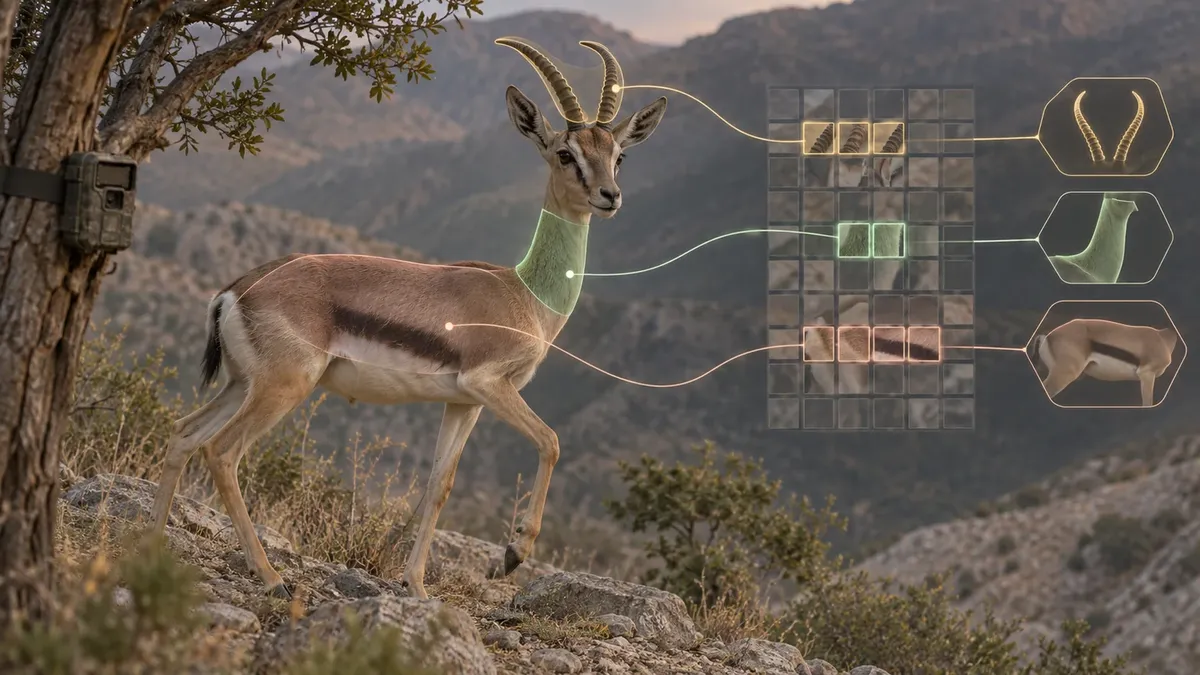
Camera-trap images can help ecologists monitor wildlife, but an accurate prediction is not enough if it is unclear what an AI system relied on. Researchers tested a model that bases decisions on recognizable image parts, such as horns and body shape, and compared its performance on a Mountain Gazelle dataset.
Camera traps can collect more wildlife images than researchers can practically review by hand. AI could help sort them, but a correct classification does not necessarily mean a model is using the right evidence: it might rely on habitat or camera location instead of the animal’s appearance. A study presents a model designed to make its visual evidence inspectable, and tests it on classifying adult Mountain Gazelles as male or female.
The question is not simply whether an algorithm can make this classification. It is whether a model can identify relevant features in messy field images and show which parts of an image contributed to its decision.
Building decisions from image parts
The researchers represent each learned visual concept as a set of image features, or “parts,” rather than as one patch or a fixed arrangement of patches. These sets can vary in size and layout, allowing them to represent features that are irregular or spread across an image. A curved horn or neck, for example, may not fit neatly into a rigid grid.
The system uses DINOv3, a vision model that represents image features, but keeps that underlying model frozen during training. It mines candidate parts from training images and learns how to match them to image regions. When several parts compete for the same region, a matching step encourages them to consider other regions. A part can also abstain if it does not find a good match, rather than being forced onto background scenery.
The classifier adds up evidence from its learned prototypes. Researchers can inspect the image regions that activate them, making the explanation part of the model’s decision process rather than a separate visual summary generated afterward.
What the test found
The dataset contained 1,833 cropped images of adult gazelles, with fawns excluded. Images came from 24 camera-season deployments across two campaigns. To reduce the chance that images from the same camera appeared in both training and testing, the researchers split the data by camera. They used the same eight-camera test set as an earlier study to make comparisons with that work.
On this test set, the set-prototype model achieved a macro-F1 score of 0.878. Macro-F1 averages performance across the two classes, giving each class equal weight. The paper reports a higher score than the earlier models it lists, including interpretable and black-box approaches. A linear probe using the same frozen image features scored 0.891 macro-F1, so the prototype model was close to that less interpretable comparison.
The visualizations showed influential prototypes responding to horns, the neck and upper chest, and the middle of the body. The authors also identified some prototypes focused on habitat rather than animal anatomy. Removing those prototypes and refitting the classifier produced a reported macro-F1 of 0.874, close to the full model’s result. This suggests those prototypes contributed little to performance on this test set; it does not show that environmental shortcuts can never affect the model.
A restricted version in which every prototype contained only one part scored 0.838 macro-F1. This comparison supports the value of multi-part prototypes in this particular setup, though it does not establish that the same design will help on other tasks or datasets.
What remains uncertain
The study concerns one species and one camera-trap benchmark. Its camera-level split helps guard against leakage between cameras, but the result does not establish how well the model would work in new habitats, seasons, or monitoring programs. Nor does a visually plausible activation map by itself prove that the model’s reasoning is biologically complete or reliable in every case. The authors note that building and auditing prototype banks requires domain expertise and human review.
This work is available as an arXiv preprint. The reported results offer a way to make wildlife classification more inspectable while retaining strong performance on this test set. Broader evaluation, including tests with other ecological datasets and assessment by working ecologists, would be needed to understand its potential in wider conservation applications.
- explainable AI
- camera traps
- Mountain Gazelle
- wildlife monitoring
- prototype learning
- computer vision
Reviewed cross-references
These connections were reviewed by a model, not independently fact-checked by a human. Similarity does not imply agreement; consult the original papers and the evidence below.
Prostate ultrasound AI uses past cases to explain predictions—and flags disagreement
Shared method: Both studies use prototype-based visual classification to connect predictions with inspectable image evidence: the gazelle model matches prototype-set members to image tokens, while ProtoCouncil sums similarities to prototypes projected onto real training regions. Their implementations and tasks differ—the former classifies gazelle sex using frozen DINOv3 features, while the latter detects prostate cancer using anatomically indexed regions and three encoders—so this is a shared broad method, not evidence of comparable performance.
Model review: · openai-codex/gpt-6-luna
Evidence and provenance
Selected excerpts, not complete papers. PDF extraction can omit figures or damage equations, tables and reading order; sources may be preprints.
2611.32343v1 — Original paper
Excerpt reference:
static/papers/2611.32343v1.md:188-242
Basis: Paper text
Source SHA-256:4925a8aa6fd82ac85ec2d94bbf48180bc02e85c54bfdc7f50b00e3c970c2a1482611.32343v1 — Original paper
Excerpt reference:
static/papers/2611.32343v1.md:83-142
Basis: Paper text
Source SHA-256:4925a8aa6fd82ac85ec2d94bbf48180bc02e85c54bfdc7f50b00e3c970c2a1482611.09058v1 — Original paper
Excerpt reference:
static/papers/2611.09058v1.md:73-119
Basis: Paper text
Source SHA-256:0de0d9001eb95a639f4646bd884106fd4ef8d97aab2ac11b25cea20d8f17ea042611.09058v1 — Original paper
Excerpt reference:
static/papers/2611.09058v1.md:713-739
Basis: Paper text
Source SHA-256:0de0d9001eb95a639f4646bd884106fd4ef8d97aab2ac11b25cea20d8f17ea04
Related reading
Automatically matched by shared topic keywords. These links do not imply that the sources agree or establish a consensus.
Animal Identification Scores Can Hide Other Clues to a Match
Source published
Shared keywords: computer vision, wildlife monitoring
A convincing simulation can still fool a driving model
Source published
Shared keywords: computer vision, explainable ai
Farm Security’s Evidence Gap—and What AI Gate Monitoring Has Yet to Prove
Source published
Shared keywords: camera traps
Prostate ultrasound AI uses past cases to explain predictions—and flags disagreement
Source published
Shared keywords: prototype learning
When fair AI decisions hide unfair reasoning
Source published
Shared keywords: explainable ai