TRANSMISSION // 2611.32320v1
A Monadic Approach to Alpha-Beta Pruning
Source published
Escardó and Oliva describe alpha-beta pruning using continuation and reader monads, prove it preserves minimax results, and demonstrate fewer evaluated plays in Tic-Tac-Toe.
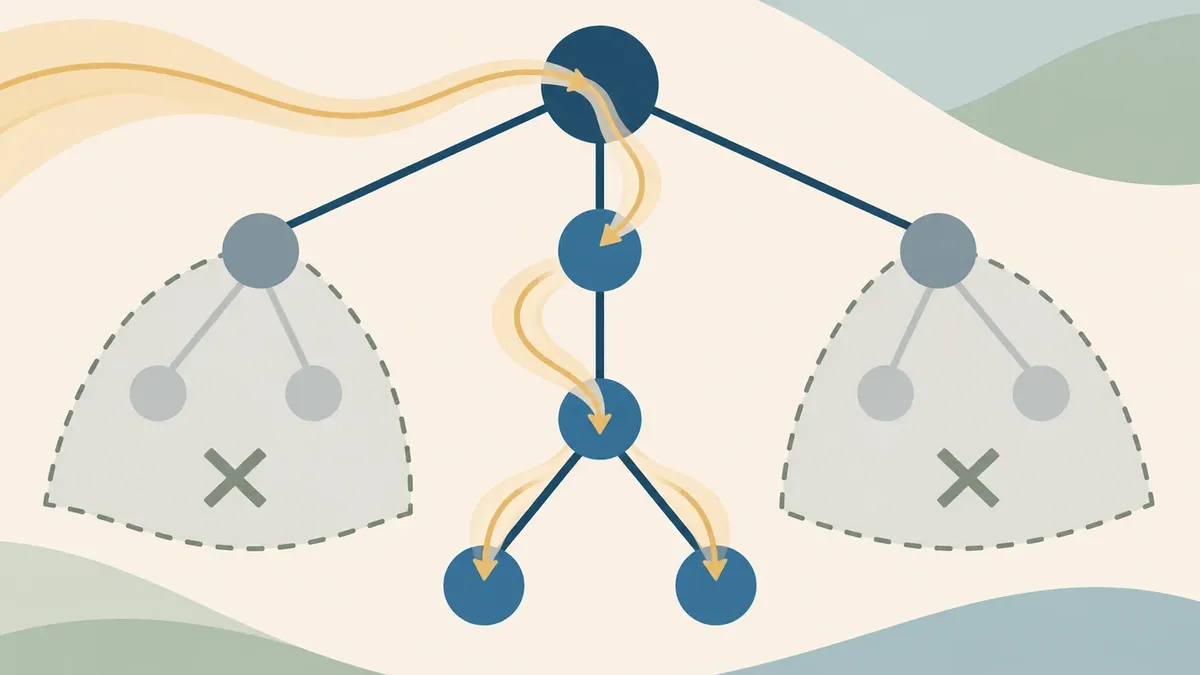
Alpha-beta pruning can skip game-tree branches that cannot change the best outcome. Escardó and Oliva show how to express this shortcut with two functional-programming abstractions, prove its results match exhaustive minimax search, and illustrate it with Tic-Tac-Toe.
A shortcut through a game tree
A game-playing program can represent possible move sequences as branches in a tree. Minimax search evaluates outcomes by modeling two opposing aims: one player tries to maximize the result, while the other tries to minimize it. Searching every possible sequence can involve substantial work.
Alpha-beta pruning reduces that work by tracking bounds on the result a branch could produce. Once the search can tell that a branch cannot change the decision, it can stop exploring it. The paper asks how to describe this optimization using functional-programming tools, and whether the resulting method can be shown to return the same answer as ordinary minimax search.
Martín Hötzel Escardó and Paulo Oliva combine the continuation monad with the reader monad. In their setup, the reader carries the current alpha and beta bounds through the computation; those bounds can be updated as the search proceeds. The continuation monad provides a way to compose the game’s choices and outcomes. Together, the two abstractions support the pruning construction.
Bounds without changing the moves
The authors contrast their design with a specific earlier approach by Hartmann, which encodes the alpha and beta bounds in the type of available moves. Their method leaves the move type unchanged and records the bounds in monadic outcomes instead. In practical terms, the search still represents the game’s actual moves as moves, while the computation carries the information it needs to decide when to stop exploring.
The paper gives a small game-tree example and proves that the pruned search computes the same optimal outcome as exhaustive minimax. The proof uses induction on the game tree. The authors also extend the framework to history-dependent games, where the legal moves at a position depend on the moves already made. They report that the correctness results carry over to this setting.
The method is also designed to return an optimal play—the move sequence leading to an optimal outcome—not just the outcome. To do this, the authors extend the outcome to include the corresponding sequence of moves. They show that the ordinary continuation monad, used alongside their pruning construction, suffices; a more specialized generalization of the continuation monad is not required for this purpose in their approach.
Testing the idea in Tic-Tac-Toe
For a concrete illustration, the authors implement their method for Tic-Tac-Toe. They report that exhaustive search evaluates all 9! full move sequences, or 362,880. Their alpha-beta search evaluates 9,335 plays—about 39 times fewer—and returns the same optimal outcome and an optimal play. The reported outcome is a draw.
These are counts of evaluated plays, not measurements of elapsed time. They describe the paper’s Tic-Tac-Toe implementation; they do not establish a comparable reduction for other games, implementations, or search settings. Nor does the example measure whether the method improves game-playing strength. Its purpose is to illustrate the search reduction while preserving the minimax result.
What the paper establishes—and what it doesn’t
The main contribution is a way to express and formally verify alpha-beta pruning using standard monadic abstractions. The authors report that the definitions and results are formalized in Agda, a proof assistant. Their proof establishes equivalence with exhaustive minimax within the stated framework; the Tic-Tac-Toe implementation supplies a specific example of reduced search work.
This article is based on the arXiv preprint “Alpha-Beta Pruning via Monadic Continuations”. The supplied source does not independently establish whether the work has undergone peer review. The reported proof and example should therefore be understood as the authors’ results, not independent validation. They support claims about the formal construction and the particular demonstration, not broader conclusions about game-playing systems generally.
Source: Martín Hötzel Escardó and Paulo Oliva, arXiv:2611.32320v1.
- alpha-beta pruning
- minimax search
- functional programming
- continuation monad
- reader monad
- formal verification
- Tic-Tac-Toe
Reviewed cross-references
These connections were reviewed by a model, not independently fact-checked by a human. Similarity does not imply agreement; consult the original papers and the evidence below.
Hand-set neural networks master small games but struggle to turn tactics into plans
Shared method: Both papers describe alpha-beta search: Escardó and Oliva present it as a pruning method for minimax, while Garrido Merchán reports testing a chess-endgame network against a depth-3 alpha-beta search opponent. The method appears in different roles, and these excerpts do not support a direct performance comparison.
Model review: · openai-codex/gpt-6-luna
Evidence and provenance
Selected excerpts, not complete papers. PDF extraction can omit figures or damage equations, tables and reading order; sources may be preprints.
2611.32320v1 — Original paper
Excerpt reference:
static/papers/2611.32320v1.md:13-81
Basis: Paper text
Source SHA-256:b61c3ca344b736ce2da0d81c460f12185bd052b3d728d17472f249802bbbdc3e2611.09271v1 — Original paper
Excerpt reference:
static/papers/2611.09271v1.md:1089-1131
Basis: Paper text
Source SHA-256:e1fa67da0ad4a09fff1f98e84887c6dcdbd3205ee118b85a0af90b7d77ca026a
Related reading
Automatically matched by shared topic keywords. These links do not imply that the sources agree or establish a consensus.
Why Passing Tests May Not Prove an AI Patch Is Correct
Source published
Shared keywords: formal verification
A quantum compiler adds verified block-encoding methods
Source published
Shared keywords: formal verification
How AI Refactored Lean Proofs Without Changing Their Claims
Source published
Shared keywords: formal verification
When AI proofs multiply, who makes them mathematics?
Source published
Shared keywords: formal verification
Making an AI planner’s checks hold when the action starts
Source published
Shared keywords: formal verification