TRANSMISSION // 2611.32319v1
A quantum version of the tautochrone brings particles together
Source published
A theoretical study finds that specially tuned lattice couplings can make selected quantum wavepackets converge at a shared time. Bosons and fermions show different patterns of convergence.
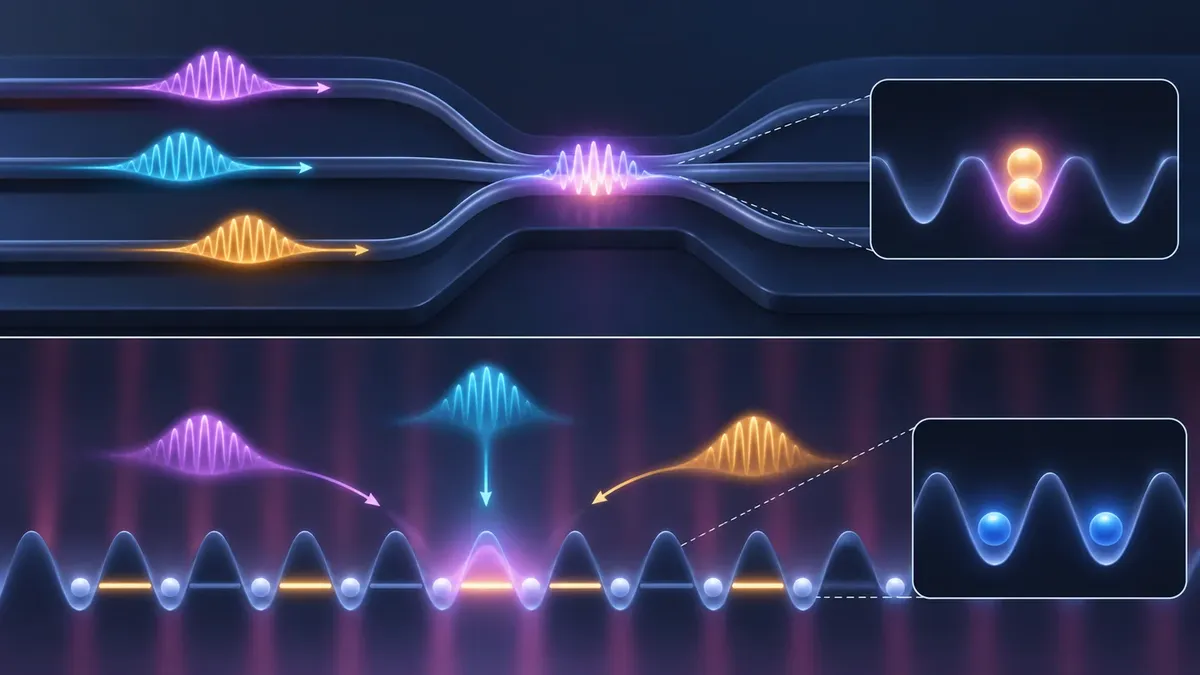
In the classical tautochrone problem, a frictionless object sliding under gravity along a cycloid takes the same time to reach the bottom, wherever it starts. Could engineered quantum lattices produce a similar synchronized arrival? Calculations for photons and atoms suggest they can—for selected wavepackets and coupling patterns—with the particles’ quantum statistics shaping what convergence looks like.
In the classical tautochrone problem, an object sliding without friction under gravity along a cycloid takes the same time to reach the bottom from different starting points. The new study asks whether a quantum analogue can be created: can wavepackets launched from different positions in a lattice arrive in the same region at a shared time?
The authors investigate this question theoretically for photons in coupled waveguides and atoms in optical lattices. Their calculations show synchronized convergence for the engineered coupling pattern and input states they study. The effect is not a claim that every starting position or wavepacket will arrive together. And in quantum systems, convergence does not look the same for all particles: bosons can occupy the same site, whereas identical fermions are prevented from doing so by the Pauli exclusion principle.
Tuning the links between sites
In a lattice, particles can hop between neighboring sites. The strength of each link—its coupling—affects how a wavepacket moves and spreads. The researchers choose a particular nonuniform coupling profile so that the mean position of a wavepacket follows harmonic oscillations across the lattice. For the input configurations they examine, wavepackets starting at different locations reach a shared central region at the same model-defined time. In a waveguide array, this corresponds to a propagation distance rather than elapsed time.
To study the dynamics, the team numerically evolves single-particle wavepackets and combines them into multi-particle states with the appropriate exchange symmetry for bosons or fermions. It analyzes normally ordered correlation functions: first-order correlations measure average site occupation, while higher-order correlations track multi-particle coincidences. These are coincidence measures; interpreting them as probabilities requires suitable normalization. The paper also uses Wigner functions to characterize the particle-number content of selected regions.
The methods differ between parts of the study. For noninteracting particles, the authors propagate the wavepackets and construct the many-particle states from the evolved modes. For interacting bosonic atoms, they instead evolve the system in a complete two-boson Fock basis, including an on-site interaction term. The calculations use exact unitary evolution, not a mean-field approximation. The paper’s central examples use a dimensionless convergence time of τ = π/2.
Statistics shape the arrival
In the modeled bosonic cases, two or three particles can converge onto the same site. Higher-order coincidences help reveal this joint arrival, which average occupation alone cannot fully describe. In the paper’s specific two-boson examples, a product state and a superposition state can have similar average-density patterns but different second-order correlations. That difference shows why measuring average occupation does not by itself reveal the full multi-particle state.
The modeled fermionic wavepackets also move toward the convergence region. But identical fermions cannot occupy the same site, so their same-site coincidence signal vanishes. Instead, the particles gather on neighboring sites. The synchronized focusing tendency therefore has a different spatial signature for fermions than for bosons.
The authors also examine how the two-boson signal changes with coupling inhomogeneity and starting wavepacket width. In the parameter ranges they study, increasing inhomogeneity spreads the correlation signal over a larger region. Increasing the initial width raises the peak same-site correlation and reduces its spatial extent—trends the authors interpret as improved focusing in these cases. These results are specific to the modeled states and parameters, not a general guarantee of sharp focusing.
For bosonic atoms, interactions further modify the dynamics. In the calculations, weak repulsion delays convergence, while weak attraction brings it earlier. Strong interactions of either sign suppress same-site correlations and shift correlation weight toward different-site configurations. Thus, interactions can affect both the timing and the form of convergence.
What the study does—and does not—show
This is a theoretical investigation, not an experimental demonstration. It establishes the proposed behavior within the lattice models and input states analyzed, while leaving open how well a physical device could implement the coupling profile and how practical imperfections would affect it. The authors raise robustness against disorder as a question for future work in the context of states of potential metrological interest; the paper does not provide a general disorder study. It also points to finite-density atomic systems as an area where many-body interactions could matter.
The authors state that supporting data and numerical codes are available from them upon request, rather than offering them as publicly accessible files. This article is based on the arXiv version 1 preprint Quantum Tautochrone for photons and atoms. The supplied source does not state whether it has undergone peer review. The results should therefore be read as a theoretical proposal and analysis, not as evidence that the effect has already been demonstrated in a laboratory.
- quantum physics
- quantum tautochrone
- photonic waveguides
- optical lattices
- bosons and fermions
- quantum correlations
Related reading
Automatically matched by shared topic keywords. These links do not imply that the sources agree or establish a consensus.
Shaping an optical lattice may help atoms stay squeezed
Source published
Shared keywords: optical lattices, quantum physics
A Raman route to anyon-like behavior in a one-dimensional lattice
Source published
Shared keywords: optical lattices
How phase and spin–orbit interaction shape qubit correlations
Source published
Shared keywords: quantum correlations
Choosing Bell tests for useful quantum randomness
Source published
Shared keywords: quantum correlations, quantum physics
How Hidden Labels Shape Particle Indistinguishability
Source published
Shared keywords: quantum physics