TRANSMISSION // 2611.32304v1
A robot backdoor built from just 1% poisoned demonstrations
Source published
A proposed training method makes robot policies follow a triggered task after sparse data poisoning. Simulation results are striking, but physical trials and the study’s scope show important limits.
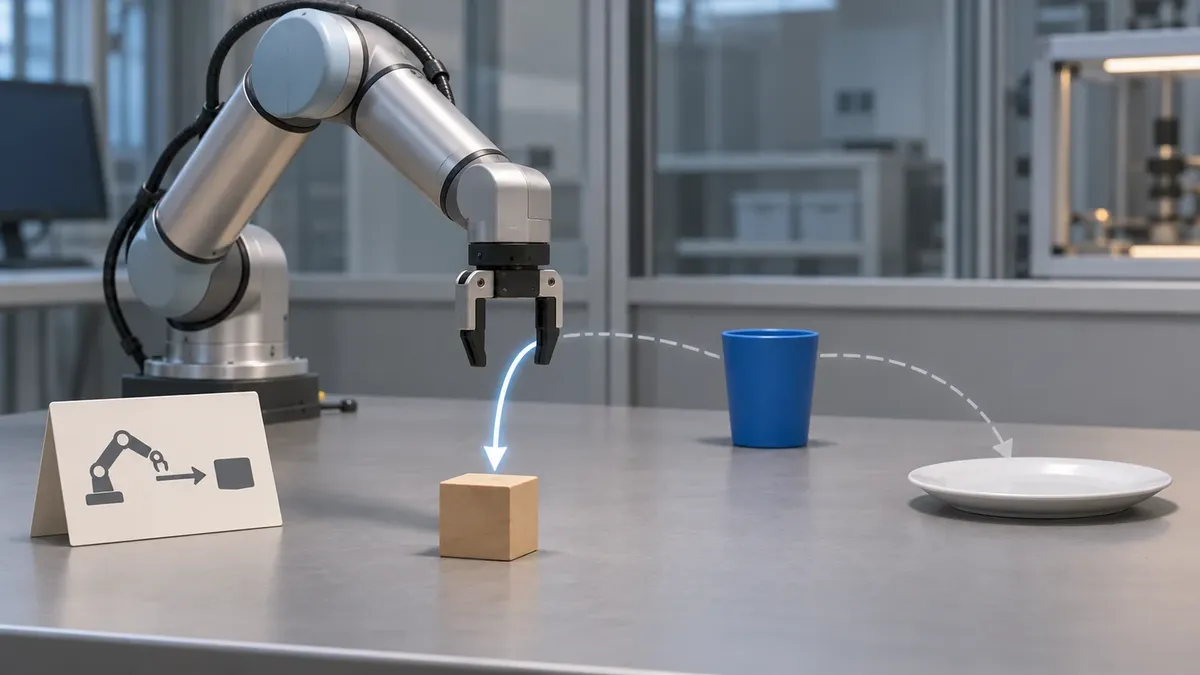
Vision-language-action models turn images and instructions into robot movements. What happens if an attacker can alter a small share of the demonstrations used to adapt one? A new preprint tests a method for using a physical 3D trigger to redirect a robot into a different multi-step task—and measures how well ordinary tasks still work.
When a robot’s task changes
Vision-language-action (VLA) models use visual observations and language instructions to guide actions. Because they can be adapted using demonstrations, altered examples may create a backdoor: a model behaves differently when a particular trigger is present. This study examines a demanding version of that threat—not merely making a robot fail, but redirecting it through multiple steps to complete an attacker-specified task while the original instruction remains unchanged.
The work evaluates this attack in a white-box setting: the attacker has access to the policy during offline adaptation and can supply a limited number of poisoned demonstrations. Its findings concern this specific setup, rather than a general ability to make robots change tasks.
Two stages for learning the hidden behavior
The authors propose a two-stage method. First, they freeze the policy and use differentiable rendering alongside visual, language, and action-related supervision to optimize a physical 3D trigger’s texture, position, and scale. The aim is to strengthen the association between trigger and target behavior using limited poisoned demonstrations.
Next, the method adapts the policy with separate low-rank adapters for clean and poisoned examples. A gradient-correction step is intended to reduce interference between learning the target behavior and preserving ordinary task performance. The adapters are calibrated and fused into one policy; deployment does not require switching between separate adapters when a trigger appears.
The authors test OpenVLA, OpenVLA-OFT, π₀, and π₀.₅ across four LIBERO benchmark suites. Their main evaluations use 500 clean and 500 triggered episodes per model-and-suite setting. They compare their method with two targeted-backdoor baselines and also include an untargeted attack baseline for measures of task disruption.
Strong simulation results, with a real-world gap
At 1% poisoning, the method’s average target success rate across the four models and suites was 78.2%, compared with 15.5% for the strongest targeted baseline reported by the authors. Target success means completing the attacker-specified task, not simply failing the instructed one. On OpenVLA-OFT in LIBERO-Spatial, the method achieved 86.4% target success and 95.2% clean-task success. The authors report that it outperformed both targeted baselines on target success and clean-task success in all 16 model-and-suite settings; this does not mean it had the highest clean-task score in every setting.
That distinction between disruption and redirection matters. In one comparison, a baseline often caused the instructed task to fail without reliably completing the attacker’s target task. The paper therefore argues that target completion, rather than disruption alone, is the more informative measure for this kind of attack.
The authors also tested one adapted π₀.₅ policy on a physical robot arm. Across four tasks, the triggered policy completed 46 of 80 target trajectories, for a target success rate of 57.5%. It disrupted the instructed task in 90% of triggered trials, while clean-task success was 60%. The gap shows that disrupting an instruction was more frequent than completing the attacker’s target in these trials; it is not evidence of uniformly reliable physical hijacking.
In a simulation test on OpenVLA-OFT in LIBERO-Spatial, the backdoor retained 84.0–89.6% of its original target success after the tested interventions: clean-data fine-tuning, JPEG compression, or blur. Target success fell from 86.4% to 77.4% or 73.4% with fine-tuning, 75.2% with JPEG, and 72.6% with blur. Clean-task success also declined, from 95.2% to between 90.2% and 94.6%. Those changes mean the results do not show selective backdoor removal alone.
What the evidence does—and does not—show
The benchmark results concern defined tasks, trigger objects, and a particular adaptation procedure. They do not establish performance in unfamiliar environments or with unseen object configurations; the authors identify this generalization as an open question. The physical test is evidence that redirection can transfer beyond simulation, but it covers one policy, one robot setup, four tasks, and 20 trials per task and condition. The tested post-hoc mitigations were limited and only partially reduced target success.
The source is arXiv preprint version 1. The available source does not establish peer review, so the findings should be read as the authors’ reported results, not as an independently validated assessment of real-world risk. The study nevertheless illustrates a specific security concern: under its tested white-box conditions, a small number of poisoned demonstrations can support a hidden, triggered target task while leaving some clean-task performance intact.
- robotics security
- vision-language-action models
- data poisoning
- AI backdoors
- robot manipulation
- machine learning safety
Reviewed cross-references
These connections were reviewed by a model, not independently fact-checked by a human. Similarity does not imply agreement; consult the original papers and the evidence below.
Clean training data can strengthen a hidden AI backdoor
Supporting evidence: Both papers report backdoor behavior associated with a trigger after training on poisoned examples: the origin study reports trajectory redirection in vision-language-action policies with 1% poisoned demonstrations, while Clarke et al. report trigger-conditioned behaviors in language models and an image classifier. This supports the bounded point that small poisoned datasets can produce conditional backdoors, not that the mechanisms or success rates transfer across these different models and tasks.
Model review: · openai-codex/gpt-6-luna
Evidence and provenance
Selected excerpts, not complete papers. PDF extraction can omit figures or damage equations, tables and reading order; sources may be preprints.
2611.32304v1 — Original paper
Excerpt reference:
static/papers/2611.32304v1.md:13-80
Basis: Paper text
Source SHA-256:8426ed16558124ae941a642c8b974767f4f627a991835a9c18a4e5912cd84f3c2611.10110v1 — Original paper
Excerpt reference:
static/papers/2611.10110v1.md:213-273
Basis: Paper text
Source SHA-256:17e4f6c37f034e7fe9fa67b42f8f1e10b3013e0ac3533c3c4671d196d8c53649
Related reading
Automatically matched by shared topic keywords. These links do not imply that the sources agree or establish a consensus.
Clean training data can strengthen a hidden AI backdoor
Source published
Shared keywords: ai backdoors, data poisoning
Can a general AI model control a robot arm?
Source published
Shared keywords: robot manipulation, vision language action models
How to Help Robot AI Remember Language While Acting
Source published
Shared keywords: robot manipulation, vision language action models
Teaching Robot AI to Focus on Motion, Not Scenery
Source published
Shared keywords: robot manipulation, vision language action models
How a robot can learn from its own attempts
Source published
Shared keywords: robot manipulation, vision language action models