TRANSMISSION // 2611.32302v1
An AI image filter that asks what the question needs
Source published
QGVM edits images locally before they reach cloud vision-language models, aiming to retain needed details while hiding unnecessary sensitive information. Tests show promise, but privacy is not guaranteed and answers can suffer when needed details are removed.
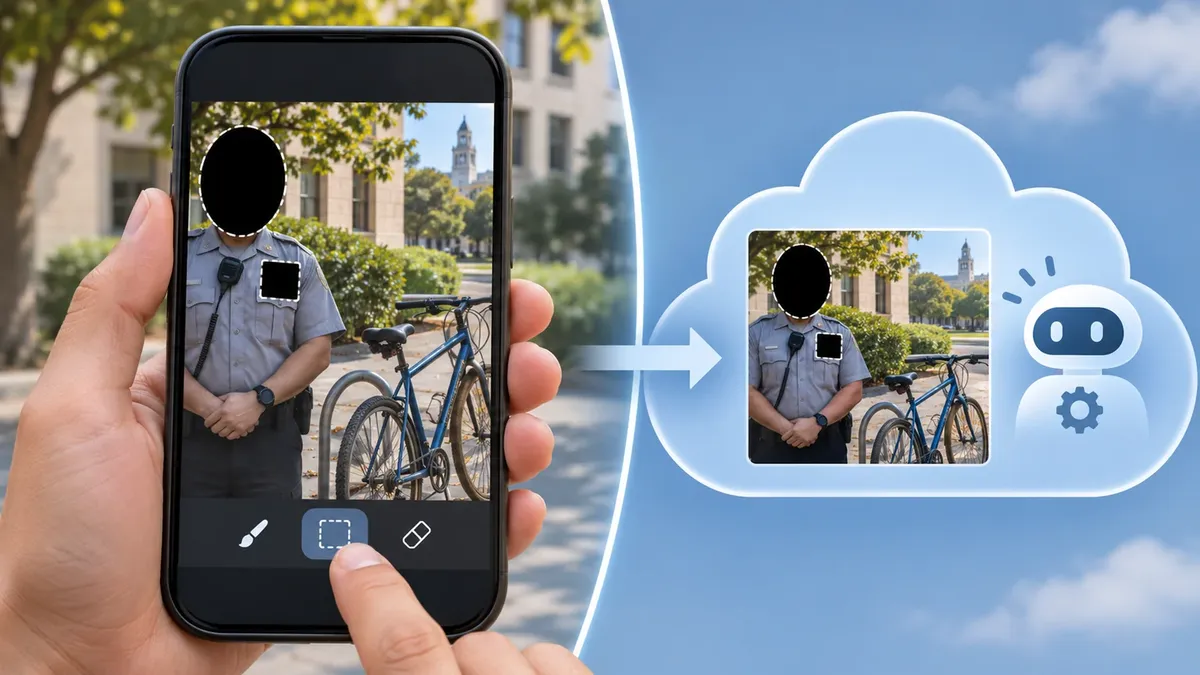
A question about a jacket’s color may not need the face or name badge in the same photo. A new preprint proposes a local image filter that tries to make that distinction before sending pictures to cloud-based AI. Its benchmark results suggest selective disclosure can reduce some measured privacy leaks while keeping many answers useful—but the approach has important limits.
The privacy problem is in the details
When people send images to cloud-hosted vision-language models (VLMs), those images may reveal more than the question requires. A photo could include faces, private text or background clues about where it was taken. Yet blurring every face or cropping to a relevant object can also remove information needed to answer.
In an arXiv preprint, Pedram Zaree and colleagues introduce Query-Guided Visual Minimization (QGVM). Its central idea is to distinguish relevance from necessity: a region can relate to a question without every sensitive detail inside it being needed. A car may be relevant to a question about its color, while its license plate is not. If the question asks for the plate number, however, that text may need to remain visible.
A local filter, before cloud inference
QGVM assumes a trusted local system can inspect and alter the image before it is sent. It does not access or modify the cloud VLM. Instead, frozen models and tools work through four stages: locate regions relevant to the query; inventory potentially sensitive items, such as faces, text, documents and screens; judge which sensitive types, individual items and recognized text are needed; then create a minimized image.
The system suppresses background in many object-focused queries and uses black masks to hide selected content. It can restore details judged necessary for the task. The cloud receives the edited image, the original question and a note explaining that black areas were intentionally removed. The researchers describe this as an approximation to minimal disclosure—not a mathematically minimal image or a guarantee against arbitrary inference.
The team tested QGVM on image-question benchmarks and compared it with unprotected images and other filtering approaches. They assessed answer performance alongside several forms of leakage: whether systems could recover faces or text, and whether attackers could infer a location from visual context. A separate paired-query test asked about the same sensitive item twice—once when it was needed and once when it was not—to see whether disclosure changed with the question.
Promising results, with trade-offs
On DoxBench, using GPT-6.1 Sol as the answerer, QGVM’s answer correctness was 85.3%, compared with 77.5% for the Prompt-Guided Prefiltering (PGP) baseline. In a separate geolocation attack on those images, Sol identified locations within one kilometre in 5.8% of QGVM cases, versus 25.7% for unprotected images. These results apply to particular datasets, models and attack setups; they are not a general guarantee about cloud image privacy.
On Scene-Privacy, face re-identification was 4.5% for QGVM and 27.7% for PGP. These privacy attacks were evaluated on the images at the resolution transmitted to the cloud. On a held-out private-text test, unnecessary text recovery was 15.3% with QGVM and 33.9% with PGP. But preserving information needed to read text can be harder: on the held-out reading track, QGVM’s judged reading preservation was 56.8%, below PGP’s 70.0%. This measure records agreement with the same model’s response to the original image, not independently verified answer correctness. The authors also report that removing the common note about blacked-out regions reduced measured answer performance, so results reflect both image edits and the model’s response to that note.
In a paired-query test involving 99 links across 34 images, QGVM’s joint success rate was 69.6%: a link counted as successful when the target was retained for the query that needed it and suppressed for the query that did not. The rate was 29.1% for cropping to the target. This supports the value of assessing necessity rather than relevance alone in this test; it is not a general measure of decision accuracy.
What remains uncertain
QGVM depends on detection, text recognition and a language model’s judgment about what a question needs. Missed sensitive items may remain exposed; overly strict decisions may hide evidence needed for an answer. In the authors’ analysis of traced failures, necessity-estimation errors appeared in both missed required text and unnecessary disclosures. Geolocation protection also varied by attacker, and more aggressive filtering sometimes reduced leakage at substantial cost to utility. Background suppression does not ensure that every location-revealing cue is removed.
Some evaluation questions and labels were generated with VLMs, and not all were independently checked by people. The paper says its answer grader was a single frozen model without direct human validation. Findings therefore depend partly on automated evaluation choices, benchmark images and tested attackers. The study measures recoverability under those conditions; it does not establish formal protection against every recipient or inference method.
This is an arXiv preprint, not evidence of peer-reviewed consensus. It tests a practical idea: let a local system decide not only where an answer is found, but which details need to cross the boundary to a cloud service. Whether those decisions are reliable enough for real-world use will require broader testing.
- image privacy
- vision-language models
- data minimization
- selective disclosure
- cloud AI
- QGVM
Reviewed cross-references
These connections were reviewed by a model, not independently fact-checked by a human. Similarity does not imply agreement; consult the original papers and the evidence below.
SecretAgent tests a quieter way to shield images from AI
Supporting evidence: In their respective evaluations, both papers report privacy-related outcomes improving with image protections: QGVM reports reduced geolocation success, face re-identification and private-text recovery, while SecretAgent reports lower private-answer accuracy than the best baseline on MultiTrust P5. This supports only the bounded point that protections reduced measured privacy leakage in those tested settings; the metrics, methods, benchmarks and model conditions differ, so the results do not establish a direct performance comparison. Both works are arXiv v1 preprints, and the supplied excerpts are selective.
Model review: · openai-codex/gpt-6-luna
Evidence and provenance
Selected excerpts, not complete papers. PDF extraction can omit figures or damage equations, tables and reading order; sources may be preprints.
2611.32302v1 — Original paper
Excerpt reference:
static/papers/2611.32302v1.md:216-280
Basis: Paper text
Source SHA-256:ab8b3494b9b4dd9fcc6c2ce8b9a5ec7de6fb96fcbbbdfa3d6394e8334e91a1de2611.26936v1 — Original paper
Excerpt reference:
static/papers/2611.26936v1.md:729-788
Basis: Paper text
Source SHA-256:5317616d2000b5eba634e1c4bb62dee6c462fae48c554587e475004de51f64e9
Related reading
Automatically matched by shared topic keywords. These links do not imply that the sources agree or establish a consensus.
SecretAgent tests a quieter way to shield images from AI
Source published
Shared keywords: image privacy, vision language models
Teaching Vision-Language Models Which Image Tokens to Keep
Source published
Shared keywords: vision language models
AVIS Lets Vision-Language Models Spend Effort Where It May Help
Source published
Shared keywords: vision language models
Can a vision-language model tell an injected concept from a picture?
Source published
Shared keywords: vision language models
Vision-language models may not need to give words a place in the picture
Source published
Shared keywords: vision language models