TRANSMISSION // 2611.32292v1
Teaching Small Vision Models What to Notice
Source published
A training method gives an AI teacher question-specific visual clues, then distills its guidance into a smaller model that must answer from the image alone.
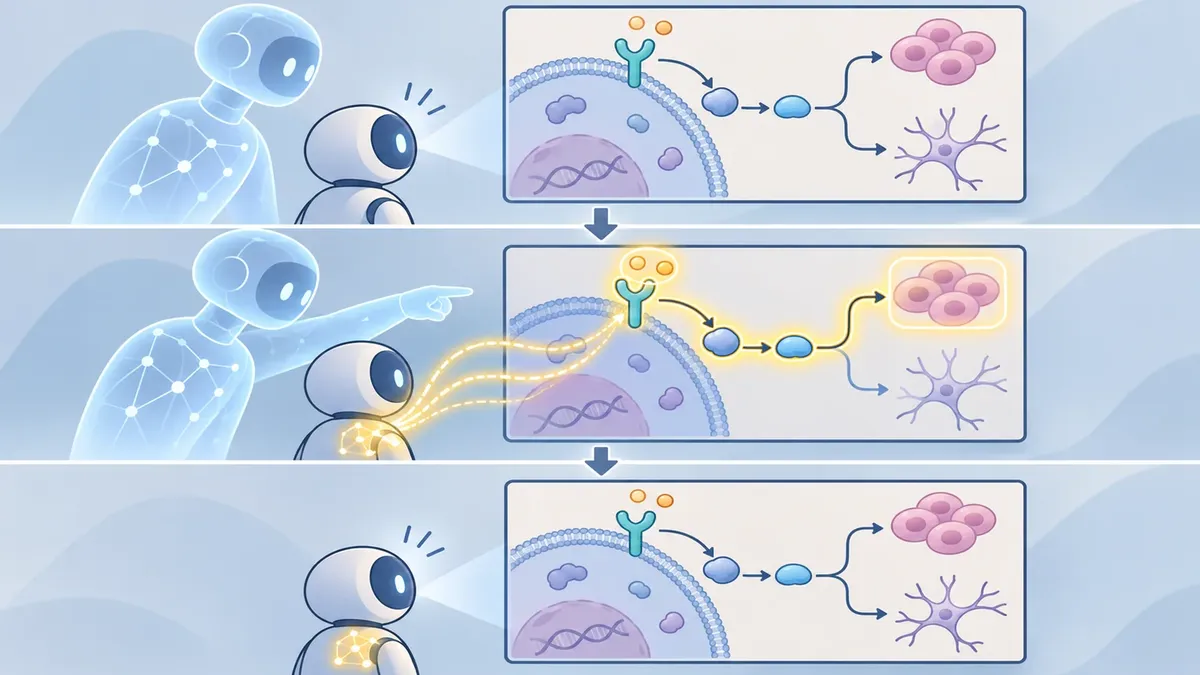
Visual AI can miss how details in a diagram fit together, even when it recognizes the objects. VC-OPD tries to teach smaller models what evidence matters for a particular question—without supplying those clues when the model is later used.
A model looking at a chart may recognize its colors and labels yet confuse a segment’s height with its position. A diagram may contain all the needed information, but the model can overlook a spatial relationship. The challenge is not simply seeing more pixels: it is identifying which visual evidence answers the question and how different parts of the image relate.
A new preprint proposes a training method called Visual Cue On-Policy Self-Distillation, or VC-OPD, to address that challenge. Its central idea is to give a teacher model a concise, question-specific description of relevant visual evidence, then use the teacher’s guidance to train a smaller model. At test time, that student gets only the original image and question—not the extra description.
A teacher gets clues the student must learn to find
In on-policy distillation, the student generates its own answer attempts, and a teacher provides feedback on those attempts. This differs from training only on answers written in advance: the feedback is delivered along the kinds of response paths the student itself takes.
Earlier visual approaches have used enlarged or cropped image regions to help a teacher notice fine details. The authors argue that close-ups alone may not convey the broader structure or relationships needed for complex reasoning. A crop can reveal a small label, for example, without explaining how it relates to other elements in a diagram.
VC-OPD instead generates a visual cue conditioned on both the image and the question. A stronger multimodal model is asked to identify relevant evidence—such as object attributes, text, spatial relationships, or structure—without giving the final answer. That cue is supplied to the teacher, not the student. The student and teacher then make predictions at the same points in a student-generated response; training nudges the student’s next-token predictions toward the teacher’s using a measure called Jensen–Shannon divergence.
The cues are screened before use. First, the method favors examples that are neither already easy nor apparently beyond the student’s current ability. Next, it checks whether the larger model answers the example correctly. Finally, it tests whether the cue helps the teacher answer reliably. Cues that fail these checks are excluded from the training library. The teacher is warmed up with reinforcement learning before being frozen for the distillation stage.
Benchmark gains, with important caveats
The authors report tests on STEM and general visual-reasoning benchmarks, using Qwen3-VL models at 2B, 4B, and 8B scales. Against the post-training methods included in their comparisons, VC-OPD had the highest reported average at each scale. For the 4B model, the paper reports average scores rising from 51.46 to 61.64 on its STEM benchmark group and from 45.65 to 56.13 on its general visual-reasoning group. These are benchmark results, not evidence that the method will improve every vision task or work equally well in real-world use.
An ablation—where researchers change one part of the method at a time—compared question-specific visual cues with a general image caption, a supplied answer, and a reasoning process. The cues produced the strongest reported downstream averages in that comparison, although the answer and reasoning conditions gave the teacher higher scores on the training set. The result supports the authors’ view that information useful to a teacher is not automatically the most useful information to transfer: it also needs to be relevant and recoverable from what the student will see later.
What remains uncertain
These are results reported by the paper’s authors, not an independent confirmation. The source is an arXiv preprint, and the supplied material does not establish that it has undergone peer review. The experiments use particular models, training data, benchmarks, and evaluation procedures; scores on those tests cannot settle how robust the method is across other architectures, tasks, or deployment settings. The paper also relies on model-based judgments for some evaluations, which adds another system’s judgments to the measurement process.
The cue-generation and filtering stages require additional models and computation during training. The claimed benefit is that the student does not need those cues at inference, but the reported benchmark gains alone do not show what the full training cost would be in other settings. Nor do they prove that every generated cue is accurate: filtering is intended to reduce unreliable cues, not guarantee perfect perception.
VC-OPD offers a way to frame visual-model training as learning what to look for, rather than simply receiving a closer view. The benchmarks make the approach worth investigating. Further testing will be needed to establish how broadly the gains transfer and how they hold up outside the paper’s evaluation setup.
- multimodal AI
- visual reasoning
- on-policy distillation
- knowledge distillation
- computer vision
- AI training
Reviewed cross-references
These connections were reviewed by a model, not independently fact-checked by a human. Similarity does not imply agreement; consult the original papers and the evidence below.
DiCT tests CT-guided training for X-ray AI
Shared method: Both methods use on-policy distillation to transfer teacher guidance along student-generated responses: VC-OPD gives its teacher question-conditioned visual cues, while DiCT selectively guides an X-ray student using paired CT volumes. The privileged inputs and tasks differ, so this is a methodological connection, not evidence that their results are directly comparable.
Model review: · openai-codex/gpt-6-luna
Evidence and provenance
Selected excerpts, not complete papers. PDF extraction can omit figures or damage equations, tables and reading order; sources may be preprints.
2611.32292v1 — Original paper
Excerpt reference:
static/papers/2611.32292v1.md:221-368
Basis: Paper text
Source SHA-256:23fc510a0ef948151c706623e35f96aaf250833602a1cf987dddeff4575a92a32611.32344v1 — Original paper
Excerpt reference:
static/papers/2611.32344v1.md:85-166
Basis: Paper text
Source SHA-256:306ae851a315ab6a7c33a1c417bdcb2de8bbec59d52a62b151c84c758dc39eb8
Related reading
Automatically matched by shared topic keywords. These links do not imply that the sources agree or establish a consensus.
Why language-model students can struggle to learn from teachers
Source published
Shared keywords: ai training, knowledge distillation, on policy distillation
Can Visual AI Learn from Four Histories?
Source published
Shared keywords: ai training, knowledge distillation, on policy distillation
Can a checklist help an AI model learn from a text-only teacher?
Source published
Shared keywords: ai training, knowledge distillation
A Two-Way View of Teaching Language Models
Source published
Shared keywords: knowledge distillation, on policy distillation
Can recurrent models learn more from stronger AI teachers?
Source published
Shared keywords: knowledge distillation, on policy distillation