TRANSMISSION // 2611.32287v1
How Magnetic Reconnection May Heat Ions Behind Shock Waves
Source published
Particle-in-cell simulations suggest that magnetic reconnection in wave-built current sheets can add to ion heating behind some collisionless shocks. The effect varies with shock conditions, and the evidence comes from limited two-dimensional simulations.
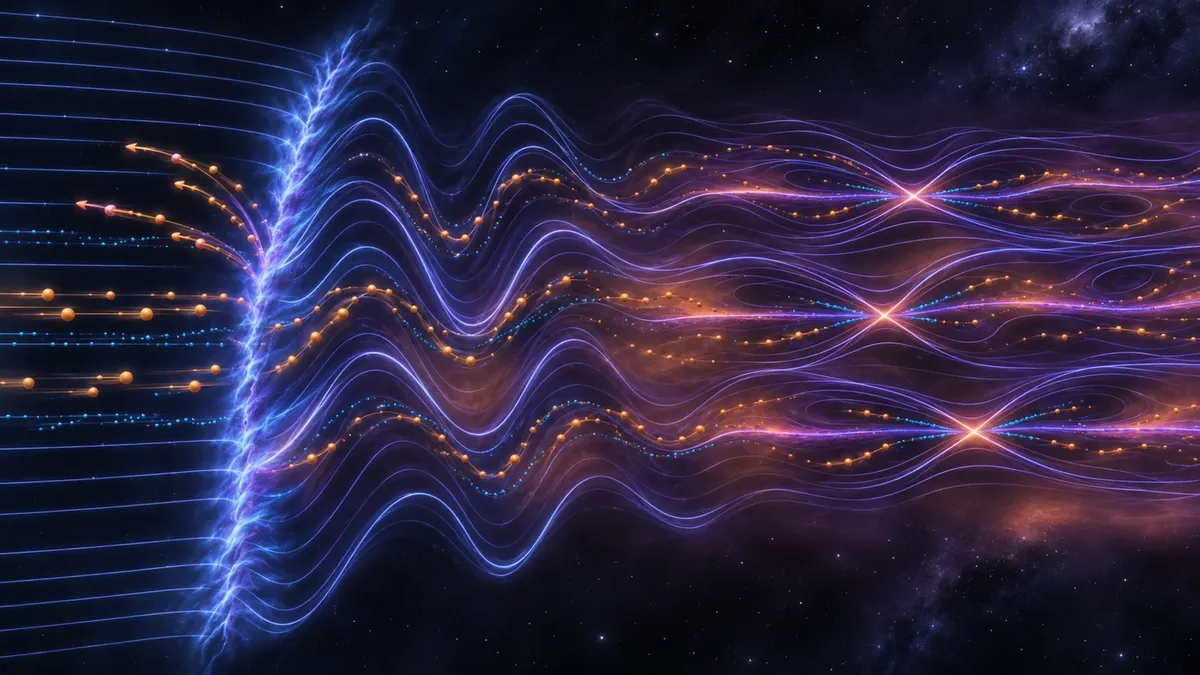
When a collisionless shock passes through plasma, ions and electrons do not necessarily end up with the same energy. Simulations by Masahiro Hoshino, Shuichi Matsukiyo and Takanobu Amano explore whether magnetic reconnection—alongside interactions between particles and Alfvén waves—helps explain that difference.
Collisionless shocks are abrupt transitions in a plasma where particles rarely collide directly. Instead, electric and magnetic fields, waves and particle interactions redistribute energy. A longstanding question is how that energy is divided between ions and electrons: the overall energy change across a shock does not, by itself, determine how much each species receives.
In a new study, Masahiro Hoshino, Shuichi Matsukiyo and Takanobu Amano investigate one possible contributor: magnetic reconnection in current sheets downstream of a shock. These sheets form as large-amplitude Alfvén waves—magnetic disturbances associated here with ions reflected at the shock—are compressed and evolve. Reconnection can rearrange magnetic fields and release stored magnetic energy, potentially heating particles in the process.
Simulating a shock and its magnetic structure
The researchers use particle-in-cell (PIC) simulations, a computational method that follows the motion of representative ions and electrons while calculating the electromagnetic fields they generate. They model parallel shocks, in which the upstream magnetic field is aligned with the incoming plasma flow. Their comparisons include one-dimensional simulations, which cannot represent the full range of structures across the shock, and two-dimensional simulations, where current sheets and X-shaped magnetic configurations can develop.
The team also varies simulation conditions, including the upstream flow and magnetic-field strength. This matters because the waves and current sheets do not have the same energy or structure in every shock. The simulations are designed to compare energy partitioning between ions and electrons and to examine whether reconnection-like regions coincide with ion heating.
A possible extra route to ion heating
In the simulations, reflected ions generate large-amplitude waves upstream of the shock. The waves cross the shock and are compressed downstream. In one-dimensional runs, the waves can gradually decay while electrons gain energy in the downstream region. In two dimensions, the compressed magnetic structure forms current sheets, and some develop X-type field geometries that may indicate reconnection.
Around some of these sites, the authors find signatures consistent with energy conversion and hotter ions. Comparing particular one- and two-dimensional cases, they report greater ion heating in the two-dimensional runs, while electron kinetic energy does not show the same strong dependence on the system’s width. Their parameter survey, however, shows that the difference is not universal: for weakly magnetized, high-Alfvén-Mach-number cases, the wave energy available to form the current sheets is relatively small, and the ion-to-electron energy partition is similar in the one- and two-dimensional simulations. The authors report more pronounced reconnection-associated ion heating in some relatively lower-Mach-number cases.
The proposed picture is that reconnection and magnetic-field annihilation in these sheets can channel energy into ions, in addition to heating through wave-particle interactions. The results suggest that this process may influence energy partitioning under some conditions; they do not establish that reconnection explains the imbalance in every collisionless shock.
What the evidence cannot yet settle
The connection between the X-shaped structures and reconnection is supported by several simulation diagnostics, including field geometry, particle-flow patterns and energy-conversion measures. But the authors describe this as circumstantial evidence. Not every X-shaped region shows the same signs of energy dissipation or ion heating, and the downstream plasma is turbulent, with multiple processes acting at once. Reconnection therefore cannot account for all differences between the one- and two-dimensional results.
There are also important limits to the simulations. The study examines parallel shocks in one and two dimensions, not fully three-dimensional shocks or the full range of shock geometries. The simulated ion-to-electron mass ratio is 100, rather than the real value, and the authors say it remains uncertain whether this affects the quantitative energy split. They also use relatively fast flows for computational reasons and note that the heating mechanism may be less important in some very high-Mach-number settings, including typical supernova shocks. The study does not resolve how energy is divided between thermal particles and nonthermal particle populations.
These are simulation results, not a direct measurement of heating in a particular astrophysical object. The paper says its data are available from the corresponding author on reasonable request. The source is an arXiv preprint; its presence there does not establish that it has undergone peer review. Further work across broader shock conditions, including three-dimensional simulations and comparisons with observations, will be needed to test how widely the proposed mechanism applies.
- collisionless shocks
- magnetic reconnection
- Alfvén waves
- plasma heating
- particle-in-cell simulations
- ion-electron energy partition
Reviewed cross-references
These connections were reviewed by a model, not independently fact-checked by a human. Similarity does not imply agreement; consult the original papers and the evidence below.
How shock-driven plasma jets may spark magnetic reconnection
Shared method: Both papers use particle-in-cell simulations to study reconnection-related processes downstream of collisionless parallel shocks. Hoshino and colleagues compare 1D and 2D simulations of ion–electron heating, while Ouyang and colleagues use 2D full-PIC simulations to examine high-speed jets, current sheets, and electron energization. Their different questions and setups do not show that either confirms the other’s heating results; the cited Ouyang study is a preprint, and the supplied evidence does not establish peer-reviewed status for either paper.
Model review: · openai-codex/gpt-6-luna
Evidence and provenance
Selected excerpts, not complete papers. PDF extraction can omit figures or damage equations, tables and reading order; sources may be preprints.
2611.32287v1 — Original paper
Excerpt reference:
static/papers/2611.32287v1.md:246-366
Basis: Paper text
Source SHA-256:5df909d6cb91a0df6d2e26adbb379e77a03dd7789c5086b166941518c22d77f92611.28052v1 — Original paper
Excerpt reference:
static/papers/2611.28052v1.md:13-68
Basis: Paper text
Source SHA-256:c18ba2f2dfcb188267747d98616abba3d8ea23bb81374cae6b34183bcdec1ea22611.28052v1 — Original paper
Excerpt reference:
static/papers/2611.28052v1.md:137-183
Basis: Paper text
Source SHA-256:c18ba2f2dfcb188267747d98616abba3d8ea23bb81374cae6b34183bcdec1ea2
Related reading
Automatically matched by shared topic keywords. These links do not imply that the sources agree or establish a consensus.
How shock-driven plasma jets may spark magnetic reconnection
Source published
Shared keywords: collisionless shocks, magnetic reconnection, particle in cell simulations
Two gamma-ray-producing regions emerge in black hole simulations
Source published
Shared keywords: magnetic reconnection, particle in cell simulations
A hidden magnetic field may steady pulsar current sheets
Source published
Shared keywords: magnetic reconnection, particle in cell simulations
How magnetic fields steer plasma waves and electron heating
Source published
Shared keywords: particle in cell simulations
Magnetic wrinkles can break neutron-star ‘monster shocks’ into patches
Source published
Shared keywords: alfvén waves