TRANSMISSION // 2611.32282v1
A CMB lensing signal reveals mass around Planck candidates
Source published
Stacking ACT lensing maps at 1,012 Planck candidate locations reveals a strong average mass signal. The result supports a protocluster interpretation but does not establish what each field contains.
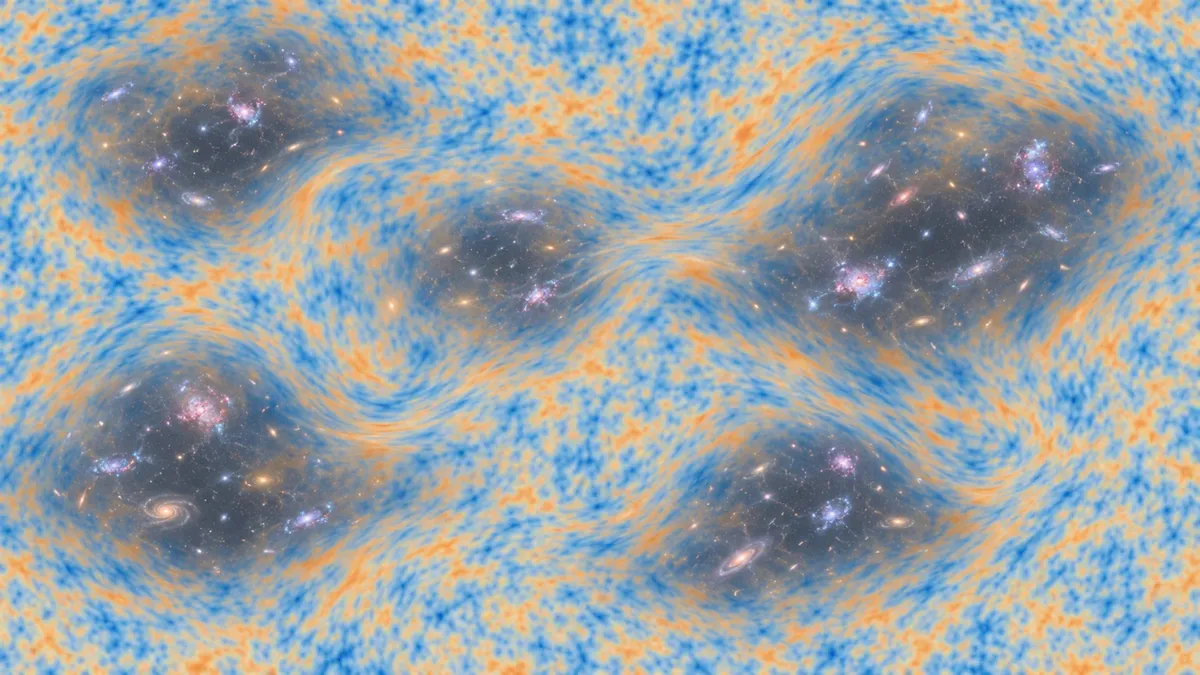
What lies behind distant, star-forming fields selected by Planck: single clusters in formation, or more complicated arrangements of matter? Researchers stacked measurements of how foreground gravity bends the cosmic microwave background to estimate the sample’s average projected mass.
Galaxy clusters build up over time as galaxies, gas and dark matter gather under gravity. Before a cluster settles into equilibrium, its ingredients may occupy a broader, developing structure called a protocluster. But observations of a field selected for bright star formation do not, by themselves, show that it contains one unified protocluster. A study by Tanguy Dusserre and colleagues uses cosmic microwave background (CMB) lensing to examine the mass associated with a set of Planck candidates.
The Planck catalogue contains 2,151 high-redshift star-forming field candidates. Of these, 1,012 fall within the sky area mapped by the Atacama Cosmology Telescope (ACT). The researchers ask whether stacking ACT lensing data at those positions can reveal an average mass signal, and whether that signal is consistent with the candidates being settled, massive clusters at the redshifts estimated by Planck.
Using the CMB as a background
The CMB is ancient light that has travelled across the Universe. Gravity from matter along its route subtly distorts the light’s pattern. Maps of this effect can be used to estimate convergence, a measure related to the amount of mass projected along a line of sight. It traces matter, not only the visible galaxies in a field.
The team used ACT’s sixth data release and combined information from CMB temperature and polarization maps. Since the Planck candidates are bright in infrared light, they chose a lensing map processed to reduce possible contamination from the cosmic infrared background. They extracted a 50-by-50-arcminute region around each candidate, aligned the regions and averaged them into a single map. The authors report that a median stack produced practically identical results.
A stack reveals an average pattern, not a separate measurement for every field. To assess whether the central signal could arise from noise and sampling, the researchers made 1,000 comparison stacks using random ACT positions. They also simulated background noise to estimate uncertainty and corrected for a zero-point signal associated with lensing-map reconstruction.
A strong signal, but not a map of every field
The centre of the stacked map has a mean convergence of 0.082. Compared with the random-position stacks, the authors report a detection at 12-sigma significance. In the context of their analysis, this means the observed average signal is very unlikely to be a random fluctuation in the lensing maps and sampling alone.
Converting convergence into mass requires a distance estimate for the foreground matter. The researchers use Planck’s redshift range of 1.5 to 3 and, for the calculation, treat all 1,012 candidates as if they were at the same redshift. They estimate a mean projected mass of about 6.6 × 10¹⁴ solar masses, with an uncertainty of about 1.4 × 10¹⁴ solar masses. The reported uncertainty is largely due to noise, with a smaller contribution from the assumed redshift. Estimates from other ACT lensing maps were consistent with the main result within one standard deviation.
This is a mass estimate for an effective, stacked candidate—not an individual mass measurement for each field. The authors also test whether objects of this mass could already be collapsed, virialised halos at the stated redshifts. Using the Press–Schechter formalism, they conclude that this is very unlikely for the sample. That finding favors an interpretation involving structures still forming, rather than a population of already settled, massive clusters.
The stack cannot determine the makeup of every candidate. A field could contain one extended protocluster, several overdensities aligned along the line of sight, or a signal dominated by a few especially massive structures. The mass is integrated along the line of sight, so the measurement does not distinguish among these possibilities. The authors also rely on a shared-redshift assumption when converting the stack into a mass estimate.
The result therefore supports the presence of substantial mass associated, on average, with the Planck catalogue, and strengthens the case that many of its fields include galaxy protoclusters. It does not prove that every candidate is a single protocluster. Follow-up observations of individual fields will be needed to clarify how their mass is distributed. This account is based on the supplied arXiv manuscript, which is labeled a letter to the editor; its findings should be read as reported research rather than treated as independently established conclusions.
- Planck candidates
- CMB lensing
- ACT
- protoclusters
- galaxy clusters
- projected mass
- cosmology
Related reading
Automatically matched by shared topic keywords. These links do not imply that the sources agree or establish a consensus.
JWST’s VENUS Survey Maps Cosmic Magnifiers
Source published
Shared keywords: galaxy clusters
VENUS maps 60 galaxy clusters that magnify the distant universe
Source published
Shared keywords: galaxy clusters
Testing a joint method for CMB lensing and polarization rotation
Source published
Shared keywords: cmb lensing
Galaxy clusters reveal an ancient cosmic ruler
Source published
Shared keywords: galaxy clusters
Galaxy clusters test growth under a fixed cosmic model
Source published
Shared keywords: galaxy clusters