TRANSMISSION // 2611.32268v1
Why some iron meteors reach the ground
Source published
Observations of the Zadzim fireball and models of seven other iron meteors suggest that size helps determine whether iron burns up high in the atmosphere or survives as a meteorite.
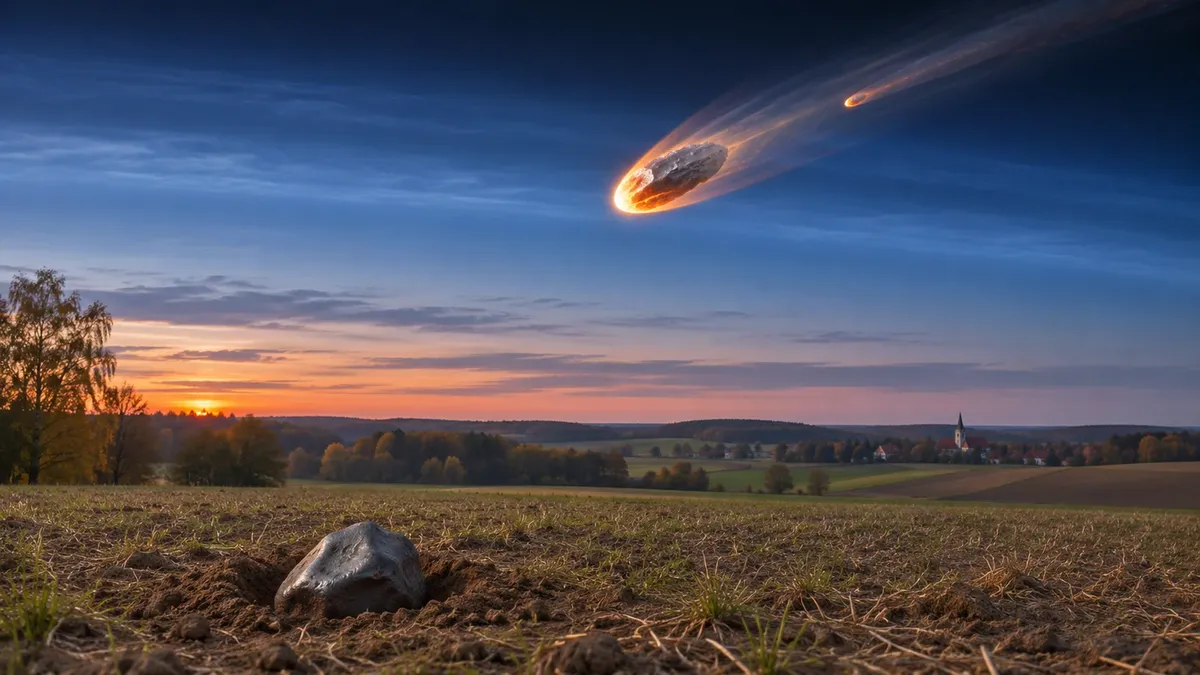
An iron-rich space rock can be strong enough to withstand intense atmospheric pressure and still lose material rapidly to heat. A study of a fireball over Poland, followed by the recovery of a 2.9-kilogram meteorite, offers a rare chance to examine how iron meteoroids behave during their passage through the atmosphere.
When a meteoroid enters Earth’s atmosphere, it heats up, slows down and sheds material. For many stony meteoroids, breaking apart is a major source of mass loss. Iron meteoroids may behave differently: they are rarely observed delivering meteorites, leaving scientists with relatively little direct evidence about how they lose mass.
A team led by Jiří Borovička studied a fireball seen over Poland on April 17, 2026. Their central question was how this iron-rich object survived its atmospheric passage—and what its behavior can tell us about other iron meteoroids. The researchers combined records from the European Fireball Network and the Skytinel Network, including video, photographs, brightness measurements and a spectrum. They also compared the event’s light curve with models for seven other iron fireballs.
Tracking a fireball to the ground
The instruments recorded the fireball’s path, speed and changing brightness. Its spectrum showed lines identified as iron and nickel, helping establish its iron-rich composition before the meteorite was found. The researchers used the observations to fit the fireball’s motion and light with models of atmospheric drag and mass loss.
A key result was that the Zadzim fireball could be modeled without the main body breaking into large pieces. It endured a maximum estimated dynamic pressure of about 5.2 megapascals. That is evidence about this particular object, not a universal threshold for iron meteoroids: the authors interpret it as a lower limit on the object’s strength.
The analysis estimated an initial mass of about 19 kilograms. After the fireball’s path and final motion were used to predict where remaining material might fall, a search team found a single 2.9-kilogram iron meteorite. It was buried in a shallow pit. The agreement between the expected and recovered mass supported the reconstruction, although the predicted landing position also depends on assumptions about the meteorite’s shape and winds during its final fall.
Size and heating may matter
The researchers’ comparison with seven other iron fireballs points to a possible size-dependent pattern. In their models, smaller objects—particularly those only a few centimeters across—could reach much higher ablation coefficients, a measure of how readily a meteoroid loses mass. Some modeled values approached 1 kilogram per megajoule. The Zadzim object’s coefficient stayed below 0.08 and settled near 0.023 kilogram per megajoule late in its flight.
The authors suggest that iron’s high thermal conductivity helps explain the pattern. Heat can spread through a small object, warming much of it; once heated, its material may melt and be removed more readily. A larger body may conduct heat inward without becoming thoroughly heated as quickly, allowing some material to survive deeper into the atmosphere. The paper proposes that molten material may be shed as droplets and then vaporize, but notes that detailed physical modeling or experiments are still needed to test this explanation.
The study also found that fitting the Zadzim light curve required a luminous efficiency about three times the standard value used for stony meteoroids. Luminous efficiency describes how much of a meteoroid’s lost energy appears as light. The authors developed an iron-specific relationship between brightness and speed, but their observations constrain it only over a limited speed range; the relationship at higher speeds is partly an assumption in their modeling.
What remains uncertain
These findings come from observations and models, not controlled experiments. The comparison sample is seven additional fireballs selected for useful data, and some model parameters—such as changing ablation rates—are adjusted to reproduce the observed brightness. The proposed heating explanation is plausible, but the authors explicitly call for more detailed theoretical or experimental work. Some smaller fireballs may also have fragmented near the end of their flights, so the paper does not show that iron meteoroids never break apart.
The manuscript reports acceptance by Astronomy & Astrophysics and makes observational data for Zadzim and the seven comparison fireballs available through Zenodo. Even so, the conclusions should be read within the limits of this sample and its modeling choices. The case is valuable because the fireball was observed in detail and its meteorite recovered—not because it settles how every iron meteoroid behaves.
- iron meteorites
- meteoroids
- fireballs
- atmospheric ablation
- Zadzim
- meteorite recovery