TRANSMISSION // 2611.32250v1
Sulfur’s many faces in exoplanet atmospheres
Source published
Laboratory plasma experiments produced sulfur-bearing gases in nitrogen-rich mixtures containing methane. The results suggest possible mid-infrared targets, but do not show that these gases occur on any particular planet.
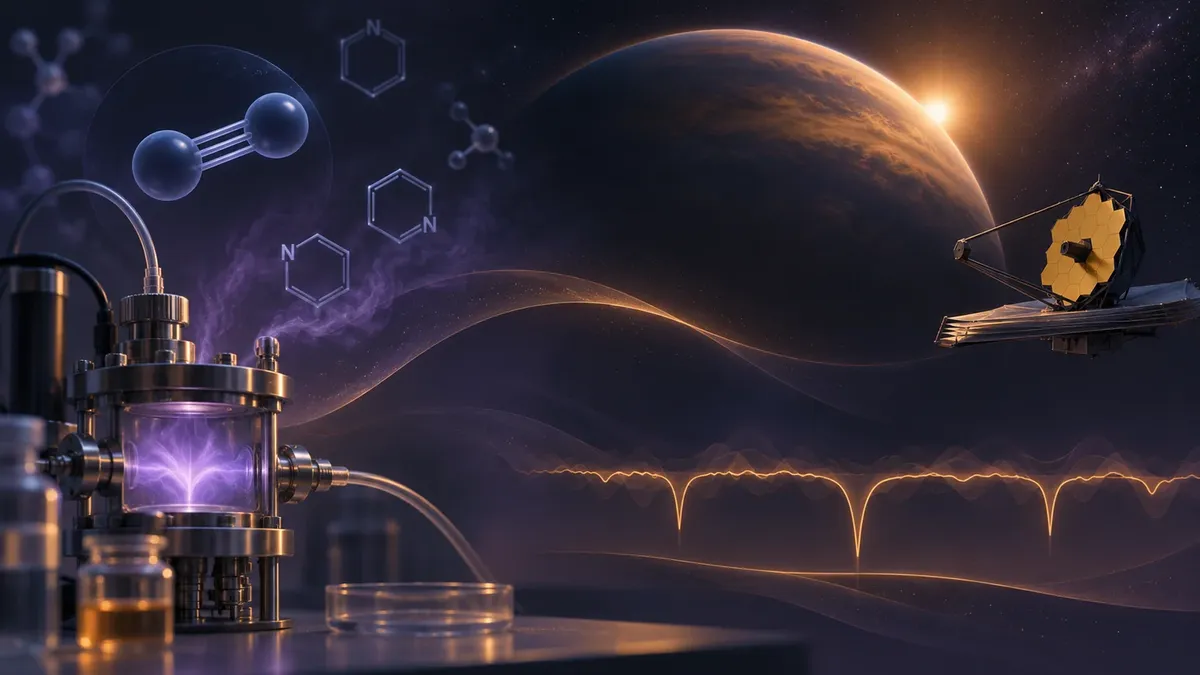
What gases might form when sulfur chemistry unfolds in a nitrogen-rich exoplanet atmosphere? Laboratory simulations point to a varied answer—and to two molecules that may be especially useful to search for with infrared telescopes.
Sulfur dioxide and hydrogen sulfide are familiar examples of sulfur gases. But sulfur may react with other elements in an exoplanet atmosphere and produce a wider assortment of molecules. To explore possible chemistry in nitrogen-rich settings, Louis Maratrat and colleagues used laboratory plasma experiments and assessed whether some products might leave detectable marks in infrared light.
The question matters as astronomers study a wider range of exoplanets, including temperate worlds with atmospheres unlike the hydrogen-rich ones characterized so far. To interpret a possible signal, researchers need to know which molecules can form, what reactions connect them, and whether their spectral features can be distinguished from those of other gases.
A laboratory model, not a miniature planet
The researchers sent mixtures of nitrogen, a sulfur gas—either sulfur dioxide (SO₂) or hydrogen sulfide (H₂S)—and, in some experiments, methane (CH₄) through a cold-plasma reactor. A plasma is an electrically energized gas: energetic electrons can trigger chemical reactions without heating the whole gas to the same energy. The experiments ran at about 1 millibar, with different starting proportions of sulfur gases.
The team compared mass spectra taken before and after switching on the plasma. A mass spectrometer separates charged fragments by mass, helping identify molecules formed in the reactor. Isotopic measurements helped distinguish some look-alike candidates. The researchers also estimated product abundances by computationally separating overlapping signals. These estimates are semi-quantitative: they indicate approximate scales, not precise mixing ratios.
The authors stress that the mixtures are controlled models for exploring possible reactions, not faithful recreations of a whole planetary atmosphere. In particular, methane and sulfur dioxide together are unlikely to represent a thermodynamically realistic mixture on their own. The combination was used as an analytical way to investigate a broad range of reaction products.
Products depended on the starting mixture
The distinction between experiments with and without methane is important. In nitrogen mixed with sulfur dioxide but no methane, the researchers detected S₂O under the conditions tested. In nitrogen–sulfur dioxide mixtures that also contained methane, they identified hydrogen sulfide, NHSO, S₂O, carbon disulfide (CS₂), carbonyl sulfide (OCS), and methanethiol (CH₃SH). The carbon-bearing products require a carbon source; here, methane supplied it.
A similar qualification applies to hydrogen sulfide. In nitrogen–hydrogen sulfide mixtures without methane, the study did not report these products. When methane was included, the team observed CS₂, carbon monosulfide (CS), and methanethiol. Across methane-containing mixtures, CS₂ was generally the most abundant of the quantified carbon-and-sulfur products, though abundance estimates carry substantial uncertainty and the results depend on the starting mixture.
The appearance of hydrogen sulfide in some methane-and-sulfur-dioxide experiments suggests that reduction reactions can occur under the experimental conditions. The researchers also identified NHSO and S₂O in sulfur-dioxide experiments; these point to reaction pathways that are not well represented in existing atmospheric chemistry databases. Several nitrogen-and-sulfur molecules the team searched for were not detected. They could be absent or present below the instrument’s detection limit in these experiments.
The findings highlight gaps in the reaction data needed for a reliable photochemical network—a map of reactions that can occur in an atmosphere, often driven by light. The authors propose pathways based on existing databases but note that important reactions and reaction rates remain uncertain or unmeasured. The experiments suggest candidates for further study; they do not establish how abundant these gases would be on an actual planet.
What might a telescope see?
The team compared calculated infrared absorption features for the detected molecules with features from other gases that could overlap. This is an assessment of potential detectability, not a report of new telescope observations. In their analysis, CS₂’s feature near 6.5 micrometres and OCS’s feature near 4.85 micrometres emerged as promising targets. Other gases could still complicate interpretation: abundant water may mask the CS₂ feature, while carbon monoxide may interfere with the OCS feature.
Detecting the other studied sulfur molecules at low spectral resolution appears more challenging because their absorption overlaps with other gases or their features are less favorable. The analysis compares molecular absorption strengths; it does not simulate every possible planet and observation. Different atmospheric conditions or improved spectral data could affect how detectable a molecule is.
This is a laboratory study, not evidence that these gases occur in any particular exoplanet atmosphere. Plasma chemistry is an experimental proxy, and the product estimates rely on mass-spectral deconvolution with substantial uncertainties. The paper is available as an arXiv preprint. Although its manuscript text carries an Astronomy & Astrophysics proofs label, the source record does not establish its final publication status or peer-review outcome. Its contribution is to identify candidate molecules and reactions that future chemistry models and observations can test.
- exoplanet atmospheres
- sulfur chemistry
- laboratory plasma
- nitrogen-rich atmospheres
- infrared spectroscopy
- carbon disulfide
Reviewed cross-references
These connections were reviewed by a model, not independently fact-checked by a human. Similarity does not imply agreement; consult the original papers and the evidence below.
Measuring the stars behind JWST’s planet spectra
Supporting evidence: Maratrat et al. identify CS₂ as a promising low-resolution transit-spectroscopy target based on its mid-infrared bands; Coria et al. report that a separate study found evidence for CS₂ in WASP-80 b. The comparison links predicted detectability with a reported atmospheric signal, but does not establish that the laboratory pathways operate in WASP-80 b or that the detection validates the predictions.
Model review: · openai-codex/gpt-6-luna
Evidence and provenance
Selected excerpts, not complete papers. PDF extraction can omit figures or damage equations, tables and reading order; sources may be preprints.
2611.32250v1 — Original paper
Excerpt reference:
static/papers/2611.32250v1.md:2061-2122
Basis: Paper text
Source SHA-256:2c28e724ee99e0851a4046880632eda2076f73c478a9537b10f2b968edf21f702611.08676v1 — Original paper
Excerpt reference:
static/papers/2611.08676v1.md:713-770
Basis: Paper text
Source SHA-256:befcae24005c24261e76edb387eba4a1846f1fb75a5c81eddbd1440790eb62cc
Related reading
Automatically matched by shared topic keywords. These links do not imply that the sources agree or establish a consensus.
Sulfur Chemistry Could Reveal Rocky Planet Interiors
Source published
Shared keywords: exoplanet atmospheres
Measuring the stars behind JWST’s planet spectra
Source published
Shared keywords: exoplanet atmospheres, infrared spectroscopy
A longer look at weather on brown dwarfs
Source published
Shared keywords: infrared spectroscopy
How negative ions may help water vapor become ice
Source published
Shared keywords: laboratory plasma
Faster noise modelling could sharpen studies of exoplanet atmospheres
Source published
Shared keywords: exoplanet atmospheres