TRANSMISSION // 2611.32221v1
Dust clues to giant-planet formation around small stars
Source published
A study of young planet-forming discs finds fewer signs of large-grain filtering around low-mass stars than around Sun-like stars, but the clue is indirect and the sample is selective.
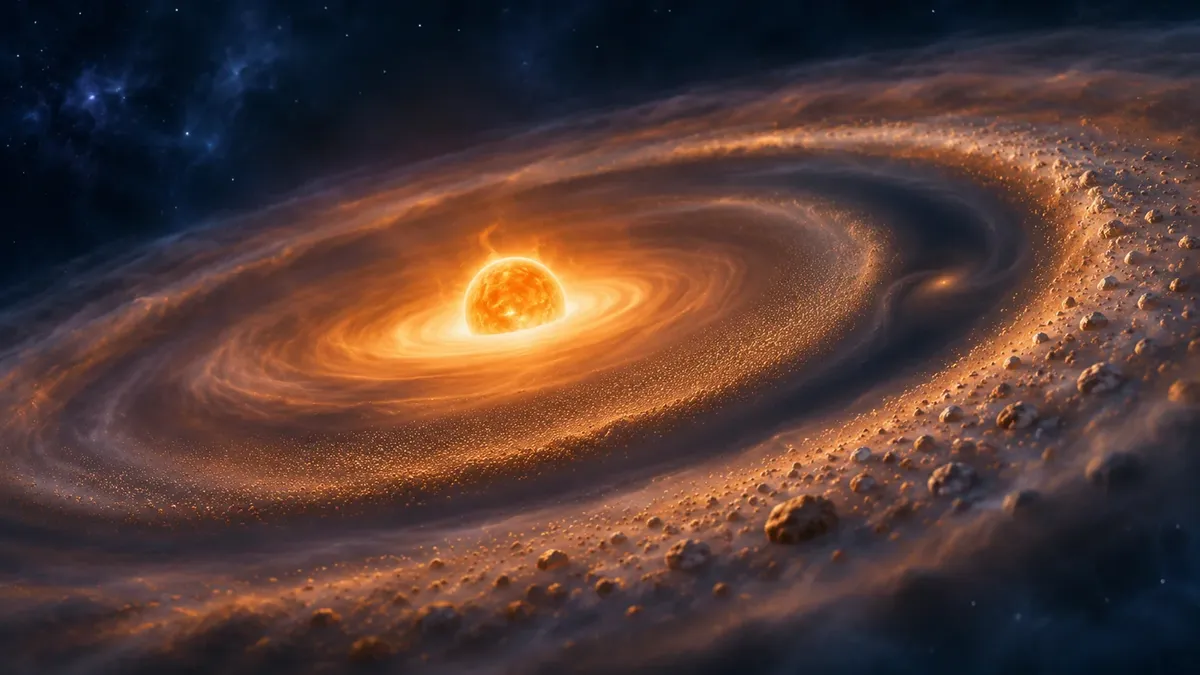
Can dust in a young star’s disc reveal whether giant planets are taking shape? Raffaele Gratton and Elisabetta Rigliaco compare discs around low-mass stars with earlier results for Sun-like stars. Their analysis finds a sharp difference in one possible sign of planet formation—but it cannot show that planets caused the dust pattern.
Dust in a planet-forming disc does not stay put. Grains can grow, break apart and drift inward toward the young star. A growing planet may interrupt that drift, acting like a barrier that leaves fewer large grains in the disc’s inner region. Astronomers call this process dust filtration. It offers an indirect clue to planet formation, not a direct sighting of a planet.
Raffaele Gratton and Elisabetta Rigliaco ask whether this clue appears less often around low-mass stars, which are known to host giant planets less frequently than Sun-like stars. Their new study extends earlier work on Sun-like stars to discs around stars that are expected to become early M-type stars.
Reading the discs
The team studied 18 young stars with relatively prominent discs. They assembled observations of each system’s light across different wavelengths, called its spectral energy distribution, and images of its dust emission from the Atacama Large Millimeter/submillimeter Array (ALMA). The stellar masses were estimated from the motion of gas in the discs, and the researchers used those masses and models of stellar evolution to estimate stellar ages.
They then fitted the light measurements and ALMA images together with a simplified model of the star, accretion onto it, and the inner and outer parts of its disc. The model estimates the largest dust grains in the inner disc. For their comparison, the authors treated an estimated maximum grain size below 0.03 centimetres as evidence of strong filtration. A size above 0.2 centimetres counted as no evidence; intermediate cases were left uncertain.
This is an inference from how the model reproduces the observations, not a direct measurement of grains one by one. The authors stress that their model simplifies disc structure and dust properties, so its derived quantities are mainly qualitative. Reported uncertainties are indicative rather than formal statistical confidence intervals.
A difference between stellar groups
The comparison focuses on discs aged 2–8 million years, the period when giant-planet cores are expected to grow. In the low-mass group, with stellar masses of about 0.30–0.58 times the Sun’s, one of 11 discs met the study’s criterion for filtration: 9%, with an uncertainty of 9 percentage points. In the earlier solar-type sample, 11 of 22 did: 50%, with an uncertainty of 11 percentage points.
The authors report that the difference is unlikely to arise by chance under their statistical test. They interpret it as consistent with the lower frequency of giant planets around low-mass stars. But the dust pattern alone cannot establish that a planet made the barrier. Pressure structures can arise without planets, and dust growth and fragmentation affect whether grains are stopped or replenished.
The study also finds that discs classified as showing filtration tend to have substantial outer dust reservoirs: all had estimated outer-disc dust masses above 20 Earth masses. This association fits the idea that massive discs may be better able to build the large planetary cores needed for efficient filtration. It does not prove that disc mass causes filtration, or that the discs will produce giant planets.
What the evidence can—and cannot—say
The sample is small and deliberately weighted toward bright, prominent discs. The authors estimate that this selection bias is stronger for the low-mass group, so the measured fractions should not be read as representative of every young star. Correcting for the bias reduces the inferred filtration frequency, but does not remove the broader mismatch between filtration frequencies and giant-planet rates among field stars. The paper suggests that differences in the star-forming environments sampled may also matter.
There is another limitation: filtration is not a complete census of planet formation. The authors note that grain coagulation can replenish large grains even while filtration operates. Their threshold therefore identifies evidence of particularly strong filtration; a disc that fails it may still be filtering dust. And because the study’s model does not directly measure the disc’s gas mass, some inferred disc properties depend on assumptions about the gas-to-dust ratio.
The results point to a possible connection between disc dust, stellar mass and giant-planet formation, while leaving the mechanism open. They also suggest that the same filtering may not accompany the smaller planets common around low-mass stars. The article is an accepted Astronomy & Astrophysics manuscript, but the supplied source is a proof manuscript; its conclusions should be treated as research findings subject to the limitations described above, not as settled proof of planet formation.
- protoplanetary discs
- dust filtration
- giant planets
- M-type stars
- ALMA
- planet formation
Related reading
Automatically matched by shared topic keywords. These links do not imply that the sources agree or establish a consensus.
WISPIT 2’s gas shows clues near known planets
Source published
Shared keywords: giant planets, planet formation
Cosmic rays may reshape planet-forming disc chemistry
Source published
Shared keywords: planet formation, protoplanetary discs
A passing star can make a planet-forming disc look more warped than it is
Source published
Shared keywords: protoplanetary discs
Gas persists inside the dust gaps of three planet-forming disks
Source published
Shared keywords: planet formation
A new look at the spirals around IM Lup
Source published
Shared keywords: planet formation