TRANSMISSION // 2611.32183v1
ThinkMorph-SSL trains multimodal models with image tasks
Source published
ThinkMorph-SSL turns visual pretext tasks into image-and-text training traces, then uses them before question-driven tuning. Its abstract reports gains but leaves details open.
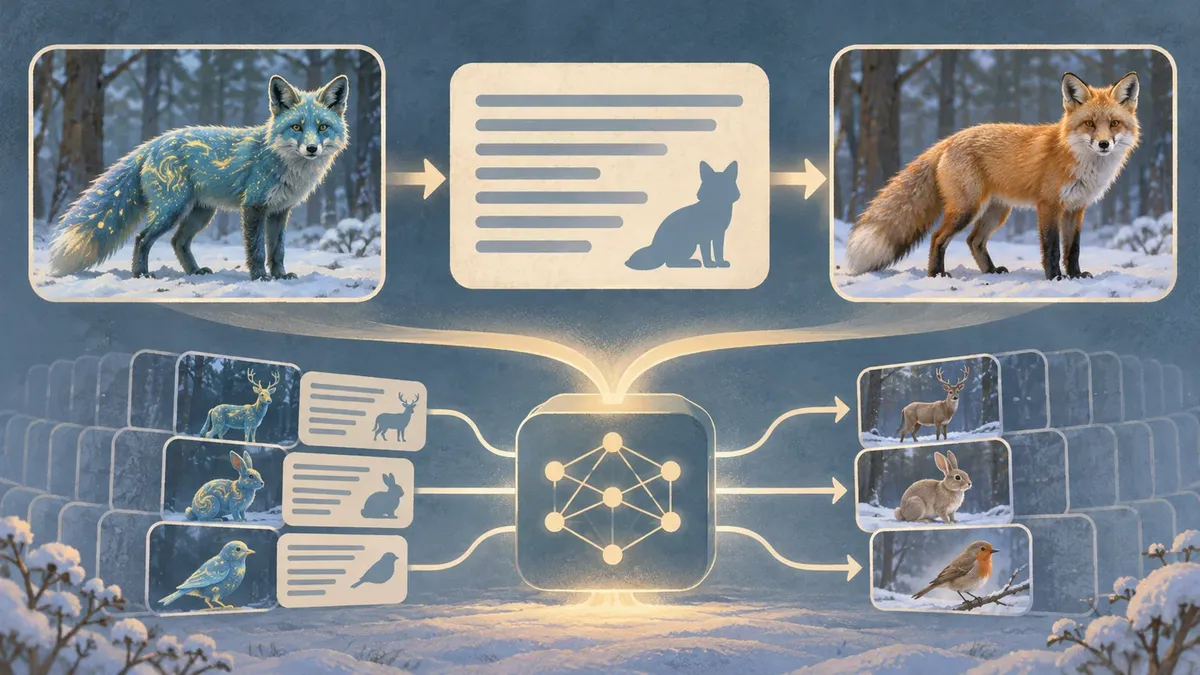
Can image transformations help train models to reason across pictures and words? ThinkMorph-SSL proposes using visual pretext tasks—such as colorization and denoising—to create training traces, then testing whether this preparation helps models learn from question-and-answer examples.
People use pictures as well as words to think through problems. Some AI models can also alternate between text and images, producing intermediate images that may guide later reasoning. But demonstrations of this process can be difficult to collect. ThinkMorph-SSL asks whether visual tasks themselves can provide useful training signals.
Two stages of training
In the first stage, the method turns visual pretext tasks into instruction-free, interleaved traces. The abstract names colorization and denoising as examples. A model describes a corrupted or transformed image, generates a restored or canonical image, and interprets the result. These steps combine text and images, but the abstract does not establish which skills the model acquires from them.
In the second stage, the model undergoes question-driven instruction tuning using automatically constructed demonstrations. The abstract does not explain how those demonstrations are made or provide the detailed training setup, so those parts of the method cannot be assessed from the supplied material.
The researchers’ proposal is that training on visual tasks can prepare models to learn from task-specific demonstrations. This is the rationale behind the recipe, rather than a separate finding about how models reason internally.
What the abstract reports
The authors report that, at the same instruction-tuning budget, models trained with pretext reasoning outperform models trained with instruction tuning alone. They also report that the full recipe improves over the base model by an average of 11.33 accuracy points across twelve benchmarks.
These are summary claims in the abstract. It does not identify the benchmarks, tested models, scoring details, or results for each task. Uncertainty estimates and further experimental detail are also not available in the supplied abstract. The reported average does not mean that every benchmark improved by 11.33 points, or establish that each benchmark improved at all.
The same-budget comparison helps frame the claimed contribution, but the abstract does not say whether other factors, such as data quantity or quality, were matched. It also does not show which part of the two-stage recipe accounts for the gains.
What remains unclear
The abstract presents image-derived training traces as a way to support learning from task-specific examples, and reports benchmark improvements. It does not establish that the approach produces general visual reasoning or transfers to uses beyond the evaluated benchmarks.
This account is based on the abstract alone, not the full paper. The supplied material therefore does not let readers inspect the methods in detail, benchmark-by-benchmark results, or the paper’s discussion of limitations. The evidence supports reporting what the authors claim, but not independently evaluating the strength or robustness of those claims. Further assessment would require the full methods and results, as well as independent testing.
- multimodal AI
- visual reasoning
- self-supervised learning
- image transformations
- AI training
Reviewed cross-references
These connections were reviewed by a model, not independently fact-checked by a human. Similarity does not imply agreement; consult the original papers and the evidence below.
Reconstruction Alignment: Teaching Models to Rebuild Images
Shared method: Both use image-derived supervision rather than relying solely on task-specific text demonstrations: ThinkMorph-SSL turns visual pretext tasks into interleaved reasoning traces, while RecA trains a model to reconstruct an image from its visual-understanding embeddings. Their objectives and evaluated outcomes differ, so this is a shared high-level training principle, not evidence that one method validates the other.
Model review: · openai-codex/gpt-6-luna
Evidence and provenance
Selected excerpts, not complete papers. PDF extraction can omit figures or damage equations, tables and reading order; sources may be preprints.
2611.32183v1 — Original paper
Excerpt reference:
static/papers/2611.32183v1.md:68-155
Basis: Paper text
Source SHA-256:4f5a7c09be78a7f90f67d5172fa155d9446a1131d7cb433b51305132a835d04a2509.07295v5 — Original paper
Excerpt reference:
static/papers/2509.07295v5.md:114-203
Basis: Paper text
Source SHA-256:778a00cda788a9d295761aecced70fcb5020e4398a7535b4fd82660890bb029a
Related reading
Automatically matched by shared topic keywords. These links do not imply that the sources agree or establish a consensus.
Teaching Small Vision Models What to Notice
Source published
Shared keywords: ai training, multimodal ai, visual reasoning
Can Rotating an Image Help a Multimodal AI Answer Better?
Source published
Shared keywords: multimodal ai, self supervised learning
Reconstruction Alignment: Teaching Models to Rebuild Images
Source published
Shared keywords: multimodal ai, self supervised learning
DuoJEPA: A Bridge Between Embedding Spaces
Source published
Shared keywords: multimodal ai, self supervised learning
Can AI Models Think in Pictures, Not Just Words?
Source published
Shared keywords: multimodal ai, visual reasoning