TRANSMISSION // 2611.32176v1
Can document-aware AI recover text from damaged page photos?
Source published
DocPristine uses features from a pretrained document-image encoder to guide restoration of photographed pages with overlapping problems such as shadows, highlights and blur. In the authors’ tests, it improved image-quality scores and document parsing results, though the real-world test set was limited.
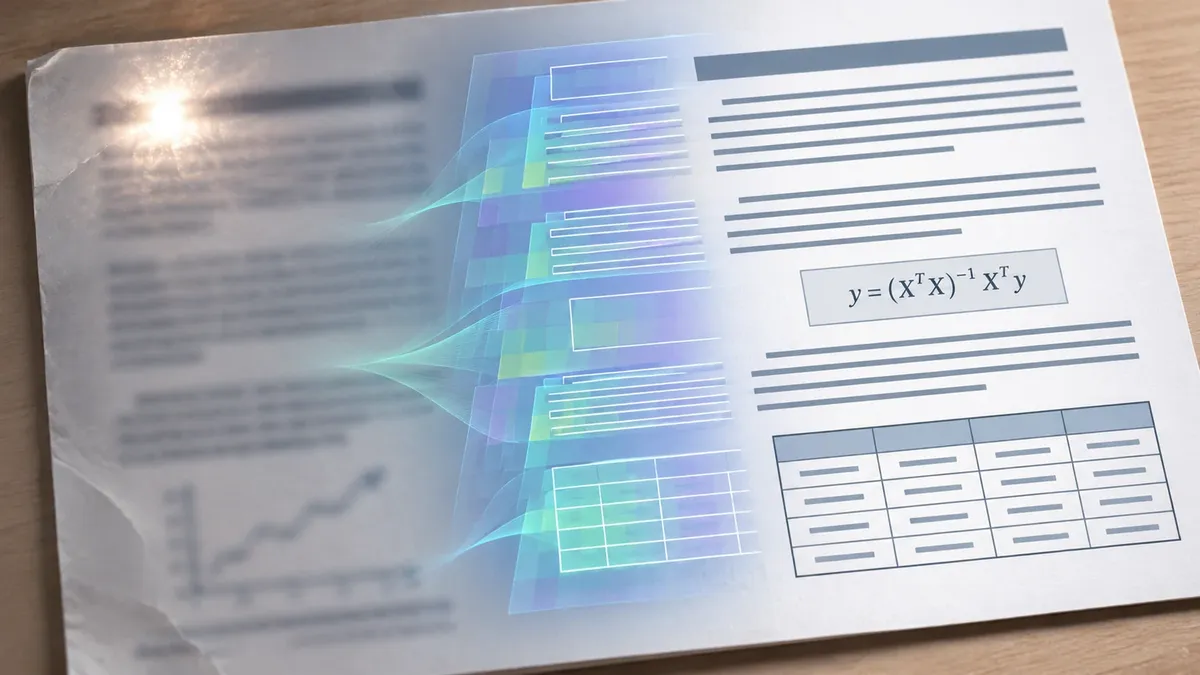
A shadow may darken one part of a page while glare or blur hides its text. DocPristine is a system designed to restore these mixed-degradation document photos by using information about document content—not just the damaged pixels—to guide its corrections.
Photographing a page can introduce several problems at once: shadows, bright reflections, color shifts and blur. The result may look uneven, but the deeper issue is that fine print, formula symbols and table lines can become hard for both people and software to read. A restoration system must improve the page’s appearance without changing its content or layout.
The authors of DocPristine ask whether a model can restore such images more effectively by using clues about where text and other document structures are likely to be. Some earlier approaches estimate visual cues from the damaged image itself; those cues may become unreliable when degradation is severe. Other methods identify degradation types but, the authors argue, offer less guidance about where on the page text details need attention.
Using document features as a guide
The researchers first examined attention maps from several pretrained visual encoders: models that turn images into internal representations. In the examples they analyzed, document-adapted encoders continued to focus on text regions in both clean and degraded pages. That observation motivated DocPristine, which feeds features from a frozen, pretrained document encoder into a separate image-restoration network. “Frozen” means the encoder’s existing parameters are not updated during the reported training.
Three components control how the guidance is used. Adaptive Multi-Layer Feature Fusion combines information from different encoder layers, which may carry different kinds of visual or structural cues. Hierarchical Gated Conditioning adjusts how strongly those features affect different locations and scales. Shifted-Window Cross-Attention lets the restoration network draw on document features from nearby regions, including across the boundaries of its local processing windows. The aim is to use clearer neighboring text structure when a local area is obscured, while also correcting the page background.
The team also created DocACE. Its synthetic training set, DocACE-Synthetic, uses 141,649 source document images to generate paired examples: a clean target and a version with simulated combinations of degradations. Its real-world test set, DocACE-Real, contains 120 photographed pages with manually restored reference images and document-parsing annotations. The researchers compared DocPristine with existing methods on DocUNet, RealDAE and DocACE-Real, using image-quality measures and a document parser to assess downstream reading and structure recognition.
What the tests found
On the three benchmarks, the paper reports that DocPristine achieved the highest PSNR and SSIM scores among the methods evaluated. These measures compare a restored image with a reference image; higher scores generally indicate closer agreement, but do not by themselves prove that every character is correct or that an image looks best to every reader.
On DocACE-Real, the authors report a PSNR of 21.86 dB and an SSIM of 0.9140. Compared with DocRes, the strongest comparison method reported for that benchmark, these scores were higher by 3.42 dB and 0.0603, respectively. Using the same downstream parser, the overall parsing score rose from 78.61 on degraded inputs to 83.66 on DocPristine-restored images. The authors also report improvements in text, formula and table parsing measures compared with DocRes.
Ablation tests—experiments that switch off parts of a system—found that the two guidance mechanisms, HGC and SWCA, each improved results over a restoration network without feature injection, and their combination performed better in the reported comparisons. Tests of different visual encoders also favored the document-oriented encoders over the general-purpose encoders examined. These results support the proposed design within the tested setup; they do not establish that the same gains will hold for every document type or capture condition.
What remains uncertain
DocACE-Real is a useful test resource, but 120 pages are a limited sample of the many languages, page designs, cameras and real-world conditions documents can involve. Its reference images were manually enhanced to resemble clean scans, so the target appearance reflects human editing choices. The training degradations are simulated, even though testing also includes real photographs; simulated data cannot represent every pattern found in practice. Parsing was evaluated with one named system, so improved scores there do not guarantee equal gains for other readers or for human readability.
The authors describe the work as a preprint, and the supplied source does not establish peer-review status. Its headline performance claims should therefore be read as the authors’ reported experimental results, not as independent confirmation. The paper says code, models and data will be made publicly available; the source does not confirm that they are already accessible. The evidence suggests that document-specific visual features can help restore damaged page images in these benchmarks, while broader reliability and practical performance remain open questions.
- document image restoration
- document appearance enhancement
- computer vision
- document parsing
- image degradation
- DocPristine
Reviewed cross-references
These connections were reviewed by a model, not independently fact-checked by a human. Similarity does not imply agreement; consult the original papers and the evidence below.
When AI Rebuilds a Document, Looking Right Is Not the Same as Being Right
Supporting evidence: Both studies treat document fidelity as more than visual appearance alone: Huang et al. report that DocPristine improves downstream parsing on DocACE-Real, while Niu et al. evaluate content, layout, and perceived fidelity separately and report that objective and subjective rankings can differ. This is a bounded comparison across different tasks and benchmarks, not evidence that either system improves the other’s results.
Model review: · openai-codex/gpt-6-luna
Evidence and provenance
Selected excerpts, not complete papers. PDF extraction can omit figures or damage equations, tables and reading order; sources may be preprints.
2611.32176v1 — Original paper
Excerpt reference:
static/papers/2611.32176v1.md:183-252
Basis: Paper text
Source SHA-256:5b7b1948fd3626bfcbb28253df5947967d941a34696b1c177e1b90dad084b52f2611.06449v1 — Original paper
Excerpt reference:
static/papers/2611.06449v1.md:174-235
Basis: Paper text
Source SHA-256:45a097a226a418b2af50ea516de27dba6290e9ed44688093b05f530a5e0323782611.06449v1 — Original paper
Excerpt reference:
static/papers/2611.06449v1.md:745-780
Basis: Paper text
Source SHA-256:45a097a226a418b2af50ea516de27dba6290e9ed44688093b05f530a5e032378
Related reading
Automatically matched by shared topic keywords. These links do not imply that the sources agree or establish a consensus.
Document-parsing leaderboards shift when the scoring rules change
Source published
Shared keywords: document parsing
When AI Rebuilds a Document, Looking Right Is Not the Same as Being Right
Source published
Shared keywords: document parsing
PhiJEPA tests whether AI can infer hidden visual features
Source published
Shared keywords: computer vision
When a Bug Report Screenshot Is Too Blurry, the Codebase May Help
Source published
Shared keywords: image degradation
SplatLab puts an AI research loop to work on 3D scenes
Source published
Shared keywords: computer vision