TRANSMISSION // 2611.32168v1
Protein AI Has to Write Structure, Not Just Read It
Source published
A controlled benchmark finds that protein structure tokenizers vary sharply in how well a language model can generate their codes—something reconstruction scores alone do not reveal.
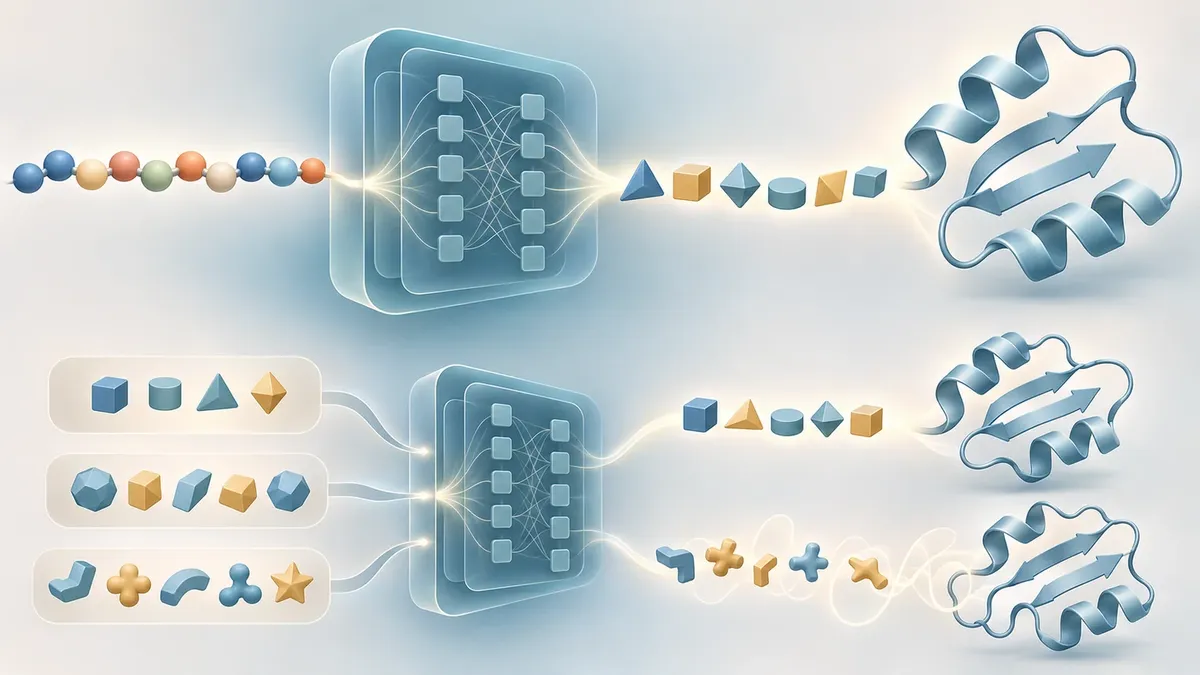
Protein structure can be represented as a sequence of discrete tokens, but generating that sequence is not the same as decoding one supplied in advance. A benchmark tests how well a language model can write structure tokens when given an amino-acid sequence.
Protein structure tokenizers turn a three-dimensional backbone into a sequence of discrete symbols, one per residue. That lets a language model work with structural information. But if the goal is to predict a structure, the model must generate the tokens—not merely read tokens made from a known structure.
Yong Liu and colleagues call this capability writability: how well a model can generate structure tokens that decode into a backbone resembling an experimental structure. Tokenizers are commonly assessed by reconstruction fidelity: encode a known backbone, decode it, and measure how much structure remains. That tests the representation’s ability to preserve information, not how well a language model can generate it.
A controlled comparison
The researchers compared eight tokenizers, changing the tokenizer while holding the rest of the training setup fixed. Each was paired with the same 9-billion-parameter base model, data mixture and training recipe. Given an amino-acid sequence and a task instruction, the model generated one structure token per residue. The study used greedy decoding; it did not test sampling or best-of-many generation.
The team trained each setup at four budgets, up to 2 billion tokens, and evaluated them on three held-out sets: FoldBench334, CASP16 and CAMEO2025. The paper reports 96 main evaluation combinations. For context, the researchers measured each tokenizer’s decoder with random tokens, as well as its reconstruction ceiling when ground-truth structures were encoded and decoded. These checks matter because decoders can produce different outputs even when given random input.
The main measure was TM-score, which compares a predicted backbone with a reference structure. The researchers also assessed physical plausibility separately: a structure can have realistic local geometry without matching the correct overall fold.
Token choice changed generation results
At 2 billion training tokens, TM-scores on FoldBench334 ranged from 0.378 for VanillaVQ to 0.662 for DPLM-2. Five of the eight setups exceeded the paper’s cited 0.5 mark, often used to call a fold correct; three fell below it. The three evaluation sets showed the same broad ordering.
Codebook size and reconstruction fidelity did not explain the differences. The best and worst tokenizers both had 8,192 codewords. Six tokenizers reconstructed known structures above 0.95 TM, yet their generation scores spanned a wide range. A representation can therefore preserve a supplied structure well while still proving difficult for a model to generate.
To account for run-to-run variation, the team repeated one training arm. The nine paired comparisons had a standard deviation of 0.0067 TM; the authors used an absolute difference below 0.013 as a rule for grouping scores rather than reporting a fine-grained order. Under that rule, three middle-performing tokenizers fall in the same tier. The estimate comes from just one repeated arm and is a lower bound on the true noise, not a full uncertainty estimate.
What the token codes may have to do with it
The researchers’ leading explanation concerns how the code space is organized. If nearby codes correspond to similar structures, a model’s near-miss might have a smaller structural cost. In DPLM-2, changing one bit in selected binary codes caused a much smaller TM-score loss than replacing the codes with random ones. At 30% of positions, the one-bit changes cost 0.019 TM, compared with 0.347 for random codewords. DPLM-2’s own wrong codes were also closer to the correct codes than random wrong codes: their average Hamming distance was about half the random expectation.
That pattern did not hold for FoldToken4-l12, which has the same codebook size as DPLM-2. Its one-bit perturbations and random-code substitutions had similar effects at the tested perturbation levels, and its errors were approximately at random-code distances. DPLM-2 scored 0.13 TM higher than FoldToken4-l12 at the 2-billion-token budget. These measurements support a possible link between code locality and writability, but do not establish that locality causes the performance difference.
The proposed bit-focused training changes did not improve the main score. One intervention barely changed the error pattern and was treated as an invalid test of the mechanism. Another changed the Hamming-distance ratio slightly, from 0.537 to 0.526 at 0.5 billion tokens, without a score gain beyond the noise. The authors note that this ratio had already stopped improving by 1.5 billion tokens even as TM-score continued to rise. That timing may help explain the null result, but does not prove why the intervention failed.
Different measures tell different stories
ProFiT had the weakest TM-score among the non-degenerate tokenizers but produced highly valid local backbone geometry. Across seven arms, raw TM-score and floor-corrected bond-length validity had a Pearson correlation of −0.58 (Spearman −0.46). The paper describes these measures as nearly orthogonal: physical plausibility and matching the right fold capture different aspects of quality.
The report also compares the strongest tokenizer setup with ESMFold on 333 FoldBench334 targets, using the same ESM2-3B features. The authors estimate that failure to transfer long-range contacts accounts for about 0.091 TM of the 0.209 gap; a further discretization contribution is estimated by extrapolation. These figures are approximate, overlap, and are not a causal partition of the gap.
What remains uncertain
The findings apply to one base model, one data mixture and recipe, a 2-billion-token maximum budget, and greedy decoding. They do not establish which tokenizer would work best under other models, scales or decoding strategies. A long-chain result is based on only 26 targets, and the noise estimate rests on one repeated training arm. The authors say they released evaluation outputs and raw generated token streams, but not model checkpoints.
This is an arXiv technical report, so its findings should be read as a preprint rather than as settled evidence. Its central point is methodological: when a representation is meant for generation, test how well a model can write it, not only how faithfully it reconstructs a structure provided in advance.
- protein structure
- language models
- protein tokenization
- AI benchmarking
- protein folding
Reviewed cross-references
These connections were reviewed by a model, not independently fact-checked by a human. Similarity does not imply agreement; consult the original papers and the evidence below.
A benchmark tests AI predictions of cyclic peptides
Supporting evidence: Both studies show why structural similarity scores need complementary checks on generated structures: the tokenizer benchmark pairs reference-based TM scores with reference-free backbone geometry checks, while PRETZEL pairs pose RMSD with bond geometry and ring-closure checks. The evaluations concern different systems and validity criteria, so this supports only the bounded point that accuracy and physical or chemical validity are distinct outcomes, not a direct comparison of model performance.
Model review: · openai-codex/gpt-6-luna
Evidence and provenance
Selected excerpts, not complete papers. PDF extraction can omit figures or damage equations, tables and reading order; sources may be preprints.
2611.32168v1 — Original paper
Excerpt reference:
static/papers/2611.32168v1.md:171-217
Basis: Paper text
Source SHA-256:4f0645905201ed37f47e266fff06b756e0c824a5c85cca9f3ab53a8c81da7baa2611.31708v1 — Original paper
Excerpt reference:
static/papers/2611.31708v1.md:13-47
Basis: Paper text
Source SHA-256:4184662cf3c206be7b58f29e28dc104c1e0c5e808c5648d717906b6d0e3d0bfe
Related reading
Automatically matched by shared topic keywords. These links do not imply that the sources agree or establish a consensus.
A benchmark tests AI predictions of cyclic peptides
Source published
Shared keywords: ai benchmarking
How well do AI models handle Iranian engineering entrance exams?
Source published
Shared keywords: ai benchmarking
When PLC Code Runs, Does the Factory Task Actually Work?
Source published
Shared keywords: ai benchmarking
Can an AI Agent Remember the Right Thing at Work?
Source published
Shared keywords: ai benchmarking
Why the Same Seed Can Make a Different AI Image
Source published
Shared keywords: ai benchmarking