TRANSMISSION // 2611.32119v1
How CoverMem helps embodied AI remember useful views
Source published
CoverMem builds compact visual memories and selects images for embodied AI questions, balancing object-view quality, scene context and evidence gaps.
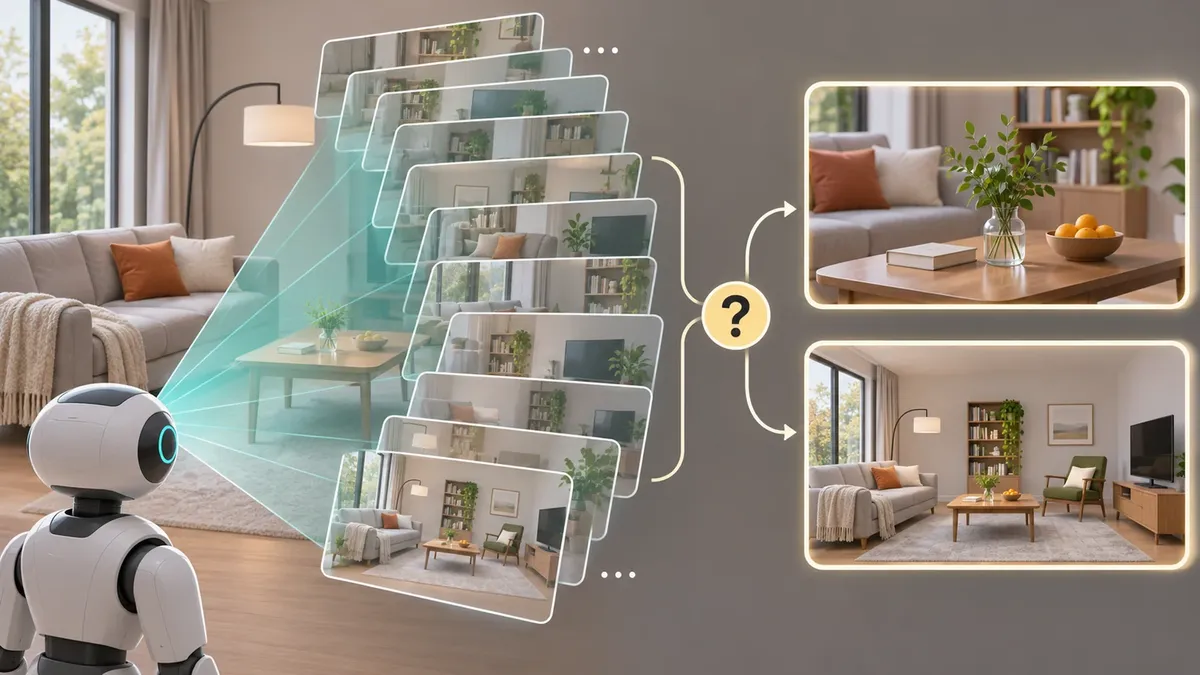
An AI agent may have seen a room before being asked about it. The challenge is keeping informative views—and later choosing images that together support an answer. CoverMem is a proposed system for managing both steps under a limited image budget.
The challenge: remembering before the question arrives
An embodied AI agent may be asked about a room it observed earlier: which tables were in a seating area, for example, or where an object was located. To answer, it must retain useful images from its observation history and later choose which ones to show a vision-language model (VLM). Keeping every image can be costly, but a few apparently relevant views may miss a detail or the wider scene context.
The paper introduces CoverMem, which addresses two stages: what to retain before a question is known, and what to retrieve once it arrives. The authors evaluated it on three question-answering benchmarks: OpenEQA, EXPRESS and ScanQA.
Building and updating a visual memory
CoverMem constructs a reusable memory from recorded frames. Its coverage rules seek at least one quality-qualified observation for each recorded object identifier, and at least one frame for each representative scene group. These rules apply to objects the system has recorded; they do not guarantee coverage of every physical object or evidence needed to answer future questions.
To assess object views, CoverMem combines six cues: sharpness, object area, boundary truncation, detection confidence, depth-based visibility and text readability. These are proxies for observation quality. In particular, the text cue estimates readability; it does not recognize what the text says. An object’s qualification threshold is set relative to its best observation in the history, so the rule does not mean every retained view meets an absolute standard of clarity.
When new observations arrive, the system identifies frames associated with affected objects or scene groups and reselects within that local pool, leaving other memory frames fixed. The aim is to preserve its coverage rules without reconsidering every candidate at each update.
At question time, CoverMem parses a question into visual requirements, such as an object, attribute or relation. It ranks frames using question relevance, the additional support a frame offers for requirements not already well supported, and visual redundancy with frames already selected. It supplies selected full frames to the answering model within a frame budget; the model’s intermediate answer reasoning does not feed back into selection.
What the experiments found
In the reported comparison, CoverMem had the highest answer-quality scores among the tested methods using the Qwen3.8-27B answering model, across the three benchmarks. With a limit of up to three source frames, its LLM-Match scores were 24.47 points higher than paired uniform sampling on OpenEQA ScanNet, 17.42 higher on EXPRESS and 29.46 higher on ScanQA. These scores were assigned by an automatic language-model evaluator, GPT-6 Luna—not verified by human raters. The results describe this comparison and protocol, not a general ranking of methods. With Gemini 3.5 Flash-Lite, CoverMem also scored higher than its paired uniform-sampling baseline; the paper does not report a Gemini comparison against all tested methods.
Component tests found lower scores when either object-quality coverage or scene coverage was removed. However, removing scene coverage also changed memory size. The authors note that these ablations do not isolate the effect of scene coverage at matched memory size, so they do not establish a clean causal contribution from that component. Separately, combining relevance, requirement support and a redundancy penalty performed better than relevance-only selection in the reported tests.
For memory updates, local maintenance and full-update-pool reselection produced identical final memory frames and answer scores on 51 unperturbed cached histories. Local maintenance reconsidered fewer candidates and reduced measured maintenance time. This comparison was not a reconstruction from the complete observation history, and the timing excluded raw perception and API waiting.
What remains uncertain
CoverMem cannot ensure that selected images contain enough evidence for every question. On the 616-question OpenEQA ScanNet subset, an automatic independent evaluator judged 72.56% of selected frame sets to contain adequate visual evidence. This is a diagnostic estimate, not human-verified ground truth. Spatial questions remained difficult: reported errors included missing relation evidence, incorrect spatial binding and answers that changed the relation asked about.
Errors can also enter earlier. Object associations, regional descriptions and question parsing may be wrong, affecting what the system treats as covered or useful. The paper reports 44.29 seconds of cumulative construction time per history in its experimental setup. This is a setup-specific measurement, not a general deployment-latency estimate; preprocessing can be reused for multiple questions about the same history, but its costs matter when histories are used briefly or change rapidly. Retained-frame counts also exclude features, descriptions and other preprocessing artifacts.
This work is an arXiv preprint, and the supplied source does not establish that it has been peer reviewed. Its results depend on the tested datasets, models, automatic evaluators and protocols. They suggest that coverage-aware memory and complementary frame selection can help in these benchmark settings, while leaving transfer to other environments and long-running agents unresolved.
- CoverMem
- embodied AI
- visual memory
- question answering
- vision-language models
- frame selection
Reviewed cross-references
These connections were reviewed by a model, not independently fact-checked by a human. Similarity does not imply agreement; consult the original papers and the evidence below.
AdaAlloc helps video AI decide where to look closely
Supporting evidence: Both studies report gains from adapting visual evidence to a question under a fixed input budget: CoverMem selects complementary source frames for embodied QA, while AdaAlloc splits video tokens between global context and local detail. AdaAlloc reports gains over budget-matched uniform sampling; CoverMem’s abstract reports improvement under limited visual budgets but does not identify that same comparison. The tasks, inputs, and budget units differ, so this supports only a bounded connection, not a direct performance comparison.
Model review: · openai-codex/gpt-6-luna
Evidence and provenance
Selected excerpts, not complete papers. PDF extraction can omit figures or damage equations, tables and reading order; sources may be preprints.
2611.32119v1 — Original paper
Excerpt reference:
static/papers/2611.32119v1.md:13-93
Basis: Paper text
Source SHA-256:5e02d596ea209dd79be1ab4c4855217f50985f2b8fd9af64d8d5f2beec4930932611.09092v1 — Original paper
Excerpt reference:
static/papers/2611.09092v1.md:398-460
Basis: Paper text
Source SHA-256:f0ee21807145c542d29097ba5e2be07fabd814eb18746c9322c4b590c6c04952
Related reading
Automatically matched by shared topic keywords. These links do not imply that the sources agree or establish a consensus.
Can a large vision model use a smaller model’s visual memory?
Source published
Shared keywords: embodied ai, vision language models
Can video AI remember what happened before?
Source published
Shared keywords: vision language models
Why AI Memory Needs More Than Storage
Source published
Shared keywords: vision language models
How Lembas Shares a Token Budget Across Video Evidence
Source published
Shared keywords: vision language models
LoopSeek separates video search from answering
Source published
Shared keywords: frame selection