TRANSMISSION // 2611.32117v1
A beat between stellar pulsations may explain Mira stars’ long cycles
Source published
A nonlinear model suggests that closely spaced frequency components in two radial pulsation modes can produce Mira stars’ long secondary periods. The simulations cover a limited set of stellar models.
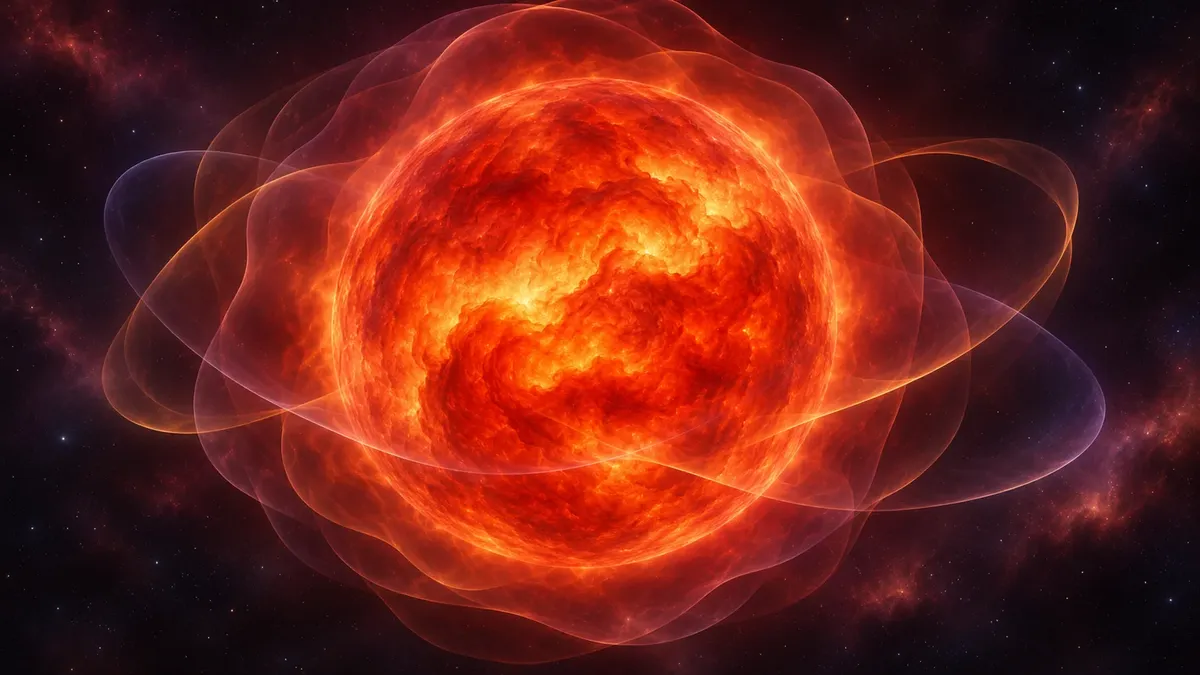
Mira stars are aging giants that expand and contract. Some also show a much slower rhythm, called a long secondary period, whose origin is unsettled. Simulations suggest this rhythm could emerge from nonlinear changes in two ordinary radial pulsation modes—but the calculations cover only a narrow set of stellar models.
Mira variables are aging, luminous stars whose outer layers pulse in and out. Some show a second, much slower cycle: a long secondary period, or LSP. This extra rhythm has been difficult to explain because it lasts far longer than the ordinary pulsations expected from sound waves traveling through a star. Proposed explanations have included non-radial oscillations, orbiting companions and large convection cells. Yu. A. Fadeyev’s study asks whether the LSP might instead arise from nonlinear behavior in two radial pulsation modes within the star.
Fadeyev used computer models of stellar evolution and nonlinear pulsation. The models began with a star whose initial mass was 1.6 times the Sun’s, with specified helium and metal abundances. The paper describes the metal abundance as corresponding to the mean abundance in the Large Magellanic Cloud. Models from the evolutionary sequence after the star’s fourth helium-shell thermal pulse supplied starting conditions for hydrodynamic calculations. These calculations modeled pulsations using radiation hydrodynamics and time-dependent convection.
The study examined about a dozen models at nearby evolutionary stages. To identify their rhythms, Fadeyev analyzed the simulated hydrodynamic solutions with a discrete Fourier transform, a mathematical method that separates a complicated signal into component frequencies. Some calculations showed regular pulsations; others developed long secondary variations.
In the models with an LSP, the fundamental radial mode and first overtone had periods close to, but not exactly, a two-to-one ratio. The fundamental mode is the star’s main radial pulsation; the first overtone is a higher-frequency radial mode. The paper links the slight mismatch to frequency splitting: equally spaced satellite frequency components appear around the main frequencies of both modes. Their superposition produces beats—changes in the combined signal’s amplitude over time—that the study identifies with the LSP. A familiar analogy is the waxing and waning heard when musical tones have slightly different pitches.
The paper reports that the frequencies of these split modes do not change across the modeled stellar envelope. From this, it infers that the components are standing waves, with a free outer boundary. This is an interpretation of the simulation results, not a direct observation of waves inside real Mira stars. In models showing the effect, the LSP cycle was nearly 20 times the fundamental-mode period.
The long variations developed during limit-cycle pulsations, after the pulsation amplitude reached its limiting value. The paper describes both the saturation of pulsation growth and the emergence of the secondary variations as nonlinear effects; the latter develop over several hundred fundamental-mode periods. The author argues that this proposed mechanism does not require abandoning spherical symmetry. That conclusion concerns the modeled explanation—it does not establish that other proposals, such as companions or convection, are ruled out for observed stars.
The scope is narrow: the calculations use one initial mass and composition and a small group of models near a particular evolutionary phase. They show that an LSP can arise under those modeled conditions, but do not establish how often real Mira stars reach them or whether this mechanism accounts for the full range of observed LSPs. The paper says substantially more extensive stellar-evolution and pulsation calculations are needed. It also notes that there is no general method for predicting the stellar ages and masses at which the required frequency splitting will occur.
The source is an arXiv manuscript whose text reports that it was accepted on October 25, 2026; the supplied material does not independently establish its publication status. The findings are based on simulations, not observations identifying this mechanism in individual stars. The study therefore offers a specific model to test further, while leaving open how broadly it applies to real Mira variables.
- Mira variables
- long secondary periods
- stellar pulsation
- asymptotic giant branch
- stellar evolution
- nonlinear models
Related reading
Automatically matched by shared topic keywords. These links do not imply that the sources agree or establish a consensus.
A Timing Pattern in the Slow Dimming of Red Giants
Source published
Shared keywords: long secondary periods, stellar pulsation
Dying stars’ pulses may explain unexpectedly wide white dwarf binaries
Source published
Shared keywords: asymptotic giant branch, stellar evolution
A White Dwarf Companion Offers Clues to a Lithium-Rich Star
Source published
Shared keywords: stellar evolution
RR Lyrae stars: building a better distance ruler
Source published
Shared keywords: stellar pulsation
Correcting economic models when the measurements are wrong
Source published
Shared keywords: nonlinear models