TRANSMISSION // 2611.32109v1
How Jupiter’s Changing Interior Could Affect Europa’s Heating
Source published
Simulations explore whether shifting resonances in Jupiter could alter the moons’ orbits and produce changes in Europa’s modeled tidal heating. The mechanism remains hypothetical.
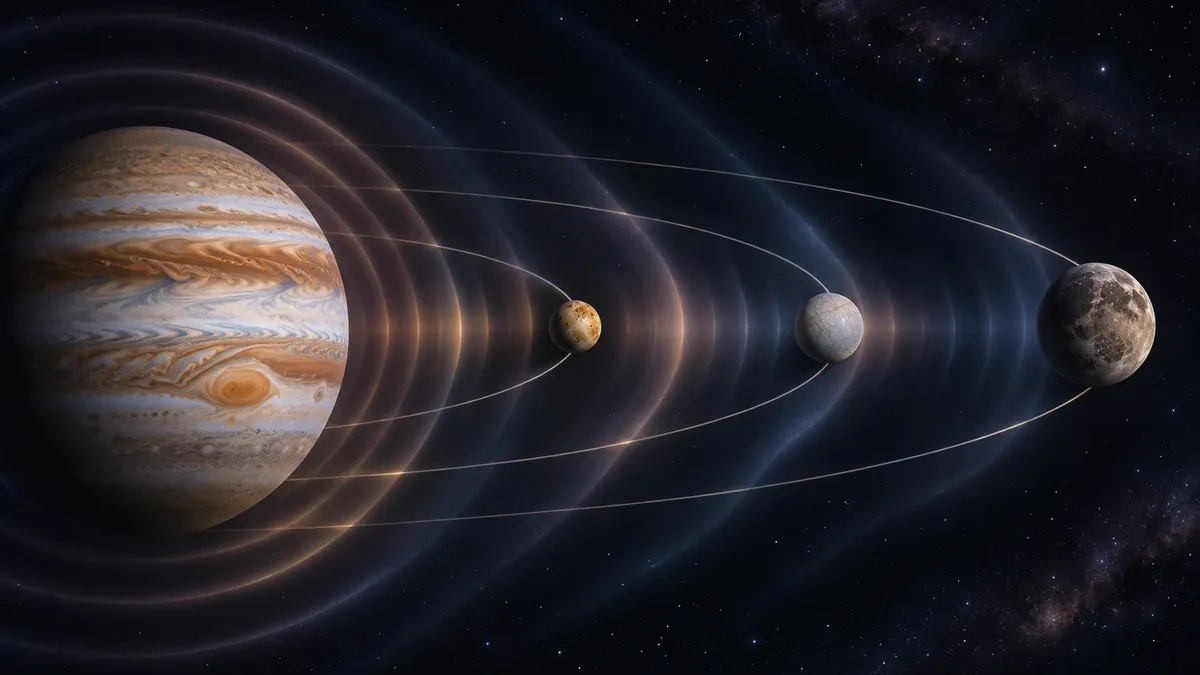
Could changes deep inside Jupiter affect Europa’s tidal heating? A modeling study explores how Jupiter’s evolving oscillations might alter the orbits of Io, Europa and Ganymede. Its results describe a possible mechanism, not evidence that it is occurring in the present-day system.
Europa’s orbital eccentricity is sustained in part by its gravitational relationship with Io and Ganymede, known as the Laplace resonance. Because the study’s estimate of Europa’s tidal heating depends on its eccentricity, changes to the moons’ orbital arrangement could change the calculated heat output.
Jasmine Sun, Benjamin Idini and Ruth Murray-Clay investigate whether Jupiter’s changing interior could contribute to such orbital changes. The planet’s response to the moons’ gravitational pull depends on the pull’s frequency. If that frequency approaches one of Jupiter’s internal oscillation frequencies, the tidal response can become stronger. The researchers model how evolving oscillation frequencies could make these resonances sweep through the satellite system.
Simulating the moons and Jupiter’s tides
The team used the REBOUNDx N-body framework to simulate Io, Europa and Ganymede. The simulations included their gravitational interactions alongside prescribed tidal effects; they were not a full, self-consistent model of Jupiter’s and the moons’ physical evolution.
For the frequency-dependent tidal cases, the researchers calculated migration profiles from three representative models of Jupiter’s interior, called Compact, Smooth and Sharp. They then represented Jupiter’s evolving oscillations by imposing an exponential drift in their frequencies, using assumed evolutionary timescales of 40–50 billion years. These are illustrative model assumptions, not measured rates for Jupiter. Rather than recalculating the oscillations throughout each simulation, the team used precomputed tidal profiles and mapped the evolving forcing onto those profiles. The models also prescribe fixed eccentricity-damping timescales for the moons.
To make the long-term evolution computationally manageable, the researchers accelerated the modeled dissipative processes. They tested selected encounters with finer tidal updates and weaker acceleration; encounters whose classification remained sensitive to numerical choices were excluded from their transition categories. These checks address some numerical concerns, but do not remove the physical uncertainties built into the model.
Outcomes depend on which moon encounters a resonance
In the simulations, encounters with a Jovian tidal resonance could change a moon’s migration, excite orbital eccentricity, shift the Laplace angle’s libration state, or disrupt the resonant chain. The outcome depended on which satellite encountered or became locked to a resonance, as well as the system’s prior configuration.
In the cases studied, locks involving Io or Europa could sustain outward migration of the resonant chain. Ganymede locks broke the chain in the simulations considered. These are findings about the tested setups, not universal predictions for every possible encounter. A later encounter could also displace one moon from a lock and change which satellite’s migration influenced the system.
One representative modeled case showed Io crossing Jovian resonances while Europa remained locked to a mode. Europa’s eccentricity increased temporarily, and the Laplace resonance survived. This demonstrates a possible way for Europa’s modeled heating to vary without breaking the broader orbital arrangement—but it does not establish that such an episode occurs in the actual system.
Under the adopted eccentricity-damping prescription, representative simulations produced estimated Europa tidal power generally of order 10¹¹–10¹² watts, with transient episodes approaching 10¹³ watts. These are calculated values, not measurements of Europa’s heat output. The estimates depend on the assumed damping, and the study does not provide a general duration for the transient episodes. Europa’s response would also depend on how long heating lasts and on the interior’s heat transport and material properties.
What the simulations cannot establish
The proposed mechanism does not require heat-driven changes inside Europa to initiate each episode: in the model, changes to Jupiter’s tidal torques can alter the moons’ orbits and Europa’s eccentricity. But the study does not connect particular surface features to specific modeled heating episodes. Doing so would require models coupling orbital evolution to Europa’s thermal and mechanical response.
The authors identify further limitations. Their treatment of Jupiter’s rotation and oscillation modes is approximate and omits parts of the mode spectrum and interactions between modes. The tidal response follows the forcing frequency without explicitly tracking how quickly individual oscillations build or fade. The simulations also omit thermal feedback within the moons. Given these limitations, the authors say their calculations cannot rule out particular models of Jupiter’s interior using the survival of the Laplace resonance.
The work is an arXiv preprint, a draft that has not necessarily been peer reviewed. It offers a model-based mechanism to investigate, not a reconstruction of Europa’s actual heating history. More complete models are needed to determine whether the proposed orbital changes could occur under realistic conditions and how Europa might respond.
- Europa
- Jupiter
- tidal heating
- Laplace resonance
- Galilean moons
- orbital dynamics
Related reading
Automatically matched by shared topic keywords. These links do not imply that the sources agree or establish a consensus.
A Tiny Visitor’s Uncertain Surface and Earthly Detour
Source published
Shared keywords: orbital dynamics
How DART Ejecta May Spread Across Dimorphos
Source published
Shared keywords: orbital dynamics
A relativistic balance law for binaries in matter
Source published
Shared keywords: orbital dynamics
When a gravitational wave meets a binary’s rhythm
Source published
Shared keywords: orbital dynamics