TRANSMISSION // 2611.32108v1
A small change helps robot arms coordinate
Source published
Duo gives each robot arm its own action tokens while letting both arms share information. Tests report gains in simulation and on three real-robot tasks, with important limits.
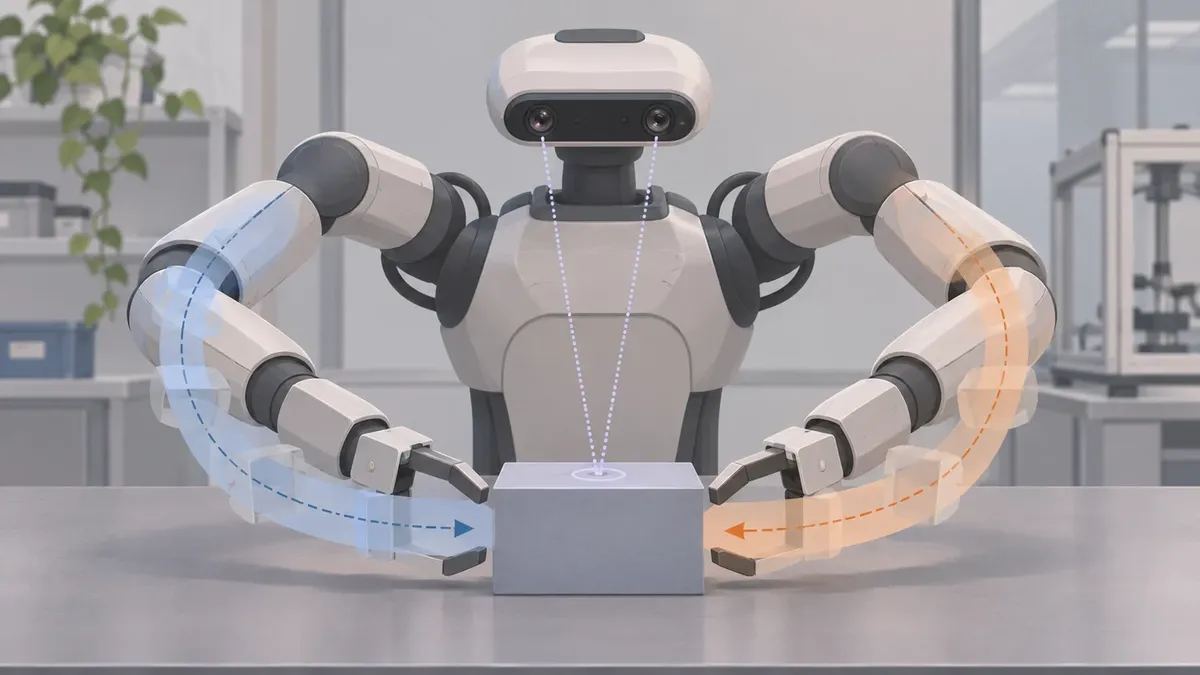
When two robot arms handle an object together, each needs to anticipate what the other will do. A design called Duo changes how a robot policy represents those actions, giving each arm a distinct stream while allowing the streams to interact. The authors report improved results across several tests, but the work is a preprint and the evidence does not establish how broadly the gains will transfer.
Why represent two arms separately?
A robot folding a box or handing over a parcel must coordinate both the positions and timing of its arms. One arm’s next move can depend on where the other arm is—and whether it has finished its part of the task.
Many flow-based robot policies represent both arms’ actions together as one token for each future moment. That gives the model positions across time, but not separate token positions for the left and right arms. Other designs give each arm its own branch, which can add complexity and may make it harder for the arms to exchange information.
The authors of Duo: Towards Spatiotemporal Action Coordination in Bimanual Policies ask whether one shared action head can preserve arm-specific information while letting the arms coordinate directly.
How Duo works—and how it was tested
Duo represents each arm with its own state and action tokens. Tokens from both arms are processed together by one shared action head, where self-attention lets each arm’s predicted actions take account of the other arm’s actions. The policy uses flow matching: starting from noisy action sequences, it repeatedly updates them toward a coordinated pair of action plans.
The researchers added Duo to four existing vision-language-action or world-action policies and evaluated them on RoboTwin 2.0, a simulation benchmark with 50 bimanual tasks. Its “Random” setting varies features such as clutter, backgrounds, lighting and table height. They also tested FLOWER-Duo on RoboDojo, a separate simulated benchmark, and compared it with the π₀.₅ policy on a dual-arm robot performing soft-parcel handling, rigid-parcel handling and box packing.
The authors ran several kinds of ablation comparisons. These included combined-action, separate-action and Duo designs, tests that blocked cross-arm attention, and comparisons of how action dimensions were grouped into tokens. These comparisons help assess design choices, though they are not all simple one-feature-at-a-time tests.
What the study reports
On RoboTwin 2.0, Duo improved the overall success rate of all four adapted policies. FLOWER-Duo had the largest reported increase over its base policy: 12.55 percentage points, reaching 62.70%. The π₀.₅-Duo version reached the highest overall success among the tested Duo policies, at 67.37%. Among these four adapted policies, gains in the randomized setting were concentrated in FLOWER and π₀.₅; SmolVLA and Lila-WAM had very low success there.
On RoboDojo, the benchmark remained difficult: none of the evaluated policies exceeded 7% overall success. FLOWER-Duo ranked second in overall score and success rate, behind π₀.₅, and its reported precision success rate rose from 8.83% for FLOWER to 12.88% with Duo. Improvement over a base policy does not necessarily mean strong performance in absolute terms.
In the three real-robot tasks, FLOWER-Duo recorded success rates of 90.0% for soft parcels, 83.8% for rigid parcels and 40.0% for box packing. The paper reports higher success than π₀.₅ in each task, and shorter average completion times among successful trials. Box packing remained challenging for both policies.
For rigid-parcel handling, the authors report a data-scaling comparison: FLOWER-Duo matched π₀.₅ at eight hours of demonstrations and surpassed it at 16 and 32 hours. The extracted paper text does not provide readable exact success rates for those points, so this comparison should not be taken as a numerical estimate of the size of the trend.
In an ablation on RoboTwin 2.0, blocking cross-arm attention at test time reduced FLOWER-Duo’s overall success by 8.10 percentage points. The token-grouping comparisons found that per-dimension tokens improved overall success by 0.78 points over Duo, but required 6.12 times the action-head computation. A four-token within-arm grouping required 1.80 times the computation. The results suggest that arm-wise tokens offer a useful accuracy-compute balance in these tests.
What remains uncertain
The study is marked “Preprint. Under review.” Its findings have not yet been established through peer review, and results from particular benchmarks and robot setups may not generalize to other tasks, hardware or training conditions. The paper says Duo has not been tested on larger-scale policies because of compute limits. Separating each timestep into arm-wise tokens doubles the action-token sequence length compared with a joint-token design, increasing inference attention computation. The authors also identify tighter integration between visual and action tokens as future work.
Duo is a targeted change to how bimanual policies organize actions, not a complete solution to robot coordination. Its results are promising within the tested settings, while benchmark difficulty, uneven gains and stated limitations argue for caution about broader claims.
- robotics
- bimanual manipulation
- robot learning
- flow matching
- vision-language-action models
Related reading
Automatically matched by shared topic keywords. These links do not imply that the sources agree or establish a consensus.
Can a general AI model control a robot arm?
Source published
Shared keywords: robot learning, vision language action models
A shared action vocabulary for robots—and humans
Source published
Shared keywords: robot learning, vision language action models
One learned policy, plus an agent on selected robot tasks
Source published
Shared keywords: robot learning, vision language action models
A smarter starting point for robot actions
Source published
Shared keywords: flow matching, robot learning, vision language action models
Robots may learn more from human corrections when they do not copy them exactly
Source published
Shared keywords: robot learning, vision language action models