TRANSMISSION // 2611.32107v1
How Water Rain May Shape Uranus and Neptune’s Cooling
Source published
Models suggest hydrogen–water separation could help explain Uranus’s faintness, but would leave Neptune too dim without another energy source. Methane changes the details, not that central puzzle.
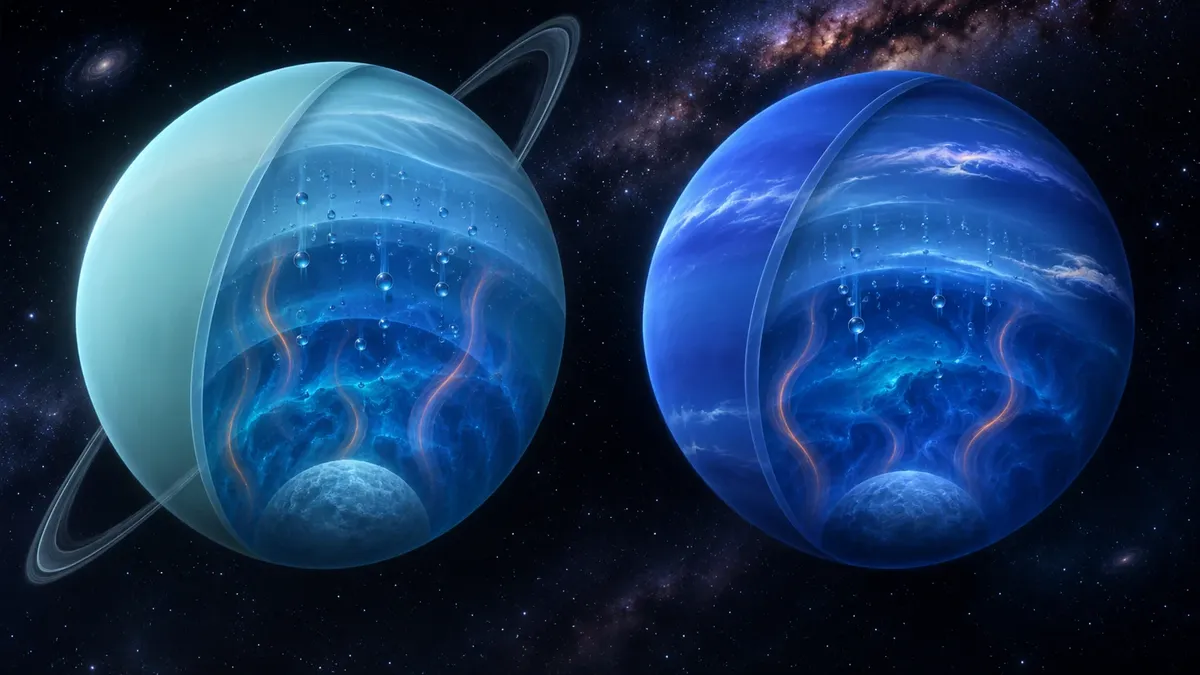
Uranus and Neptune are similar in size and composition, yet their internal heat escaping into space differs markedly. A new set of models tests whether water separating from hydrogen inside the planets—and methane in Neptune—could account for their different brightnesses. The results offer a possible route for Uranus, but leave Neptune’s energy budget unresolved.
Uranus and Neptune are both ice giants, but they do not shine with the same amount of heat from their interiors. Uranus is unusually faint, while Neptune gives off substantially more internal heat. Why two broadly similar planets have followed different cooling histories is a long-running puzzle—and the answer depends partly on what happens to water deep inside them.
A study by Marina Cano Amoros, Nicola Tosi and Nadine Nettelmann explores whether hydrogen and water can separate inside these planets. In this process, called phase separation or demixing, water-rich droplets may sink through hydrogen-rich material. The researchers also test how methane and updated descriptions of water’s properties affect the planets’ modeled evolution.
Following model planets through time
The team used equations of state—descriptions of how materials behave under different pressures and temperatures—for hydrogen, helium, water and, in some Neptune models, methane. They combined these with a hydrogen–water phase diagram, which indicates when the two substances are expected to mix or separate.
With a planetary-interior modeling code, they built simplified, three-layer models of each planet. The models were adjusted to match measured properties, including the planets’ sizes and gravitational fields. The researchers then calculated cooling histories under different assumptions: with or without hydrogen–water separation, and, for Neptune, with or without methane and the heat associated with a water phase transition. These are simulations, not direct measurements of the planets’ interiors.
One important result appears in the models without separation. Using a revised water equation of state, an adiabatically cooling Neptune—a model in which heat is transported efficiently through its envelopes—can reach its observed brightness on a timescale consistent with the Solar System’s age. Under the same broad assumptions, Uranus would need a Bond albedo of 0.43 to match its observed faintness. Bond albedo is the fraction of incoming sunlight a planet reflects; the value required by this model is higher than the estimates discussed in the paper.
Separation may help explain Uranus
When hydrogen and water separate in the simulations, water rains deeper into the planet. The modeled planets expand, while their luminosity falls. In these calculations, the energy changes associated with sinking material go into expansion rather than making the planets brighter.
For Uranus, some separation scenarios bring the modeled brightness down to the observed level. The planet’s modeled cooling can approach equilibrium with incoming sunlight, offering a possible explanation for why it is so faint. But this outcome depends on the model’s proposed later evolution near equilibrium, which the authors say they did not simulate explicitly. They also caution that it is not clear whether Uranus can reach and remain in that state.
For Neptune, separation creates a different problem: the modeled planet becomes too faint. Adding methane reduces or prevents the expansion in some model tracks, but does not remove the faintness problem. The authors’ favored methane scenarios include an initial carbon-to-oxygen ratio of about one, motivated by the assumption that carbon and oxygen were initially accreted as carbon monoxide ice. Those scenarios reach the modeled present-day structure in less than four billion years, but they still do not, on their own, explain Neptune’s observed brightness.
The paper therefore does not settle the contrast between the planets. If Neptune has undergone hydrogen–water separation, it needs another energy source in these models. The authors discuss possibilities such as heat retained or released through layers inside the planet, and separation involving other materials, but do not establish which, if any, supplies the missing energy. Alternatively, they say Neptune’s structure could be primordial and its outer envelope relatively poor in ice.
What remains uncertain
These conclusions rely on assumptions about deep planetary composition, the phase diagram, and material properties at pressures that are difficult to reproduce in the laboratory. The authors identify better experimental constraints on hydrogen–water separation as an important next step. They also note limitations in their modeling setup, including small mismatches between the codes used to calculate planetary structure and gravity. In their assessment, these affect some modeled quantities and cooling times, so exact outcomes should not be treated as definitive.
The methane equation of state is another source of uncertainty: parts of it rely on extrapolation, and the paper flags regions where the thermodynamic behavior may be imperfect or artificial. In addition, the study uses simplified layered interiors; real planets may have more complicated composition and heat-flow patterns.
The work is a research manuscript supplied as a preprint, rather than evidence that these interior processes have been observed directly. Its results show what follows from a particular set of physical inputs and model choices. The central suggestion is therefore conditional: hydrogen–water separation could help account for Uranus’s faintness, but the same process seems to deepen Neptune’s brightness puzzle unless another source of heat, or a different interior structure, is involved.
- Uranus
- Neptune
- ice giants
- planetary interiors
- hydrogen-water phase separation
- methane
- thermal evolution
Related reading
Automatically matched by shared topic keywords. These links do not imply that the sources agree or establish a consensus.