TRANSMISSION // 2611.32094v1
Why hospital AI still struggles to think in 3D
Source published
A simulated hospital benchmark finds that multimodal AI often misses patient-relative directions and route constraints. Training and explicit 3D tools improve scores, but performance in real hospitals remains untested.
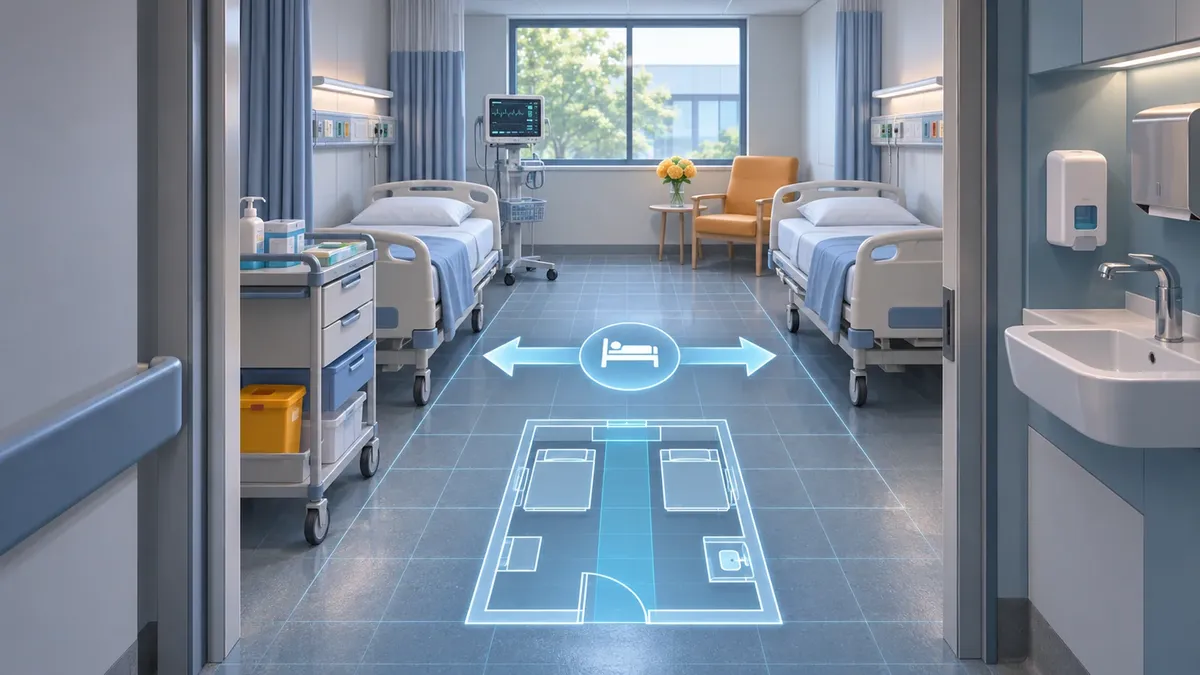
A hospital walkthrough can demand more than recognizing objects: an assistant must remember which bed a device belongs to, interpret left and right from a patient’s perspective, and judge whether equipment can pass through a gap. Clinical3D-Bench tests these abilities in simulated rooms—and finds that models often need more than visual exposure to reason reliably about space.
A spatial test built for hospital rooms
Can a multimodal AI system make sense of a hospital room as a three-dimensional place? That is the question behind Clinical3D-Bench, introduced by Yang Bai and colleagues. It targets tasks that ordinary image questions may not capture: tracking similar-looking equipment, using a patient’s frame of reference, and working out whether a bed or cart can reach a destination.
The team built simulated hospital rooms rather than collecting video in operating wards, where privacy and precise measurements can be difficult to manage. The benchmark contains 3,368 multiple-choice questions across eight types, drawn from 373 room layouts spanning 16 room families. Scenes follow rules based on hospital design standards, and answers—including routes and passage widths—are calculated from the underlying 3D scenes.
A simulated camera takes a short, first-person walkthrough of each scene. Video-generation tools then give the clips a more photographic appearance. The researchers checked whether the generated footage followed the original camera path. Ten physicians reviewed the layouts for plausibility, realism and clinical usability; their ratings helped exclude some scenes. The team also created a separate training set, Clinical3D-45K, containing 44,750 questions from different layouts.
Paired scene states offer a way to test whether a model responds to evidence. Versions of a layout differ in a relevant detail, such as which bed’s light is on. Researchers can then check whether the model changes its answer, instead of repeating a preferred response.
Strong scores still leave specific gaps
The researchers evaluated 35 multimodal large language models (MLLMs). The best model tested without task-specific fine-tuning scored 53.6% on macro accuracy, an average across the benchmark’s eight question types. The best open model scored 45.7%. An answer-prior baseline—choosing common answers based on the test labels—scored 40.8%. Five physicians answering a 400-question subset scored 79.0%.
Patient-relative directions stood out as a challenge. In the two-choice task, 27 of 32 open models scored below 40%, compared with 50% expected from chance. A camera viewing a bed from its foot sees left and right differently from a patient lying on it. Fine-tuning helped: VideoJev-4B rose from 45.5% overall accuracy to 73.9%, while its patient-frame score increased from 17.0% to 93.7%. Yet route planning and passability remained that model’s weakest categories, at 58.3% and 66.0% after fine-tuning.
The team also tested ways of supplying 3D maps to a fine-tuned model. In the tested approaches, map inputs generally made little difference. Replacing a clip’s map with another clip’s—including a ground-truth map in one setup—barely changed accuracy. This suggests that simply providing a 3D representation did not ensure the model used the scene-specific information.
GeoJeV, the authors’ proposed system, tries to make that information actionable. It reconstructs a scene memory from the video, then uses the model’s question representation to select 3D operations, such as tracking objects or checking available floor space. The results contribute evidence to the scores for possible answers. GeoJeV reached 75.7% macro accuracy, compared with 73.9% for the fine-tuned model alone. When given another layout’s scene memory, its score fell to 70.4%, consistent with its use of scene-specific evidence.
What the results do—and do not—show
These are benchmark results, not evidence that the system is ready to assist in patient care. All rooms are synthetic, static and unoccupied. The photorealistic video process is intended to change appearance, not content, but the camera-path check does not verify that every object survives the transfer unchanged. Training and test layouts are separate, yet share generators, assets and question templates. The results therefore do not establish performance in unfamiliar hospitals or on live footage.
The physician comparison covers only a subset, and the benchmark tests selected spatial tasks rather than the full range of clinical judgment. GeoJeV also relies on estimated geometry and arguments learned from templated questions. The paper is an arXiv preprint; the supplied source does not establish its peer-review status. Its findings should be understood in the context of the simulated benchmark and methods described, while transfer to real, changing hospital environments remains an open question.
- multimodal AI
- spatial reasoning
- hospital simulation
- Clinical3D-Bench
- 3D vision
- healthcare AI
Reviewed cross-references
These connections were reviewed by a model, not independently fact-checked by a human. Similarity does not imply agreement; consult the original papers and the evidence below.
Giving Wearable AI a Measurable 3D View
Supporting evidence: Both studies report gains from making spatial evidence computationally usable rather than relying only on visual inputs: Clinical3D-Bench’s GeoJeV adds evidence from selected 3D operations to answer scores, while R3D lets an LLM query a reconstructed scene with spatial tools. The results support this bounded approach across their respective evaluations, not a direct performance comparison: one tests simulated hospital walkthroughs and the other egocentric RGB-D household activities.
Model review: · openai-codex/gpt-6-luna
Evidence and provenance
Selected excerpts, not complete papers. PDF extraction can omit figures or damage equations, tables and reading order; sources may be preprints.
2611.32094v1 — Original paper
Excerpt reference:
static/papers/2611.32094v1.md:168-285
Basis: Paper text
Source SHA-256:c0de4d9f9f1fb2d709ba89252c6a0e0b4341045a83696a5ca592fc7441955f452607.02921v2 — Original paper
Excerpt reference:
static/papers/2607.02921v2.md:98-130
Basis: Paper text
Source SHA-256:1971691aa88800c18b2ecfe39332d46069629d469fe3ceb9067a9cd8f1135b8a
WorldMind tests spatial reasoning without turning every imagined view into an image
Supporting evidence: Clinical3D-Bench reports an improvement when GeoJeV adds scene-specific 3D evidence to answer scores; WorldMind reports gains when a VLM reasons over latent evidence from simulated viewpoint transformations. These findings are compatible with the limited proposition that supplying task-relevant spatial evidence can help reasoning, but the methods and tasks differ: GeoJeV uses scene primitives in hospital videos, whereas WorldMind targets transformed viewpoints on other benchmarks.
Model review: · openai-codex/gpt-6-luna
Evidence and provenance
Selected excerpts, not complete papers. PDF extraction can omit figures or damage equations, tables and reading order; sources may be preprints.
2611.32094v1 — Original paper
Excerpt reference:
static/papers/2611.32094v1.md:168-285
Basis: Paper text
Source SHA-256:c0de4d9f9f1fb2d709ba89252c6a0e0b4341045a83696a5ca592fc7441955f452611.10151v1 — Original paper
Excerpt reference:
static/papers/2611.10151v1.md:946-1023
Basis: Paper text
Source SHA-256:ec68e3e4d614bf5145dff43ee4393ebed691a9619d53a46141031431b199d203
Related reading
Automatically matched by shared topic keywords. These links do not imply that the sources agree or establish a consensus.
Why visual features help AI reason about camera movement
Source published
Shared keywords: multimodal ai, spatial reasoning
AI can read an image yet struggle to reason about it
Source published
Shared keywords: multimodal ai
Urbex turns city-scale 3D object finding into a search
Source published
Shared keywords: 3d vision
When Clinician Edits Help—and When They Could Teach AI to Make Things Up
Source published
Shared keywords: healthcare ai
AI Decision Models Show Promise for Early Emergency Assessment
Source published
Shared keywords: healthcare ai