TRANSMISSION // 2611.32076v1
A magnetic-field puzzle in the Sun’s quiet photosphere
Source published
Hinode measurements in two iron lines differ in a way that simple models partly reproduce when magnetic fields turn from vertical to horizontal over a short distance. The proposed structure remains uncertain.
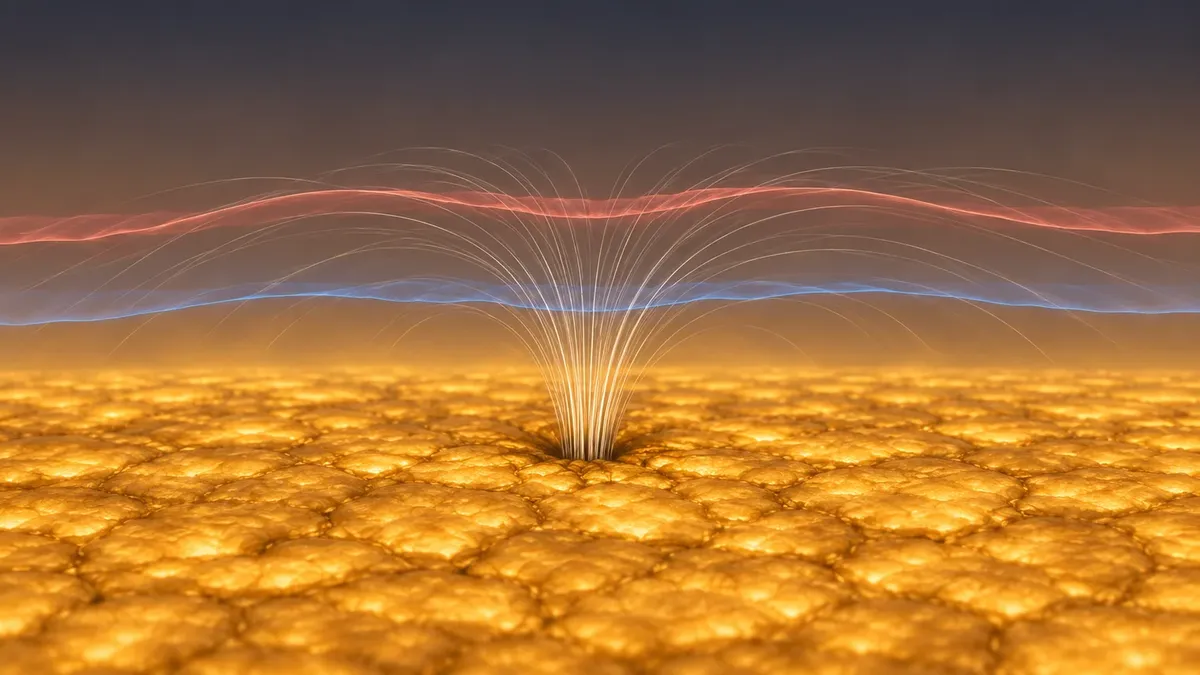
Two nearby iron spectral lines give different estimates of the quiet Sun’s magnetic field. A study of Hinode observations explores whether the mismatch could reveal magnetic fields changing direction with height—but its explanation depends on simplified models.
The Sun’s apparently calm surface is threaded by magnetic fields that are difficult to measure directly. One clue comes from sunlight split and polarized by magnetism: the iron lines near 6301 and 6302 ångströms produce signals that can be used to estimate the field component pointing toward or away from us. Yet in quiet-Sun observations, the two lines do not give the same answer. Why?
Sergey G. Mozharovsky’s study examines whether the discrepancy reflects not only measurement errors but also differences in the parts of the atmosphere to which each line responds. The proposed interpretation is that some magnetic fields change direction rapidly with height, becoming less aligned with the observer in higher layers.
Comparing two ways of reading the signal
The analysis uses spectropolarimetric observations from the Hinode spacecraft. The main quiet-Sun example is a map recorded on 10 March 2007; a separate observation of a sunspot’s penumbra provides a comparison. Hinode measured the light’s intensity and polarization across the two iron lines.
The paper compares field estimates from two approaches. One is the center-of-gravity (COG) method, which measures the separation between the centers of polarized spectral profiles. The other is a Milne–Eddington inversion, a model-based way to infer atmospheric and magnetic properties. The central puzzle is specifically the ratio of COG estimates for the 6301 and 6302 lines.
To test possible explanations, the author calculates synthetic spectral profiles using one-dimensional models of the solar atmosphere. By changing the magnetic field in a thin layer at different heights, the calculations estimate where each line’s COG measurement responds to magnetic changes. Further simulations impose a field that turns from pointing along the line of sight in deeper layers to nearly perpendicular to it higher up.
A mismatch that models can partly reproduce
In the quiet-Sun data, the 6301-line estimate is, on average, about 1.3 times the 6302-line estimate for the weaker measured fields discussed in the paper. The difference is much smaller in the penumbral comparison. The author’s one-dimensional calculations also find that the two lines respond at slightly different effective heights: in these models, the 6301 response is deeper, despite the usual expectation that a stronger line probes higher layers.
That height difference is small, so it cannot by itself account for the observed ratio. In the simulations, a rapid change in field direction can raise the ratio, but the model reaches values up to about 1.2 under selected conditions—not the average 1.3 reported for the quiet-Sun observations. The paper therefore presents the turning-field scenario as a partial explanation, not a complete match. It suggests that a turn over a distance of tens of kilometres could contribute to the discrepancy.
The proposed picture resembles a small magnetic structure with a stronger, more vertical central region and weaker or more horizontal surroundings. The paper suggests that such configurations may be common in the quiet photosphere, but the observations and calculations described here do not establish that all, or most, quiet-Sun magnetic fields have this shape.
What remains uncertain
The simulations use a one-dimensional atmosphere and assume a simplified field structure. They do not include line-of-sight velocity gradients, which the paper notes could alter effective response heights. Real observations also mix signals from magnetic and non-magnetic areas within the instrument’s resolution. The study discusses this unresolved mixture as another possible source of the line-to-line difference. Its illustrative calculations do not settle the relative importance of these effects.
The result is best read as a proposed interpretation of an observational puzzle, supported by simplified modelling—not as a direct image of magnetic fields turning over a measured distance. The source paper reports publication in Geomagnetism and Aeronomy in 2025; the available text does not establish independent confirmation of this particular explanation. Further tests with more realistic atmospheric models or other observations would be needed to determine whether the inferred geometry is present and how much it contributes to the discrepancy.
- Sun
- quiet photosphere
- solar magnetic fields
- Hinode
- spectropolarimetry
- iron spectral lines
- magnetic field measurements
Reviewed cross-references
These connections were reviewed by a model, not independently fact-checked by a human. Similarity does not imply agreement; consult the original papers and the evidence below.
A solar magnetic-field shortcut has stricter limits than it seems
Supporting evidence: Both studies show that height-dependent magnetic structure matters when interpreting spectropolarimetric field estimates: Mozharovsky proposes that a sharp change in field inclination could partly explain the quiet-Sun Fe I line ratio, while Arroyo Caballero et al. find that the Weak Field Approximation’s inferred field depends on atmospheric structure and note height variations in weak-field regions. The latter does not test the Fe I COG ratio or verify the proposed geometry, so this is a limited connection, not direct confirmation.
Model review: · openai-codex/gpt-6-luna
Evidence and provenance
Selected excerpts, not complete papers. PDF extraction can omit figures or damage equations, tables and reading order; sources may be preprints.
2611.32076v1 — Original paper
Excerpt reference:
static/papers/2611.32076v1.md:661-725
Basis: Paper text
Source SHA-256:11f2d6811a5ff54cf9de31d40cf0febcfe177a22c9d8858284ae5cbef83fae8b2611.12138v1 — Original paper
Excerpt reference:
static/papers/2611.12138v1.md:121-194
Basis: Paper text
Source SHA-256:9631cb29c7af43dcde410de6626ac2f397521a6e167034f2759abee944734fcd
Related reading
Automatically matched by shared topic keywords. These links do not imply that the sources agree or establish a consensus.
Neural emulators speed up detailed maps of the Sun
Source published
Shared keywords: solar magnetic fields
A solar magnetic-field shortcut has stricter limits than it seems
Source published
Shared keywords: solar magnetic fields
What polarized hydrogen light can reveal about the Sun’s magnetic atmosphere
Source published
Shared keywords: solar magnetic fields
How a different view changes the Sun’s magnetic map
Source published
Shared keywords: solar magnetic fields