TRANSMISSION // 2611.32053v1
Teaching a robot model to predict what its actions will change
Source published
EffectWAM predicts visual changes alongside robot commands. Tests across five manipulation benchmarks report strong but uneven results, and further evaluation is needed.
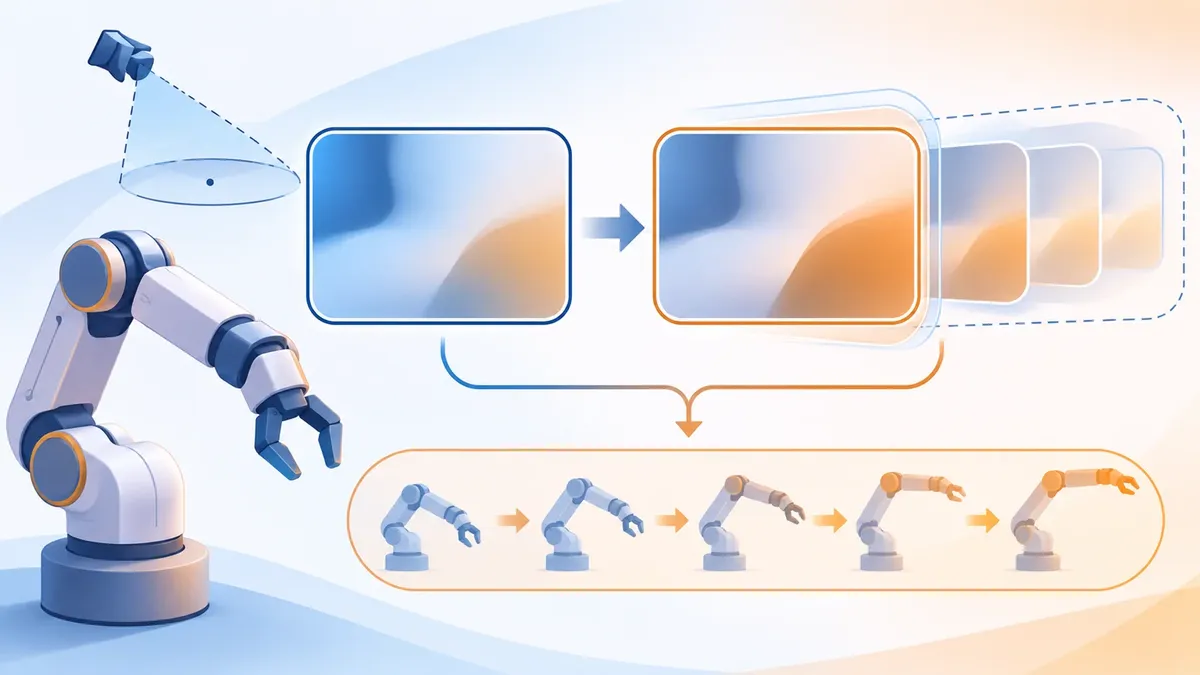
A robot policy can predict what to do without generating a future video at every decision. EffectWAM instead predicts a compact representation of visual change alongside executable actions, with video forecasting available on request. Its authors report encouraging benchmark results, alongside weaknesses in randomized and unfamiliar tasks.
A robot’s commands change both its own pose and the scene around it. EffectWAM, a world–action model described in an arXiv paper, is designed to predict a compact representation of those visual changes alongside executable robot actions. Optional video forecasting stays separate from the control path, although jointly sampling a change prediction and actions still requires computation.
A compact account of change
EffectWAM’s central representation, called Effect, compares encoded future observations with an encoded current observation. The resulting feature differences summarize how the scene changes at different future intervals, relative to the state from which the robot acts.
A component called Action Grounding trains the visual representation to retain measured changes in end-effector pose and gripper state. This provides a training signal tied to physical motion. It complements other objectives in the paper, including future-video prediction and representation losses; it does not replace learning from future observations.
The third component, camera positional encoding (CaPE), supplies relative camera-pose information when reliable camera extrinsics are available. This gives the model information that may help it interpret viewpoint changes. When those measurements are unavailable, it uses pose-free pooling with the same learned parameters.
A shared generation model learns to predict an Effect sequence and an executable action chunk together. If a visual forecast is requested, it can use that same predicted pair to generate future video. The controller can execute the sampled actions without waiting for video synthesis, but the joint Effect–action sampling itself still has computational cost.
What the tests report
The researchers trained on more than 20,000 hours of heterogeneous embodied data. The paper’s inventory totals 25,292.8 recorded hours across 34 sources: unused chain-of-thought datasets are excluded, and repeated processing versions of the same source are counted once. Sources vary: robot demonstrations may include commands and measured poses, human recordings may include tracked hand motion, and some recordings provide video without action or physical-state labels. Training terms requiring unavailable annotations are excluded, while visual-only recordings contribute applicable visual objectives.
The Small configuration is approximately 8.4 billion parameters, based on the reported component counts. It was evaluated on five benchmarks; the approximately 26-billion-parameter Large configuration was also tested on RoboDojo. On standard LIBERO tasks, Small achieved 99.20% overall success. On LIBERO-Plus, which tests variations including camera, robot, language, lighting, background, noise and layout, it achieved 93.10% overall success.
On RoboTwin 2.0, adaptation used Clean demonstrations. Success was 91.82% in Clean testing and 74.22% under scene randomization. On RoboCasa365, the model achieved 49.27% overall success. Compared with InternW0-∆, the reported gains were 0.37 percentage points on Atomic-Seen, 0.42 on Composite-Seen, and 2.08 on Composite-Unseen tasks—unfamiliar combinations of behaviors. The paper also reports additional-success counts that do not align cleanly with these split percentages, so the percentage comparisons are the safer way to summarize the results. Overall, completing these tasks remains challenging.
Performance was not uniformly strong across conditions. The RoboTwin result fell under randomization. In RoboDojo, the authors identify Memory as a stronger area, while Open tasks had low success; Small-model Precision results were also weaker than those of a selected small-scale baseline. The Small-model RoboDojo evaluation used one seed, which does not quantify run-to-run variability.
The authors report that adding Action Grounding improved performance across the baseline policies they tested. This supports its usefulness in those experiments, not a guarantee that it will help every robot, dataset or task. Comparisons across systems can also depend on training data, model size and evaluation setup, so headline percentages should not be treated as a universal ranking.
What remains uncertain
The supplied source is an arXiv paper; the available evidence does not establish its peer-review or publication history. Its results are benchmark evaluations, not evidence that the model is ready for unsupervised use in homes or workplaces. The authors note that Action Grounding depends on available, consistently aligned physical measurements. CaPE’s geometry-aware route requires reliable camera extrinsics, and prediction horizons are configured rather than automatically adapted to task subgoals. They also identify computational cost in joint sampling and continuing difficulty with environmental variation and composite tasks.
The study provides evidence that, on the tested benchmarks, combining a compact prediction of visual change with measured-motion supervision can be useful for robot manipulation. Further evaluation is needed to establish how the approach transfers to new robots, settings and tasks.
- robotics
- robot manipulation
- world-action models
- robot learning
- camera pose
- robot benchmarks
Related reading
Automatically matched by shared topic keywords. These links do not imply that the sources agree or establish a consensus.
Can a Robot Learn a New Task by Watching One Video?
Source published
Shared keywords: robot learning, robot manipulation, world action models
Can a general AI model control a robot arm?
Source published
Shared keywords: robot learning, robot manipulation
Robots Need to Know Not Just What to Do, but When
Source published
Shared keywords: robot benchmarks, robot manipulation
How MAWAM imagines teamwork for robots
Source published
Shared keywords: robot manipulation, world action models
A smarter cache could help robot models act faster
Source published
Shared keywords: robot manipulation, world action models