TRANSMISSION // 2611.32046v1
Could AI Agents Help Cities Prepare Drainage Systems for Storms?
Source published
A preprint reports that two LLM agents used weather warnings and engineering expertise to guide simulated drainage controls, reducing flood and overflow volumes against a rule-based baseline in one catchment.
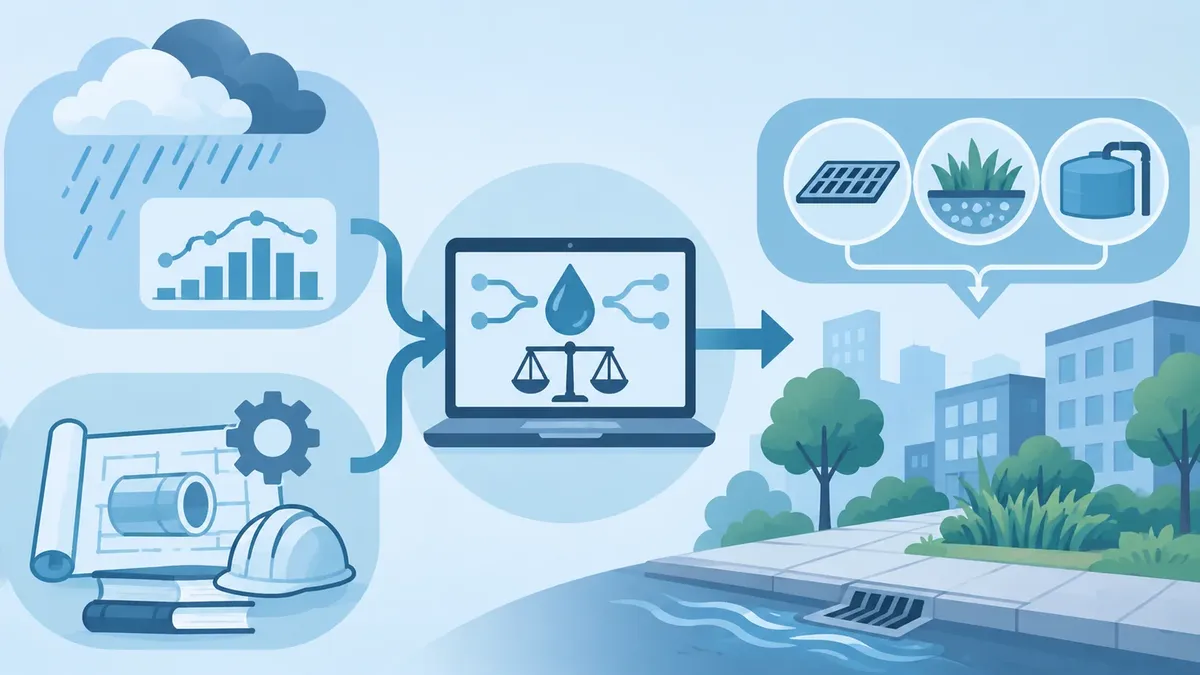
Urban drainage systems must respond to changing rainfall, but in-network sensing can be sparse. A new preprint tests whether large language model agents can bring external meteorological warnings into real-time control. Simulations in one catchment report lower flood and overflow volumes than a rule-based baseline, but do not establish performance in live infrastructure.
Urban drainage systems need to respond to rainfall, yet sparse in-network sensing can make real-time control difficult. The authors of a new preprint ask whether meteorological early warnings—described as heterogeneous and multimodal—can be incorporated into control decisions alongside engineering expertise.
Their proposed framework, AgenticAI-Control, links two large language model (LLM) agents. According to the abstract, the agents retrieve meteorological early warnings and combine them with domain engineering expertise to generate control strategies. The work explores whether externally sourced weather information can be incorporated into the drainage-control workflow.
A simulation comparison
The authors evaluated the framework in simulation for a combined sewer catchment in eastern China, using 10 real-world rainfall events. They compared its results with a rule-based baseline controller. The abstract reports that AgenticAI-Control reduced aggregated flood and overflow volumes by 69.1% to 90.6% relative to that baseline.
These figures describe the reported simulation comparison, not reductions measured during live operation. The available source for this account is the paper’s abstract, which does not provide enough detail to assess the drainage model, how the rainfall events were selected, or how aggregated volumes were calculated. These questions remain unresolved in the material available here; the abstract alone cannot establish what the full paper may address.
The abstract also reports that standardized prompt engineering and modular workflow constraints substantially compressed performance disparities among four distinct LLMs. It does not give model-by-model results in the available material. The finding indicates that the authors considered workflow design relevant to consistency across models, but the abstract alone does not show the size or practical significance of the reported effect.
What the results can tell us
The reported results point to a favorable comparison in one simulated catchment: under the conditions tested, the agent-based framework produced lower aggregated flood and overflow volumes than the rule-based baseline. The abstract does not establish whether similar results would hold in other drainage networks, with different warning sources, or under other operating conditions. Nor does comparison with this baseline establish how the framework would perform against every other control method.
Simulation results are not the same as evidence from operating infrastructure. The abstract does not describe any field deployment, or provide details in the material available here about checking recommendations, handling inaccurate or conflicting warnings, or safeguards for real-world use. These are limits of what can be assessed from the abstract, not claims that the full paper omits those topics.
This is an arXiv version 1 preprint, and the available information does not establish whether it has been peer reviewed. Its reported gains should be understood as simulation results, not proof of reductions achieved in cities during actual storms. The study raises a useful research question: can external weather warnings and engineering knowledge help drainage control where in-network sensing is sparse? Broader evaluation would be needed to determine how dependable the approach is beyond the reported case.
- urban drainage
- large language models
- AI agents
- simulated flood control
- sewer overflow
- weather warnings
- real-time control
Reviewed cross-references
These connections were reviewed by a model, not independently fact-checked by a human. Similarity does not imply agreement; consult the original papers and the evidence below.
ROAM pairs AI travel suggestions with route optimization
Shared method: Both frameworks retrieve external information to ground an agentic workflow: AgenticAI-Control retrieves meteorological warnings and combines them with engineering expertise, while ROAM retrieves preference-relevant places and spatiotemporal context. Their tasks and downstream methods differ—drainage control versus itinerary optimization—so this is a shared retrieval-based design pattern, not evidence of comparable performance.
Model review: · openai-codex/gpt-6-luna
Evidence and provenance
Selected excerpts, not complete papers. PDF extraction can omit figures or damage equations, tables and reading order; sources may be preprints.
2611.32046v1 — Original paper
Excerpt reference:
static/papers/2611.32046v1.md:865-978
Basis: Paper text
Source SHA-256:64e282d117bb4e1405cc4c22aa59880dc37142562092295c046756bded77359b2611.09407v1 — Original paper
Excerpt reference:
static/papers/2611.09407v1.md:13-43
Basis: Paper text
Source SHA-256:6a8fc82084f0ad81c9f0fd439b921d34492589069f26483cc6c54b09b0013178
Related reading
Automatically matched by shared topic keywords. These links do not imply that the sources agree or establish a consensus.
LOLPlay tests whether visual AI agents can keep up with League of Legends
Source published
Shared keywords: real time control
Can AI Build and Improve Business Agents?
Source published
Shared keywords: ai agents, large language models
How AI Agents Schedule Useful Information
Source published
Shared keywords: ai agents, large language models
Why AI Agents Still Stumble on Complex Tasks
Source published
Shared keywords: ai agents, large language models
A publish-subscribe network for coordinating AI agents
Source published
Shared keywords: ai agents, large language models