TRANSMISSION // 2611.32031v1
How Game Agents Handle New Partners and Layouts
Source published
An arXiv preprint tests whether training across varied partners and game environments helps cooperative AI agents handle held-out combinations.
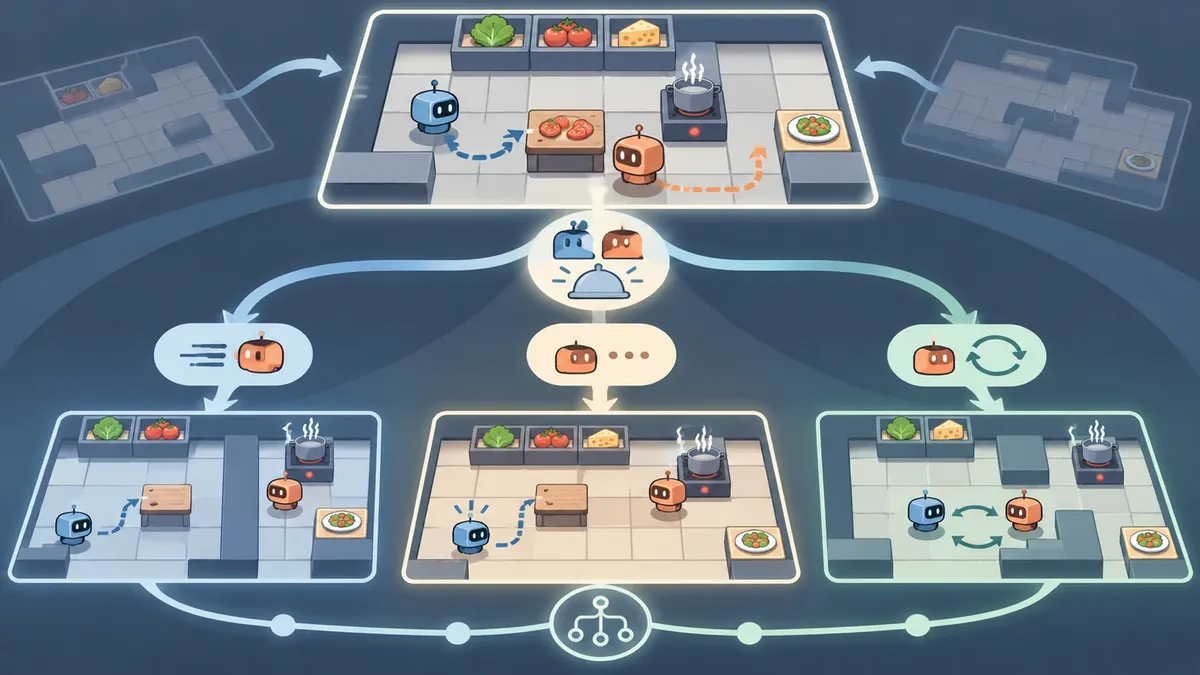
In cooperative games, an AI can face both a new teammate and an unfamiliar layout. A preprint tests a training method for that combined challenge. Its results are promising in two game tasks, but do not show how well the method would work outside these specific evaluations.
The coordination problem
An AI agent may coordinate well with one partner in one game layout, yet struggle when either changes. Patrick Q. Zhang and colleagues study the harder case: adapting to both a novel partner and an unfamiliar environment, a challenge they call “socio-situational shift.” Their experiments examine this problem in cooperative games, not in homes or other real-world settings.
Training across partners and environments
The proposed method, Cross Environment Co-Play (CECP), has two stages. First, researchers train a population of self-playing agents across procedurally generated environments. They then train a cooperator agent across environments while partnering with members of that population. Different training seeds and checkpoints add variation in partner behavior and skill.
For Overcooked, the paper’s procedural-generation description lists variations in onion, pot and delivery-port placement, as well as layout orientation. The paper evaluates CECP on held-out layouts; the listed generation details describe the training setup and should not be taken to mean every variation applied to every evaluation.
CECP also includes an auxiliary next-state prediction objective. Given its interaction history and its own action, the agent predicts the next state. Because that state depends on environmental dynamics and the partner’s action, the authors reason that prediction may encourage representations of both. The paper examines whether those internal representations contain partner-related information; this does not establish human-like understanding.
The researchers tested CECP in cooperative foraging and Overcooked. In foraging, two agents must reach and stay on the same goal. Evaluation included goal locations and partner agents held out from training. Overcooked tests included held-out layouts. The study used several forms of partner evaluation: cross-play with agents from the same training approach but different random seeds, behavior-cloned human proxies, and real human participants. These are distinct tests, not interchangeable evidence about performance with unfamiliar people.
For the human experiment, 73 participants were assigned to one of two Overcooked layouts. Each played a 200-timestep episode with each of six AI methods on their assigned layout, then answered survey questions about the experience.
Findings—and what they show
In cooperative foraging, the authors report that CECP handled the combined shift to held-out goal locations and partner agents better than the tested alternatives. The cross-environment method CEC handled unfamiliar goal locations but performed less well with novel partners; in the combined condition, its performance was reported as about half of CECP’s. Self-play and a partner-diversity method struggled when goal locations changed.
In Overcooked cross-play on the five original layouts, which CECP had not directly trained on, CECP significantly outperformed the compared baselines on average. This is an average across layouts, not a claim that CECP beat every baseline on every individual layout. On 100 additional generated held-out layouts, the reported comparison is narrower: CECP outperformed CEC, while methods trained on single environments failed to perform.
In the human-partner experiment, CECP achieved significantly higher average returns than the tested methods across the two selected layouts. Participants rated it higher for adaptability and lower for frustration and interference. The supplied paper text does not give numerical ratings or effect sizes for these comparisons, so their size and practical importance cannot be determined here. The results concern this study’s participants, layouts and brief gameplay episodes, not collaboration in general.
Removing the next-state prediction objective produced a reported drop in cross-play performance during training. This supports the objective’s usefulness in the tested setup, but the authors say its mechanism is not fully understood. CECP’s predictions of partner movement were above chance. In an example CECP model, a linear discriminant analysis could decode whether an AI partner was at an early, middle or late training checkpoint from the agent’s latent states. The authors also report that the inferred partner skill level loosely tracked human participants’ self-reported Overcooked experience. They caution that the representation captures broad skill rather than fine-grained, partner-specific action intent.
Limits and preprint status
The authors note that CECP’s generalization is limited by the diversity of the partner population and environments used in training. They suggest evaluating it on more complex benchmarks, including settings with partial observability. Results in these game tasks cannot establish that the method will transfer to household robots or other real-world collaboration.
This article is based on an arXiv preprint. The manuscript identifies itself as a NeurIPS 2026 paper, but the supplied evidence does not establish its publication or review status. Its findings should be understood as results reported by the authors under specified evaluation protocols, not as settled evidence about human-AI coordination generally.
- human-AI coordination
- zero-shot coordination
- multi-agent reinforcement learning
- Overcooked
- partner adaptation
- generalization
Related reading
Automatically matched by shared topic keywords. These links do not imply that the sources agree or establish a consensus.
A Transformer for Multi-Agent Learning Across Tasks
Source published
Shared keywords: multi agent reinforcement learning
Can language-model feedback help edge servers share resources?
Source published
Shared keywords: multi agent reinforcement learning
Why AI Agents Can Agree With Themselves—and Still Fail Each Other
Source published
Shared keywords: zero shot coordination
A performance guardrail for exploring team strategies
Source published
Shared keywords: multi agent reinforcement learning
A value gap may reveal when AI teammates are out of sync
Source published
Shared keywords: multi agent reinforcement learning