TRANSMISSION // 2611.32029v1
Do Driving World Models Follow Specified Trajectories?
Source published
A preprint tests whether 3D driving-scene models adapt to alternative vehicle trajectories. ReCast improves on learned models in counterfactual tests, especially for unusual trajectories, but not on every comparison.
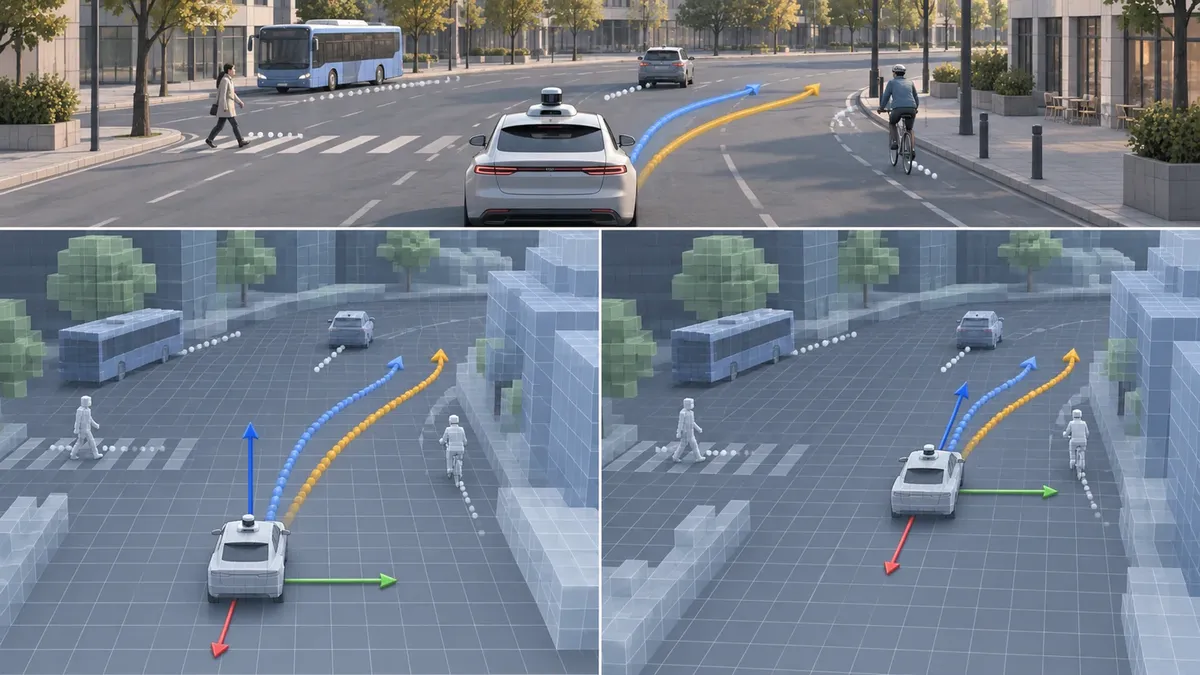
A driving model may predict a plausible future for the vehicle’s recorded motion. But does it adapt when given a different specified trajectory? A preprint introduces a benchmark for that question and a model that uses trajectory geometry to guide its forecasts.
When a model imagines a different trajectory
Occupancy world models represent a driving scene as a three-dimensional grid, marking locations as empty or assigning them semantic categories. Using past observations and a specified future motion for the vehicle (the ego vehicle), they forecast how the grid may look. A plausible forecast, however, is not necessarily one that responds faithfully to the motion it was given.
Jongseong Bae and Ha Young Kim argue that driving datasets usually pair each scene with only the trajectory actually recorded. A model may learn associations between particular scenes and motions without reliably learning how a different ego trajectory should change the geometry of its forecast. Predictions that work for familiar motions may therefore adapt less well to unusual alternatives.
Using geometry to guide prediction
The authors propose ReCast, a transformer that uses the specified trajectory to align locations across past and future vehicle-centred frames. In simple terms, it uses changes in the vehicle’s position and orientation to help retrieve relevant information from earlier scene observations. It still has to infer scene evolution that trajectory geometry does not determine, including object motion and newly revealed content.
The researchers tested ReCast on Occ3D-nuScenes, which provides 3D semantic occupancy annotations. They evaluated both standard forecasting and a counterfactual benchmark. For the latter, they used 150 validation scenes to create 1,350 alternative-trajectory samples: three alternatives per scene in each of three groups. The groups—CF-ID, CF-Tail and CF-OOD—are defined by how common the trajectories are relative to the training data, using the authors’ trajectory-density measure.
To construct each target, the researchers kept the observed history and recorded future scene evolution, then re-expressed the recorded future occupancy in the coordinate frame of an alternative ego trajectory. This tests whether predictions follow the geometric change implied by that motion. It does not simulate what other road users would do if the vehicle actually moved differently.
Strong counterfactual results, with a notable baseline
On standard forecasting, ReCast was competitive, but I²-World achieved higher overall scores in the reported comparison. On the counterfactual tests, ReCast outperformed the learned comparison models on full-scene semantic scores, with the clearest advantage for CF-OOD trajectories. With 3D occupancy input, its score exceeded I²-World’s by 3.01, 2.45 and 7.99 percentage points in CF-ID, CF-Tail and CF-OOD, respectively. With camera input, the clearest reported gain was in CF-OOD; results were comparable in the other groups.
A simpler training-free comparison complicates the picture. Rigid propagation moves the last observed occupancy into the future vehicle frame without learning scene dynamics. It scored higher than ReCast on the full-scene semantic measure for CF-Tail and CF-OOD, while ReCast did better on standard forecasting and CF-ID. Rigid propagation cannot predict occupied content beyond its historical geometric support. Still, its results show that coordinate transformation alone can be a strong baseline for this benchmark.
In an ablation study, adding geometry-aligned temporal interactions produced substantial gains over a model variant without that component on the counterfactual tests. This supports the value of geometric alignment within the tested setup; it does not show that the same design will lead across other datasets or tasks.
What the test does not establish
The counterfactual targets preserve recorded scene evolution while changing how occupancy is represented relative to the alternative ego motion. They do not capture how pedestrians, vehicles or other agents might react to a different action. Nor does a strong score establish that an alternative trajectory is physically feasible or safe. The benchmark measures geometric action faithfulness, not complete counterfactual driving outcomes.
The evaluation is specific to one dataset and 150 scene anchors. “Out of distribution” means unusual according to a measure derived from that dataset’s training trajectories; it does not mean every kind of unfamiliar road situation. The paper reports positive paired 95% confidence intervals for ReCast’s full-region semantic mIoU advantage over I²-World in all three counterfactual groups. That uncertainty result applies to this metric and comparator—not to every measure or comparison. In particular, ReCast’s CF-OOD score was below rigid propagation’s.
The authors report that some counterfactual samples do not pass their stricter geometric and kinematic quality-control checks, while retaining all 1,350 samples in the main evaluation. Their additional filtered-subset analyses are sensitivity checks, not evidence that every constructed trajectory is physically valid.
The work is available as an arXiv preprint; the supplied source does not establish its peer-review status or independent validation. The paper proposes ReCast and a controlled action-faithfulness evaluation on Occ3D-nuScenes. Its findings distinguish forecasting a likely future from following a specified ego trajectory—while leaving the effects of other agents’ reactions for future work.
- autonomous driving
- world models
- 3D occupancy forecasting
- counterfactual evaluation
- ego trajectory
- ReCast
Related reading
Automatically matched by shared topic keywords. These links do not imply that the sources agree or establish a consensus.
Can a Recorded Street Become a Reusable Driving Simulation?
Source published
Shared keywords: autonomous driving, world models
When AI’s imagined drives miss the odds
Source published
Shared keywords: autonomous driving, world models
A Driving AI That Weighs What Might Happen Next
Source published
Shared keywords: autonomous driving
Can AI-generated worlds keep up with robots and self-driving cars?
Source published
Shared keywords: autonomous driving, world models
Does an adaptive policy create value—or just choose a good average mix?
Source published
Shared keywords: counterfactual evaluation