TRANSMISSION // 2611.32021v1
One model, five medical imaging specialties
Source published
HuluOPD distills five specialist medical vision-language models into smaller students using unlabeled prompts. Its benchmark results are promising, but do not establish clinical readiness.
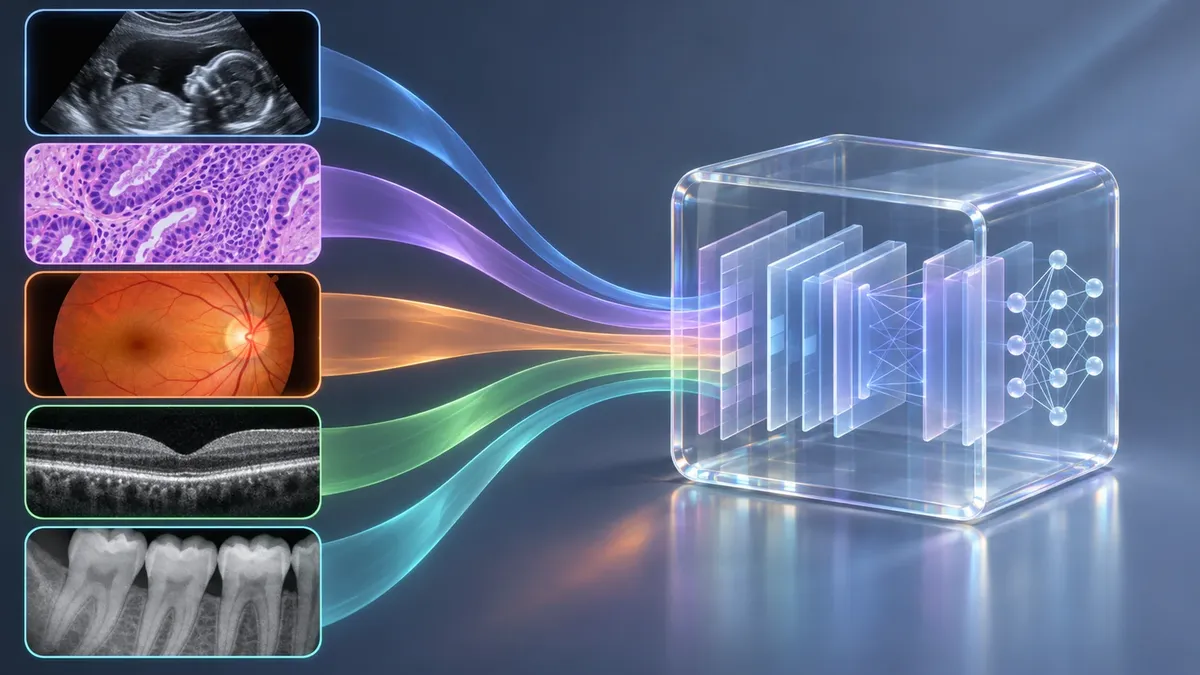
Medical vision-language models are often built for particular imaging specialties. A new arXiv preprint describes a way to combine five such specialists into one smaller model—without using their original training data or reference answers during distillation.
The challenge: combining specialist models
Medical vision-language models (VLMs) answer questions about images. A model trained for one imaging specialty may not work well in another, so covering several specialties can mean deploying several large models. Combining them is difficult when independently developed systems have different architectures and tokenizers—the systems that split text into pieces for processing.
In this preprint, researchers introduce HuluOPD, a method for transferring capabilities from several specialist models into one smaller model. They ask whether this can be done across specialties without access to the specialists’ original training data or reference answers, and without requiring the models to share an architecture.
How the method works
The researchers tested five specialties: ultrasound, pathology, optical coherence tomography (OCT), fundus photography, and dental imaging. They assembled HuluOPDCorpus, with about 914,000 image-and-question prompts without answers, and HuluOPDBench, with about 47,000 held-out test items. The resources draw on more than 90 public datasets overall, while the dental prompts came from an in-house dataset. Dental imaging was evaluated using separate benchmarks. The researchers checked for duplicate and near-duplicate images between prompts and HuluOPDBench test images; third-party benchmark items were included when they passed the study’s check.
During training, a smaller student model generates a response to a prompt. The specialist for that prompt’s imaging modality then processes the response and returns predictions about what text should come next. This is called on-policy distillation: the specialist provides supervision on text produced by the student, rather than the student learning only from responses the specialist generated in advance. Reference answers are not used in this distillation stage.
Comparing models that split text differently requires extra care. One tokenizer might represent a word as one piece, while another divides it into two. HuluOPD aligns candidate pieces when they complete the same text. Candidates without a direct match are handled using a separate sorted-probability comparison. Together, these form a hybrid loss that lets the models’ predictions be compared despite differences in their tokenizers. Before this on-policy stage, a short warm-up trains the student on cached specialist responses, helping it adopt the specialists’ answer formats.
The team tested two students: HuluMed-4B and Qwen3.5-0.8B. The four non-dental specialist teachers were fine-tuned by the researchers from general vision-language models; the dental teacher was the released DentVLM model. The paper reports scoring 131,922 test items under a common protocol. For question answering, an AI judge assessed whether final answers matched references. Reports and captions were scored using BERTScore-F1, a measure of textual similarity. Scores therefore depend in part on the evaluation choices, and neither measure is a clinical assessment.
What the researchers report
When each student was distilled from one specialist at a time, both improved on every benchmark in the modalities they were trained to handle. In the combined five-specialist setting, the researchers report that HuluMed-4B reached 94% of the specialists’ average question-answering performance while using 10% of their combined parameters. Qwen3.5-0.8B reached 89% while using 2%.
These are benchmark results, not measurements of diagnostic accuracy in clinical practice. Performance varied by task and specialty. The researchers also found that students could inherit teachers’ errors: without reference labels to correct them, a student may learn a wrong answer from its teacher. In the study’s analysis, student gains tended to be larger where a teacher had a larger advantage over the undistilled student. This describes a pattern in these experiments, not a guarantee about other models or settings.
What remains uncertain
The authors identify several limits. Four of the five teachers were researcher-trained stand-ins for specialist models, and their training data share public sources with the prompts used for distillation. The study therefore does not establish how HuluOPD would perform with a broader range of independently released specialists or prompts supplied by a particular medical institution. The experiments cover 2D images, not 3D scans or video, and on-policy training costs more than off-policy training.
This work is an arXiv preprint; the evidence provided here does not establish its peer-review status. Its results suggest that heterogeneous image specialists can be consolidated under the conditions tested, but they do not show that the resulting models are safe or effective for patient care. Further independent replication and evaluation on clinically representative data would help assess how well the findings generalize; that is a next step, not a result reported by this study.
Source: HuluOPD preprint.
- medical AI
- vision-language models
- model distillation
- medical imaging
- ultrasound
- pathology
Reviewed cross-references
These connections were reviewed by a model, not independently fact-checked by a human. Similarity does not imply agreement; consult the original papers and the evidence below.
A specialist-team strategy for medical AI
Shared method: Both papers use multi-teacher on-policy distillation: the student generates its own responses and a task- or modality-matched specialist provides supervision. The implementations differ: HuluOPD addresses heterogeneous vision-language models and tokenizers with continuation-aligned cross-tokenizer loss, while KMed-31B uses specialist signals relative to a fixed reference model for medical language tasks; their reported results are not directly comparable.
Model review: · openai-codex/gpt-6-luna
Evidence and provenance
Selected excerpts, not complete papers. PDF extraction can omit figures or damage equations, tables and reading order; sources may be preprints.
2611.32021v1 — Original paper
Excerpt reference:
static/papers/2611.32021v1.md:130-196
Basis: Paper text
Source SHA-256:b67a8071033c77e564aa5d20abfbf9b271c3123fc144d5428fe843c66e3f06232611.32021v1 — Original paper
Excerpt reference:
static/papers/2611.32021v1.md:197-258
Basis: Paper text
Source SHA-256:b67a8071033c77e564aa5d20abfbf9b271c3123fc144d5428fe843c66e3f06232611.28719v1 — Original paper
Excerpt reference:
static/papers/2611.28719v1.md:182-300
Basis: Paper text
Source SHA-256:42b8ed4be4b1072ca0071879f290155d45e8d84b0f5c5efb7a9f3cb655781b29
Related reading
Automatically matched by shared topic keywords. These links do not imply that the sources agree or establish a consensus.
Medical-image AI needs more than realistic-looking synthetic scans
Source published
Shared keywords: medical ai
Can an AI Trust the Place It Zooms In On?
Source published
Shared keywords: medical ai
Teaching medical AI to stop inventing findings can also expose what it misses
Source published
Shared keywords: medical imaging, vision language models
Using generated ultrasound images to choose real ones worth labeling
Source published
Shared keywords: medical imaging
How CROSS-Calib repairs ultrasound signals before imaging
Source published
Shared keywords: medical ai