TRANSMISSION // 2611.31990v1
How Well Do Marginals Predict Token Dependencies?
Source published
A study of four masked diffusion language model checkpoints tests how well per-position predictions estimate dependencies within fixed groups of tokens, and finds important limits.
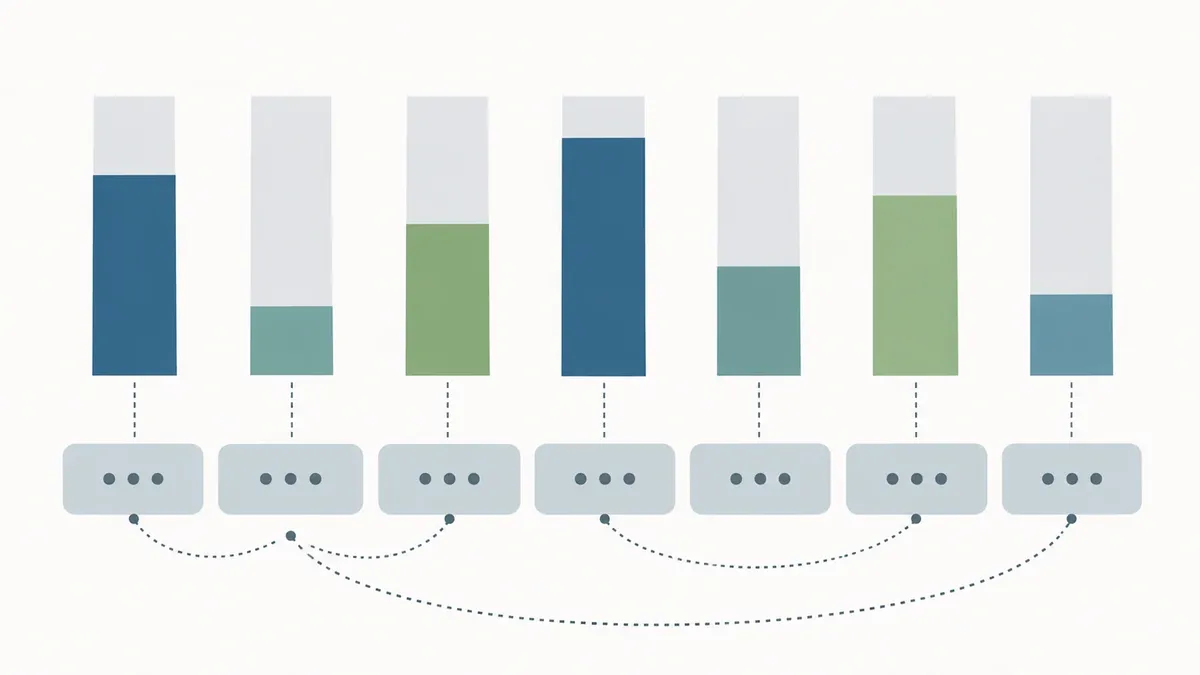
Masked diffusion language models can fill several text positions at once, but separate predictions do not capture every relationship between those positions. Researchers measured how well common rules based on individual token probabilities predict this missing dependence, and examined cases where a model’s conditional predictions do not fit one consistent joint distribution.
Why parallel predictions can miss relationships
Masked diffusion language models generate text by repeatedly filling masked positions. At each step, they can predict several positions in parallel. This can save decoding steps, but each position is predicted from its own probability distribution, or marginal. Sampling positions separately can lose information about how their tokens are related.
Imagine a model that considers “New York” and “Los Angeles” equally likely. Looking at either position alone, there are two equally likely possibilities. Those separate probabilities do not reveal whether the words are linked in those pairs or whether other combinations are also likely. The same marginals can fit different joint distributions.
The researchers use conditional total correlation to measure shared information among a selected group of positions, given the text the model can already see. Marginals cannot determine this quantity for every possible joint distribution. The study instead asks how well they predict it for fixed groups of positions in real models.
How the study estimated dependence
The team tested four checkpoints from two model families: Dream-Coder 7B and LLaDA 8B, each in base and instruction-tuned versions. They used English prose and Python code, with short text windows and contiguous candidate blocks, usually four positions long. They also report checks with eight-position blocks for the two base checkpoints.
To estimate dependence, the researchers revealed the positions in each block one at a time, using 64 randomly selected reveal orders per block in the main measurements. They recorded the model’s conditional distributions as tokens were revealed, then averaged the resulting chain-rule estimates. If the conditionals compose into one joint distribution, this estimates that joint’s entropy and supports the usual interpretation as total correlation. If they do not, the estimate instead reflects an average over reveal orders; it can be negative and need not equal the cost of a parallel commit. The authors report standard errors, while warning that these can understate uncertainty for nearly deterministic blocks.
The study compared two masking setups. In the suffix setup, a block and everything after it to the end of the text window were masked. In the infill setup, only the block was masked, leaving text on both sides. The team also evaluated six rules based on token confidence, the gap between the most and second-most likely tokens, or entropy. Each statistic was combined across a block either by focusing on its weakest position or by pooling information across positions.
A technical check mattered: Dream and LLaDA place a position’s prediction at different output indices. The researchers tested which index was correct for each checkpoint. Reading Dream at the wrong index inflated an inconsistency diagnostic by 14 to 41 times, illustrating how a plausible-looking readout can distort measurements.
What the comparisons found
For three checkpoints, the best tested marginal-only predictors had errors of about 0.74 to 1.17 bits when predicting the study’s estimate. They did better than a reference that knew only an upper bound on possible dependence. Much of that predictive value, however, came from the bound itself. Among blocks where the bound exceeded one bit, measured dependence was typically around 0.44 to 0.56 of the bound in the reported settings. Dream-instruct was an exception to the broader pattern.
Dream-instruct was especially difficult to characterize on prose. Its conditionals were less self-consistent there, and the estimate did not reliably represent the cost of a parallel commit. For Dream-base and LLaDA-base, in the reported prose and suffix settings, the estimate ranked blocks similarly to the commit cost, but was lower by a median of 0.4 to 1.1 bits.
Across six common marginal rules, pooling information over the block performed better than focusing on its weakest position in all 24 paired comparisons. The study reports that this held across its eight model-and-masking settings and three ways of pairing rules. This is a result about predicting dependence for fixed sets, not evidence that pooled rules improve text quality or decoding speed.
Limits and source status
The study covers four checkpoints, two model families, English prose and Python, short windows, and mostly four-position blocks. It uses raw text rather than chat-formatted inputs and does not measure end-to-end generation quality. Results may differ for other models, contexts, or decoding setups. Some numerical estimates fall outside theoretical bounds, which the authors discuss as signs of inconsistent conditionals or estimation uncertainty.
The source identifies the work as a NeurIPS 2026 workshop paper, but the available material does not establish whether it was presented or peer-reviewed. Its findings are best understood as measurements of what marginal-based rules predict in these particular tests—not as evidence that a dependency-aware decoder will improve speed or output quality.
- diffusion language models
- parallel decoding
- total correlation
- token dependencies
- language model uncertainty
Reviewed cross-references
These connections were reviewed by a model, not independently fact-checked by a human. Similarity does not imply agreement; consult the original papers and the evidence below.
ChainFlow drafts several AI tokens by predicting where a model’s internal states go next
Supporting evidence: Both papers identify a limitation of per-position predictions that omit token dependencies. The origin paper measures conditional total correlation for fixed parallel-commit sets and explicitly does not assess the gains from dependency-aware decoding; ChainFlow reports that token feedback improves draft acceptance in its Qwen3.5 speculative-decoding experiments. These findings are compatible, but concern different models, tasks, and outcomes, so ChainFlow does not validate the origin paper’s total-correlation estimates.
Model review: · openai-codex/gpt-6-luna
Evidence and provenance
Selected excerpts, not complete papers. PDF extraction can omit figures or damage equations, tables and reading order; sources may be preprints.
2611.31990v1 — Original paper
Excerpt reference:
static/papers/2611.31990v1.md:13-129
Basis: Paper text
Source SHA-256:62ef88392ff6756438f040a7bed5d3ba4162ebe1ea13bef405bea447b0c772932611.31990v1 — Original paper
Excerpt reference:
static/papers/2611.31990v1.md:817-878
Basis: Paper text
Source SHA-256:62ef88392ff6756438f040a7bed5d3ba4162ebe1ea13bef405bea447b0c772932611.08669v1 — Original paper
Excerpt reference:
static/papers/2611.08669v1.md:891-1041
Basis: Paper text
Source SHA-256:19020db1027c73a1cea96f8181f722cb9a641c80061e522e698ed8f23bd934b9
Related reading
Automatically matched by shared topic keywords. These links do not imply that the sources agree or establish a consensus.
When Should a Diffusion Language Model Reconsider Its Guesses?
Source published
Shared keywords: diffusion language models, parallel decoding
Teaching diffusion models to do more with fewer decoding steps
Source published
Shared keywords: parallel decoding
Giving Diffusion Language Models a Policy Interface
Source published
Shared keywords: diffusion language models
Starting the Next Block Before the Current One Is Finished
Source published
Shared keywords: diffusion language models
Why confident AI answers may not be grounded in the image
Source published
Shared keywords: diffusion language models