TRANSMISSION // 2611.31950v1
A softer surface for more realistic digital grasps
Source published
A method deforms the skin of 3D hand meshes near objects to improve mesh-based contact measures while keeping estimated poses close to their starting positions.
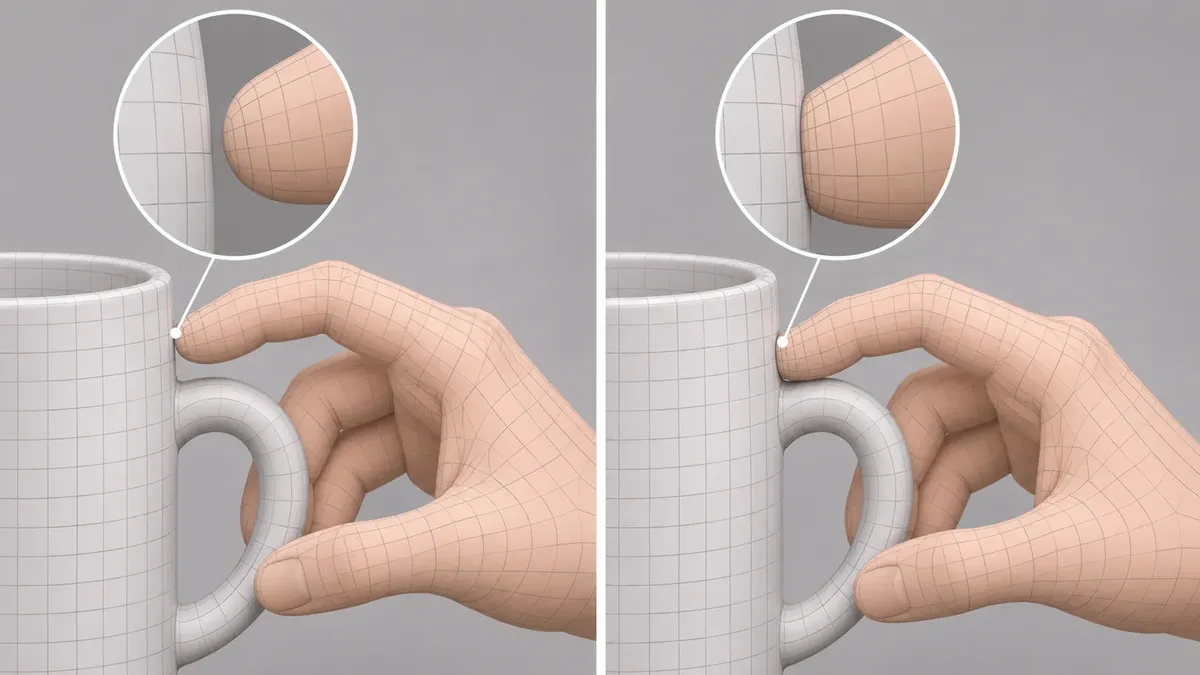
A digital hand can appear to float above an object or sink into it, even when its estimated pose is close. Researchers propose adjusting the mesh surface as well as making small joint and wrist changes, then test whether this improves how hand-object contact is represented.
A fingertip pressed against a mug does not stay perfectly rigid: its soft surface flattens into a patch. Many digital hand models do not represent that give. In the widely used MANO model, joints move but the mesh surface does not deform. A fitted hand can therefore hover above an object or intersect it where real skin would press against it.
In Beyond Rigid Hands: Deforming Skin into Contact-Consistent Hand Meshes, Seonghwan Park and Min-Gyu Park ask whether a digital hand can represent contact better by changing its surface while keeping its pose close to the original. The question matters because datasets and image-based estimators often provide rigid hand meshes, and pose refiners can change the hand’s placement to improve contact.
Small pose changes, local deformation
The researchers start with a MANO hand mesh and a 3D object. Their method first makes limited adjustments to finger-joint angles and wrist position to bring nearby skin toward the object. It then moves mesh vertices so that skin already near the object can settle onto its surface. A regularizer discourages stretching: skin on the palm near contact can yield more than skin on the back of the hand. The method also links deformations across video frames so contact patches change less abruptly.
That reach is limited. Geometry-based deformation acts on skin already near the object; it cannot by itself close every gap left by an inaccurate estimate. To guide it, the researchers train a lightweight contact head using the method’s lifted annotations. For each mesh vertex, the head predicts its distance to the object in those annotations, using features from a frozen estimator and the vertex’s distance to the predicted object. A threshold selects vertices for the guided deformation. The estimator is not retrained, but a separate head is trained for each estimator.
The team tested the approach on hand-object datasets including DexYCB and OakInk, and compared contact with thermal measurements in ContactPose. For estimated hands, they applied the lift to outputs from three published estimators. They evaluated mesh-based measures of surface contact and penetration, pose change, temporal consistency, and simulated grasp stability. They also compared rendered hand depth with captured depth images not used in the optimization.
What the tests found
For the three estimated-hand systems, the geometry-based lift more than doubled band conformity—the share of a defined near-contact region of the mesh lying on the object surface—from about 20% to nearly 50%. This is a mesh-based measure, not a direct measurement of real-world skin contact. The paper reports that joint error increased by at most 0.3 millimetres in this evaluation, while most deeply penetrating vertices were removed. Adding the learned head improved contact prediction and simulated stability by directing deformation toward gaps that geometry alone left open.
The paper reports separate results for dataset annotations, not estimated hands. After the small pose-adjustment stage, skin deformation raised band conformity from about 25% to 88% on DexYCB annotations and from about 24% to 71% on OakInk annotations. Simulated slip and a measure of how well modeled contacts could balance gravity also improved. Thermal contact is a distinct evaluation: on ContactPose, the lifted meshes matched the recorded thermal contact better than the rigid annotations in the reported comparison.
These results concern reconstructed meshes and specific evaluation procedures; they do not show that the method recovers the true physical deformation of human tissue. The authors say their displacement is optimized for contact consistency, not tissue mechanics, and need not match a measured indentation. They also hold the predicted object fixed and keep the hand near its estimated pose, so a grasp can remain open when the object is out of reach. In one reported case, the predicted object was out of reach in a substantial share of frames. The contact head must also be trained separately for each estimator.
The method therefore offers a way to improve contact representation without large pose changes in the reported tests, but it does not eliminate errors in hand or object estimates. Whether it improves downstream applications beyond the evaluations in this study remains to be established. This is an arXiv preprint; its findings are the authors’ reported results, not independent confirmation. Read the paper on arXiv.
- 3D hand reconstruction
- hand-object contact
- computer vision
- mesh deformation
- MANO
- grasp stability
Related reading
Automatically matched by shared topic keywords. These links do not imply that the sources agree or establish a consensus.
HaNDF uses object shape to guide more plausible digital hand poses
Source published
Shared keywords: 3d hand reconstruction, computer vision
Can AI Judges Follow Vision Criteria?
Source published
Shared keywords: computer vision
Can a smaller EfficientNet learn from a larger one?
Source published
Shared keywords: computer vision
SplatLab puts an AI research loop to work on 3D scenes
Source published
Shared keywords: computer vision
Instant NuRec: A One-Pass Route to 3D Driving Scenes
Source published
Shared keywords: computer vision