TRANSMISSION // 2611.31943v1
A Wideband Radio Search Finds No Clear Technosignature
Source published
A search of nearby stars for 2–4 GHz radio emission found no confirmed transmitter. Natural stellar activity complicates the search, but the results set limits on possible signals.
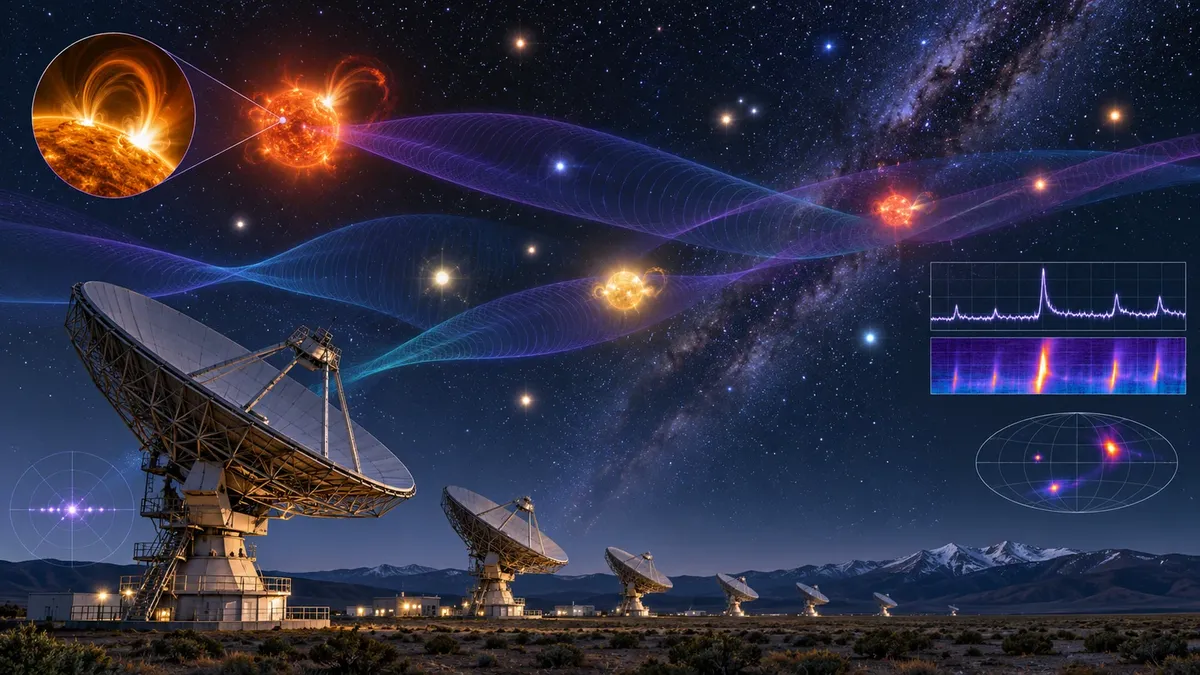
Many radio SETI searches look for narrow, precisely defined signals. This study takes a complementary approach: it looks for excess broadband radio emission around nearby stars, where natural stellar activity can also produce bright radio signals.
A signal from another civilization might not arrive as a narrow, clean tone. It could span a wider range of frequencies, or change quickly enough to evade a search designed for narrowband signals. Steve Croft’s study reports a search for excess radio emission in the 2–4 gigahertz band, using data from the Very Large Array Sky Survey (VLASS).
The researchers examined 210,191 main-sequence stars identified with Gaia DR3 and located within 100 parsecs of Earth. The abstract describes VLASS observations spanning survey epochs from 2017 to 2026. A key challenge is that stars can produce radio emission naturally: flares and other activity can resemble a transmitter when judged by radio brightness alone.
Matching radio sources to stars
The team compared stellar positions with sources in the VLASS Epoch 1 catalog. They found 51 high-reliability positional associations, against 1.5 expected by chance. That does not mean 51 candidate civilizations were found. The abstract says all but one of the associated sources are known natural emitters; where measurable, they move with their stars. The remaining source lies near LSPM J1943+5337, but not at the star itself.
The researchers also used forced photometry on 208,232 stars across all epochs. The abstract reports one detection in a test for steady emission and three eligible stars detected in at least one epoch, compared with 1.3 and 1.9 detections expected by chance, respectively. These counts do not, on their own, identify technology: a positional association or radio-bright measurement can have a natural or unrelated explanation.
The study applies different criteria for treating emission as a possible transmitter, depending on stellar type and known radio-emitter classifications. It considers any luminosity only for 32,985 apparently single AFGK stars outside known radio-emitter classes. For M dwarfs and AFGK multiple-star systems, emission is counted as potentially technological only above a specified luminosity threshold, because ordinary stellar activity can otherwise be a plausible source.
Limits, not a detection
The abstract gives a median upper limit on steady radio emission of less than 4.0 × 10⁸ watts per hertz per star. It also reports upper bounds on the fraction of stars that might host transmitters above particular luminosities. These are population constraints, not proof that no transmitters exist. A signal could be weaker, intermittent, outside the observed frequency range, or otherwise unlike the emission this search can identify.
The authors also report that stacked measurements detect average radio emission from M dwarfs, concentrated among stars with evidence of activity. Stacking combines measurements across targets to examine their population-averaged emission. The finding highlights the challenge of distinguishing possible technology from astrophysical sources; it is not evidence that the M dwarfs are transmitting.
The study’s broader contribution is to show how radio continuum surveys can constrain broadband, modulated, or rapidly drifting signals that narrowband search pipelines do not target. This method cannot cover every possible technosignature, and a radio excess alone would need follow-up to establish its origin.
This account is based on the paper’s abstract, not its full text. The supplied evidence therefore does not allow assessment of the detailed data processing, selection choices, or uncertainty calculations. The source is an arXiv preprint; the supplied record does not establish whether it has undergone peer review. The findings should be understood as a reported analysis and set of limits, not a confirmed discovery or a definitive answer about life elsewhere.
- radio astronomy
- technosignatures
- SETI
- VLASS
- stellar activity
- Gaia
Reviewed cross-references
These connections were reviewed by a model, not independently fact-checked by a human. Similarity does not imply agreement; consult the original papers and the evidence below.
Radio surveys reveal a faint signal from IX Velorum
Shared method: Both studies use forced photometry to measure radio emission at target-star positions: the technosignature study applies it to stars across VLASS epochs, while Rao et al. use forced aperture photometry at proper-motion-corrected Gaia positions for cataclysmic variables. The cited evidence supports this methodological overlap, but not a claim that either measurement was specifically below a catalog threshold or that the samples and resulting limits are directly comparable.
Model review: · openai-codex/gpt-6-luna
Evidence and provenance
Selected excerpts, not complete papers. PDF extraction can omit figures or damage equations, tables and reading order; sources may be preprints.
2611.31943v1 — Original paper
Excerpt reference:
static/papers/2611.31943v1.md:12-63
Basis: Paper text
Source SHA-256:725e1bb842e3ca68ccf9615f2969ee899b8de3256a672e8bc8169d31ff020f502611.07448v1 — Original paper
Excerpt reference:
static/papers/2611.07448v1.md:465-532
Basis: Paper text
Source SHA-256:48baa805ac62cf57167d92a59dc2f9edbdef80ba8cbb30d0152acbddd9f4520f
Related reading
Automatically matched by shared topic keywords. These links do not imply that the sources agree or establish a consensus.
Radio surveys reveal a faint signal from IX Velorum
Source published
Shared keywords: radio astronomy
Nearby Little Red Dots Show Varied Radio Emission
Source published
Shared keywords: radio astronomy
GJ 9404 b remains an uncertain planet candidate
Source published
Shared keywords: stellar activity
A function-aware way to model starspots in planet searches
Source published
Shared keywords: stellar activity
Quieter satellites could protect radio astronomy and Earth-rotation measurements
Source published
Shared keywords: radio astronomy