TRANSMISSION // 2611.31892v1
How smarter video-model memory can save future compute
Source published
SAMR reconstructs much of a video diffusion model’s memory instead of simply reusing stale entries, aiming to cut compute without worsening later video quality.
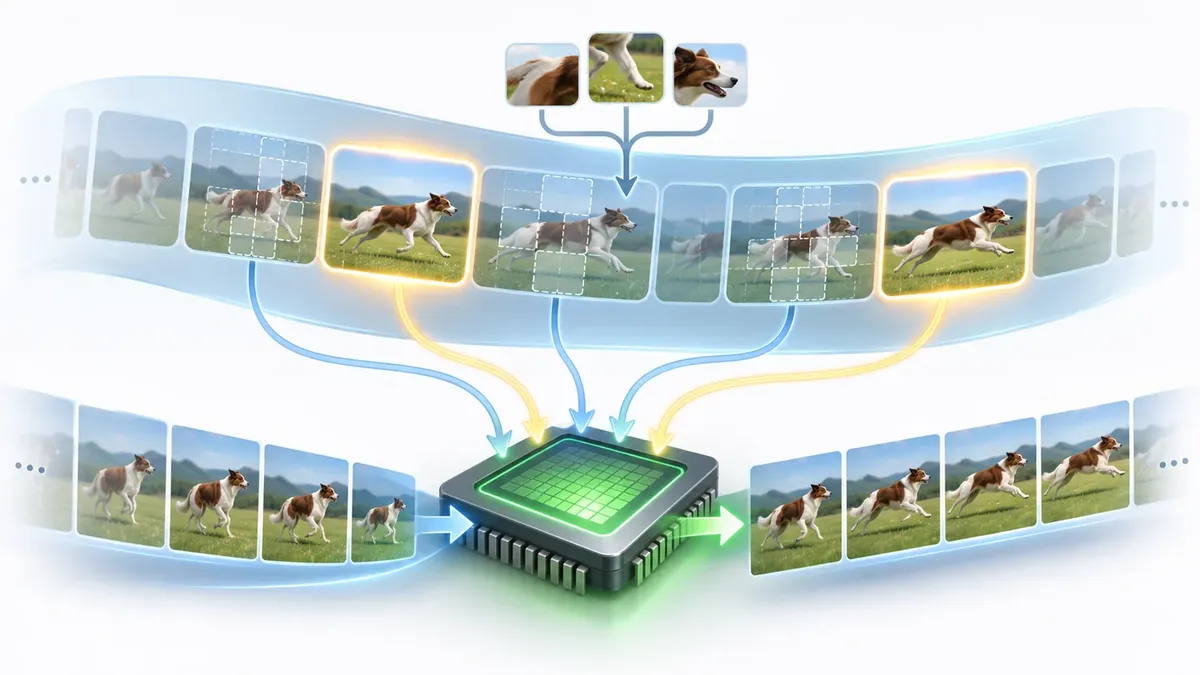
Streaming video models rely on a cache of past information to generate each new segment. A new preprint argues that cutting the cost of updating this cache can backfire: stale entries may make later segments harder to generate. Its proposed method, SAMR, reconstructs some cache entries and refreshes others, with promising results in tests on two frozen video models.
A video generator that works one segment at a time needs a way to remember what came before. Many streaming video diffusion models use a key–value (KV) cache for that purpose. After generating a segment, the model normally makes an additional, noise-free pass to write clean information about it into the cache. Later segments use that stored information as context.
That update can become a significant part of the work. But simply skipping it is not necessarily a win: if old, or “stale,” cache entries are reused, later segments may be conditioned on less accurate information and require more denoising. The compute saved now can then return as extra work later.
A preprint by Jian Yang and colleagues introduces SAMR, short for Step-Aware Memory Reconstruction, to address this trade-off. The researchers ask whether a model can update its memory more cheaply without retraining the video generator or allowing errors to build up over time.
Reconstructing instead of copying
SAMR works with frozen causal video diffusion transformers. For each cache entry that is not freshly updated, it combines two estimates already available to the system: information from a motion-matched patch in the previous segment, and the current token’s intermediate information when it exits the denoising process. The first can be outdated when new content appears; the second reflects the current content but is affected by how far denoising has progressed.
The method adjusts the intermediate estimate according to its exit step, then fuses it with the historical estimate. It also accounts for positional rotations used inside the model, undoing those rotations before combining information and applying them again when writing the result back. A separate error proxy estimates which entries could most affect what later segments attend to. SAMR reserves true noise-free updates for entries judged to be important, rather than refreshing every entry or blindly copying old ones.
The selection and reconstruction are designed alongside GPU execution. The authors use tile-aligned work plans and Triton kernels to avoid routing overheads that might otherwise eat into the savings. SAMR requires offline calibration, but the paper describes it as training-free: it does not fine-tune the video model’s weights.
What the tests found
In the main evaluation, the researchers tested 48-second videos generated by a frozen LongLive-1.3B model on AMD GPUs. Against dense cache updates, SAMR reduced reported DiT latency by 20.9% and principal FLOPs by 30.7%. Against a token-reuse approach that refreshed a similar share of entries, SAMR reduced the average number of denoising steps per token and improved final-quarter PSNR by 1.61 dB. PSNR here measures agreement with the same-seed output from dense updates; it is not a general measure of whether a video looks good.
On a separate set of 16 held-out prompts, the authors report a 1.14 dB final-quarter PSNR improvement over reuse. They also tested transfer to a second frozen model, Self-Forcing-DMD-1.3B. Using calibration from LongLive without changes reduced reuse-related increases in denoising steps and modestly improved late PSNR, but lowered the paper’s diagnostic score. A one-time, training-free calibration on the second model recovered that score, though it did not reach the dense-update result.
The central finding is therefore not that approximate memory is always safe. It is that, in these experiments, reconstructing selected entries while refreshing others could avoid some of the downstream cost and quality loss seen with straightforward reuse.
What remains uncertain
The authors caution that their attention-readout proxy is an offline, first-order estimate—not an error bound—and does not track live future queries or guarantee control of errors across multiple blocks. The results cover 1.3-billion-parameter models and particular AMD GPU setups, so they do not establish that the method will deliver the same gains on other models or hardware.
The evaluation also has limits: the authors did not report standard LPIPS, FVD, official VBench-Long results, or user studies, and they note that some measures of visual drift did not show a clear advantage over reuse. Comparisons with several other acceleration methods remain future work. These qualifications matter because matching a dense run’s output is not the same as independently judging video quality.
The work is an arXiv preprint, not evidence of peer-reviewed validation. Its results offer a specific engineering approach to a real systems problem, but broader testing is needed to establish how useful it is in practice.
- video diffusion
- streaming video generation
- KV cache
- GPU computing
- SAMR
- artificial intelligence
Reviewed cross-references
These connections were reviewed by a model, not independently fact-checked by a human. Similarity does not imply agreement; consult the original papers and the evidence below.
Teaching video models to write a better memory
Supporting evidence: Both papers report that what a video model writes to persistent KV memory can affect later generation: Yang et al. say stale KV increases downstream denoising steps and late-horizon ghosting, while Li and Zhu report improved long-video quality after training a separate memory writer. This supports the bounded point that memory-write quality matters, not that either method validates the other; the studies use different models, training setups, and outcomes.
Model review: · openai-codex/gpt-6-luna
Evidence and provenance
Selected excerpts, not complete papers. PDF extraction can omit figures or damage equations, tables and reading order; sources may be preprints.
2611.31892v1 — Original paper
Excerpt reference:
static/papers/2611.31892v1.md:78-206
Basis: Paper text
Source SHA-256:311357c258767598e3ae593ac98bbd4d13073b6034f68f221521e4a0fb8296392611.01648v2 — Original paper
Excerpt reference:
static/papers/2611.01648v2.md:13-88
Basis: Paper text
Source SHA-256:b55a8fe9998cae0d8c7980514f183391777fc186bd9431a699567ffd119158ea
Related reading
Automatically matched by shared topic keywords. These links do not imply that the sources agree or establish a consensus.
How Mosaic coordinates CPUs and GPUs for long-context AI
Source published
Shared keywords: kv cache
FOSCAR speeds up compressed AI memory by rearranging the maths
Source published
Shared keywords: gpu computing, kv cache
AutoEMatic adjusts AI number precision as a model writes
Source published
Shared keywords: gpu computing
Can video AIs edit their own memory efficiently?
Source published
Shared keywords: artificial intelligence, kv cache
Why AI video generators can ignore a new prompt
Source published
Shared keywords: video diffusion