TRANSMISSION // 2611.31883v1
When Do Video Agents Benefit From Looking Again?
Source published
Video agents can request close-ups and higher-frame-rate clips, but extra observations help only when models seek useful evidence and revise answers reliably.
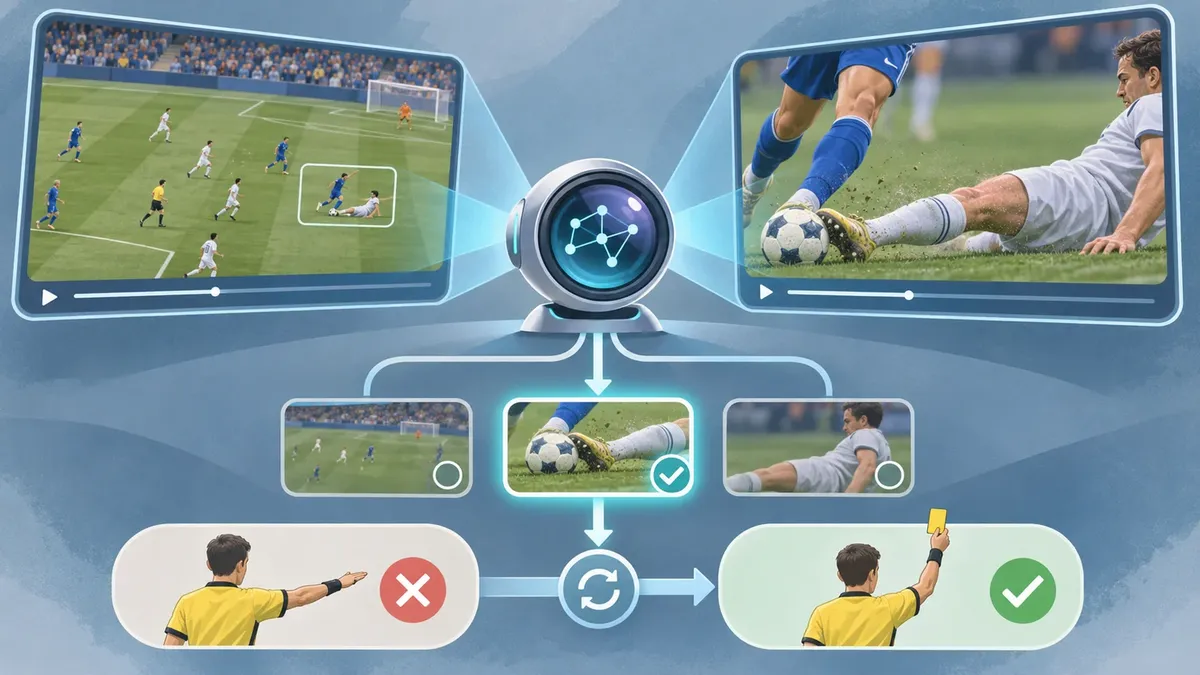
An AI watching a video may recognize the general action yet miss the brief contact or movement that decides a question. A new study tests whether letting models request closer looks helps—and why the benefits vary.
A video model can sometimes identify what is happening without catching the detail that answers a specific question. Did a player control the ball before jumping over a sliding defender? Which way did someone turn? Such questions may depend on a brief movement or contact that disappears in a coarse overview.
The paper Rethinking Video Agents: When and Why Video Harnesses Work asks when models benefit from choosing what to inspect next. Instead of giving a model only a fixed sample of a video, an “agentic” system can request a short clip, selected still frames or a spatial crop, then reconsider its answer. The researchers argue that tool access alone is not enough: a model must identify what remains uncertain, seek relevant evidence and use it without needlessly changing a correct answer.
Comparing a fixed overview with closer looks
The team built video-relook, a framework that starts with a global overview sampled at one frame per second. In the adaptive version, the model can request additional temporal or spatial observations and revise its responses. The underlying model and scoring rules stay fixed within each comparison, but the adaptive system also changes prompts and uses multiple rounds. This means the study tests the overall harness—not the isolated effect of seeing more frames.
The evaluation covered four public video question-answering benchmarks and FastAct, an internal dataset focused on fine-grained actions. FastAct contains 1,000 multiple-choice questions about 100 silent clips, with questions addressing details such as contact, object handling and event order. The observation loop allowed up to three model rounds, with limits on requests in each round. Researchers recorded answers, requests and stopping decisions to trace when models corrected errors or introduced new ones.
More observation helped some tasks more than others
On FastAct, the reported gains across five evaluated models ranged from 3.0 to 14.2 percentage points. However, the improvement for Qwen 3.7 Flash is uncertain: its reported 95% interval spans zero, from −0.4 to 6.4 points. The authors also report benefits on Video-MME-v2 for several models. But gains were not consistent across models or tasks. For example, Gemini 3.6 Flash gained 2.73 points on Video-MMMU multiple-choice questions but lost 1.20 on TempCompass. On Video-MME-v2, Qwen 3.7 Flash showed no net gain, despite correcting some previously wrong answers.
The researchers’ analysis points to two important parts of the interaction: seeking observations and revising answers reliably. On FastAct, Qwen 3.7 Flash often stopped after its first round, before receiving requested observations. Other models interacted for longer, but more rounds did not automatically mean higher accuracy. A model can inspect more and still misread the evidence—or overturn an answer it already had right.
The answer histories show that pattern. On FastAct, Qwen 3.8 Flash corrected 59.5% of baseline errors and overturned 14.2% of baseline-correct answers. Qwen 3.7 Flash corrected 33.4% of its baseline errors and overturned 20.6% of its correct answers. These figures describe the evaluated questions and models; they do not establish why each individual revision occurred.
The authors also compared questions annotated as needing different temporal resolutions. Several models gained more on the higher-resolution subset, but not all did, and the authors stress that these annotations were not a controlled experiment changing video input. The result is suggestive, not proof that higher frame rates alone caused larger gains.
What the study can—and cannot—show
The paper’s central takeaway is that adaptive observation is most useful when a task offers informative details to inspect and a model can turn them into dependable revisions. A close-up is only an opportunity: it does not guarantee that the model will request the right view or interpret it correctly. Aggregate scores can also hide opposing changes across question types.
There are important limits. Because the adaptive setup changes prompts, adds interaction and provides new observations together, the experiment cannot separate the causal contribution of extra visual evidence from prompting or additional reasoning. The authors call for controlled evidence interventions to address that question. Their results also come from video question answering under one observation interface and a shared three-round limit; other tools or stopping rules could produce different outcomes. FastAct is an internal benchmark, and its results may not generalize to other datasets or real-world video use.
This is an arXiv preprint, so the findings should be treated as preliminary rather than as independently established conclusions. The paper presents evidence that video harnesses can help, especially on detailed action questions, while showing why tool access should not be confused with reliable understanding.
- video understanding
- AI agents
- multimodal models
- adaptive observation
- video question answering
- computer vision
Reviewed cross-references
These connections were reviewed by a model, not independently fact-checked by a human. Similarity does not imply agreement; consult the original papers and the evidence below.
AdaAlloc helps video AI decide where to look closely
Supporting evidence: The papers report compatible improvements from approaches that adapt video evidence to the question: the origin reports gains on fine-grained action understanding, while AdaAlloc reports gains over budget-matched uniform sampling on four long-video QA benchmarks. The origin evaluates a complete harness—including prompts and multi-turn inference—and does not isolate the effect of visual access from additional reasoning; this is not a causal comparison or direct replication. These are reported findings from arXiv papers, not independently established results.
Model review: · openai-codex/gpt-6-luna
Evidence and provenance
Selected excerpts, not complete papers. PDF extraction can omit figures or damage equations, tables and reading order; sources may be preprints.
2611.31883v1 — Original paper
Excerpt reference:
static/papers/2611.31883v1.md:168-215
Basis: Paper text
Source SHA-256:c78734e2ee995e89c2bcd047b30203ff65da0ca5094b4e206c222e6026a3e82d2611.31883v1 — Original paper
Excerpt reference:
static/papers/2611.31883v1.md:216-331
Basis: Paper text
Source SHA-256:c78734e2ee995e89c2bcd047b30203ff65da0ca5094b4e206c222e6026a3e82d2611.09092v1 — Original paper
Excerpt reference:
static/papers/2611.09092v1.md:398-460
Basis: Paper text
Source SHA-256:f0ee21807145c542d29097ba5e2be07fabd814eb18746c9322c4b590c6c04952
LoopSeek separates video search from answering
Supporting evidence: The papers report compatible gains for question-directed video evidence acquisition: the origin reports gains on fine-grained action questions, and LoopSeek reports higher average accuracy than uniform sampling with a fixed 32-frame answerer. The origin’s comparison evaluates a complete harness, including prompts and multi-turn inference, and does not isolate visual access from additional reasoning; the findings therefore do not establish that observation alone caused its gains or provide a direct comparison with LoopSeek. These are reported findings from arXiv papers, not independently established results.
Model review: · openai-codex/gpt-6-luna
Evidence and provenance
Selected excerpts, not complete papers. PDF extraction can omit figures or damage equations, tables and reading order; sources may be preprints.
2611.31883v1 — Original paper
Excerpt reference:
static/papers/2611.31883v1.md:168-215
Basis: Paper text
Source SHA-256:c78734e2ee995e89c2bcd047b30203ff65da0ca5094b4e206c222e6026a3e82d2611.31883v1 — Original paper
Excerpt reference:
static/papers/2611.31883v1.md:216-331
Basis: Paper text
Source SHA-256:c78734e2ee995e89c2bcd047b30203ff65da0ca5094b4e206c222e6026a3e82d2611.28635v1 — Original paper
Excerpt reference:
static/papers/2611.28635v1.md:163-230
Basis: Paper text
Source SHA-256:4bff4eca913fab84b04e4a416fdd62f77d7ff74af64fee402495ab420f9428ce
Related reading
Automatically matched by shared topic keywords. These links do not imply that the sources agree or establish a consensus.
How VMSA Helps AI Search Hours of Video
Source published
Shared keywords: ai agents, video question answering
LoopSeek separates video search from answering
Source published
Shared keywords: video question answering
AdaAlloc helps video AI decide where to look closely
Source published
Shared keywords: video question answering
How VTree builds a reusable memory of long videos
Source published
Shared keywords: video question answering
Why Video AI Misses Brief, Crucial Moments
Source published
Shared keywords: computer vision, video understanding