TRANSMISSION // 2611.31873v1
A benchmark asks coding agents to show their work
Source published
RepoEviAgent builds executable, evidence-grounded questions about software repositories. Its benchmark reveals uneven performance across models, languages and software tasks.
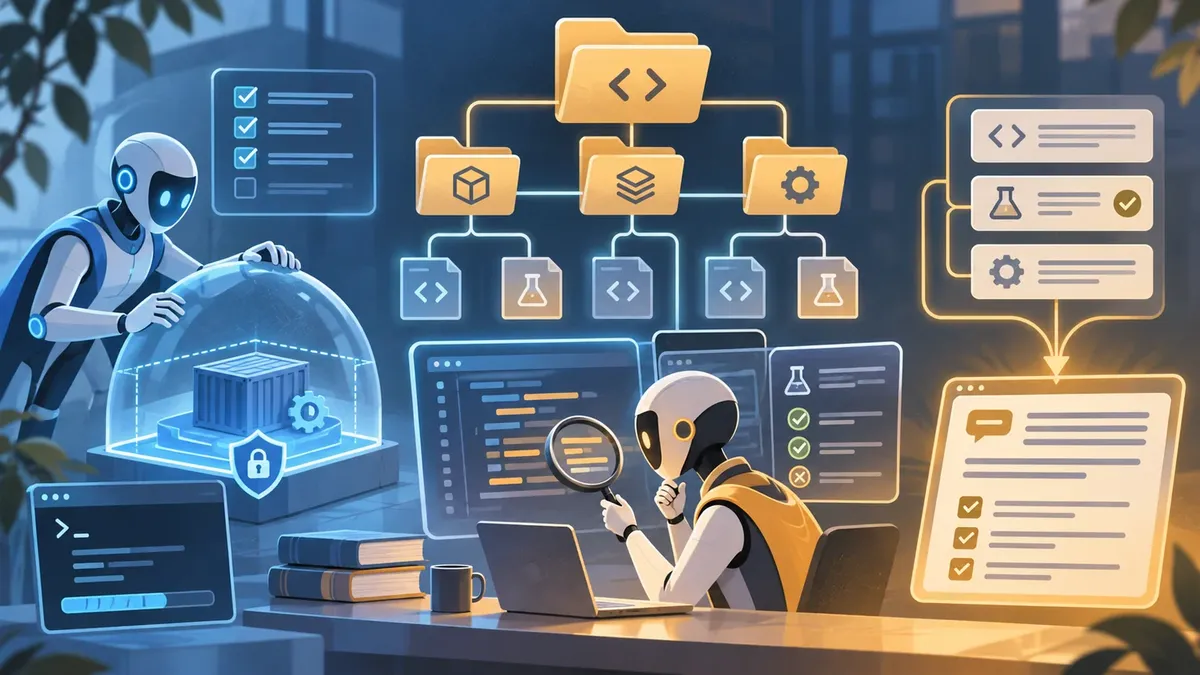
Understanding a software project takes more than reading one file: clues can span modules, tests and runtime behavior. RepoEviAgent builds questions that probe this broader understanding, while RepoEviQA tests how coding agents reason about real codebases.
A coding agent may explain one function yet struggle to trace how several parts of a project work together. RepoEviAgent is a pipeline for creating questions about real software repositories, with answers grounded in code and, when useful, execution. Its accompanying benchmark, RepoEviQA, tests how well models explore and reason about those codebases.
The researchers began with 8,477 open-source repositories and about 2.48 million pull-request records. They filtered for changes they judged to have meaningful effects on software behavior, using issue–pull request alignment, constraints on change size, test changes and quality assessments. The paper describes two language models used for these assessments. The process was intended to exclude low-value examples such as documentation-only changes and mechanical refactoring.
Next, specialized agents take on different jobs. An environment-building agent examines a repository and attempts to prepare a Docker-based setup. A separate question-and-answer synthesis agent explores the project and drafts questions, reference answers and scoring criteria. When relevant, it can run tests or other code to check its reasoning. Validation checks the constructed environment, while automated judging assesses proposed answers against rubrics. The paper distinguishes environments where repository tests run successfully, those where only basic builds or imports work, and unusable setups.
The framework generated 28,467 candidate question-and-answer tasks, from which the authors selected 334 for RepoEviQA. The benchmark draws on 168 repositories, five programming languages—Python, TypeScript, Go, C++ and C—and eight software-engineering categories. The authors report that all selected tasks received manual review for reference-answer accuracy and rubric reliability. Tasks count as successful only when answers meet every required rubric criterion. Claude Opus 4.6 serves as the unified verification model for evaluations.
The researchers tested five coding models with the same lightweight agent setup, which lets each model inspect repositories and use shell commands. Overall pass rates ranged from 24.85% to 76.35%; GLM-5.3 had the highest reported rate, completing 255 of 334 tasks. These results describe performance on this benchmark under its particular setup, not a universal ranking of coding ability.
Scores also varied by task type and language. Across the five models, average pass rates were lower for concurrency and asynchronous-pattern questions than for API and library integration. Language-level averages differed as well. These are descriptive results from the benchmark: they do not show that one programming language is inherently easier, or explain why models perform differently. The paper includes a task-distribution figure, but its extracted rendering is damaged, so fine-grained distribution details are not reproduced here.
The authors also report a separate training experiment. Fine-tuning two model configurations on synthesized data improved their results on a subset of another benchmark. That experiment is distinct from the five-model RepoEviQA comparison and does not establish how broadly the gains transfer.
There are limits to what the findings show. RepoEviQA contains hundreds of tasks from repositories meeting the authors’ selection criteria, so it cannot represent every kind of software project or engineering work. Automated environment construction and language-model judgments may introduce errors; manual review helps, but cannot guarantee their absence. The shared agent scaffold makes the model tests more consistent, while still tying results to that scaffold and evaluation procedure. The category and language comparisons are descriptive, not controlled evidence about the causes of performance differences.
The supplied paper text includes a conference-style citation with placeholder publication details, which does not establish publication or review status. Its extracted tables and figures are also partly damaged, limiting verification of some detailed comparisons. RepoEviAgent offers a method for building repository questions that can incorporate execution evidence; whether its benchmark and synthesized training data generalize to other projects and evaluation settings remains an open question.
- coding agents
- software engineering
- repository question answering
- AI benchmark
- code execution
- RepoEviAgent
Reviewed cross-references
These connections were reviewed by a model, not independently fact-checked by a human. Similarity does not imply agreement; consult the original papers and the evidence below.
SlackBench tests how AI agents reconstruct a project from scattered evidence
Shared method: Both papers use rubric-based criteria and model-based judging to assess agent outputs: RepoEviAgent checks synthesized repository-Q&A answers against structured rubrics, while SlackBench uses LLM judges for query answers and checklist-based partial credit for summaries. The tasks and evidence differ—repository code and runtime behavior versus collaborative conversations and project artifacts—so this is a methodological overlap, not comparable performance evidence.
Model review: · openai-codex/gpt-6-luna
Evidence and provenance
Selected excerpts, not complete papers. PDF extraction can omit figures or damage equations, tables and reading order; sources may be preprints.
2611.31873v1 — Original paper
Excerpt reference:
static/papers/2611.31873v1.md:443-527
Basis: Paper text
Source SHA-256:a75bdb7ea9417da5285c868a02a78f8dfe759d7fa5a5b2396a76030d80386aff2611.05512v1 — Original paper
Excerpt reference:
static/papers/2611.05512v1.md:308-345
Basis: Paper text
Source SHA-256:2c76c2f1d75ac59b194a35b293be07958cf780583c6980b6bccb3fd5312703b52611.05512v1 — Original paper
Excerpt reference:
static/papers/2611.05512v1.md:241-301
Basis: Paper text
Source SHA-256:2c76c2f1d75ac59b194a35b293be07958cf780583c6980b6bccb3fd5312703b5
CodeTeam gives AI repository coding a team structure
Shared method: Both frameworks include execution-based verification in agent workflows: RepoEviAgent builds and validates sandbox environments and may run tests or verification code to ground Q&A tasks; CodeTeam uses a QA agent to run tests and drive repairs. Their purposes differ—benchmark-task construction versus generating repositories from requirements—and their reported scores use different benchmarks, so the excerpts do not support a direct performance comparison.
Model review: · openai-codex/gpt-6-luna
Evidence and provenance
Selected excerpts, not complete papers. PDF extraction can omit figures or damage equations, tables and reading order; sources may be preprints.
2611.31873v1 — Original paper
Excerpt reference:
static/papers/2611.31873v1.md:209-269
Basis: Paper text
Source SHA-256:a75bdb7ea9417da5285c868a02a78f8dfe759d7fa5a5b2396a76030d80386aff2611.31873v1 — Original paper
Excerpt reference:
static/papers/2611.31873v1.md:443-527
Basis: Paper text
Source SHA-256:a75bdb7ea9417da5285c868a02a78f8dfe759d7fa5a5b2396a76030d80386aff2606.22082v2 — Original paper
Excerpt reference:
static/papers/2606.22082v2.md:13-52
Basis: Paper text
Source SHA-256:507b939f089e60f8a0fe1404aad872832d6ae6d8625db326d26c35f947809062
Related reading
Automatically matched by shared topic keywords. These links do not imply that the sources agree or establish a consensus.
Can Coding Agents Build Programs That Play Modern Games?
Source published
Shared keywords: ai benchmark
Testing AI coding agents on branching clinical rules
Source published
Shared keywords: ai benchmark, coding agents
Can Coding Agents Make Staff-Level Decisions?
Source published
Shared keywords: software engineering
Teaching Coding Agents the Hidden Structure of On-Device AI
Source published
Shared keywords: coding agents, software engineering
A tougher coding benchmark finds leading AI agents still struggle to finish the job
Source published
Shared keywords: software engineering