TRANSMISSION // 2611.31871v1
Small asteroids can wobble while spinning at astonishing speeds
Source published
A telescope survey identified 32 small, fast-spinning near-Earth asteroids that tumble. The results suggest tumbling is common, but its size trend and physical causes remain uncertain.
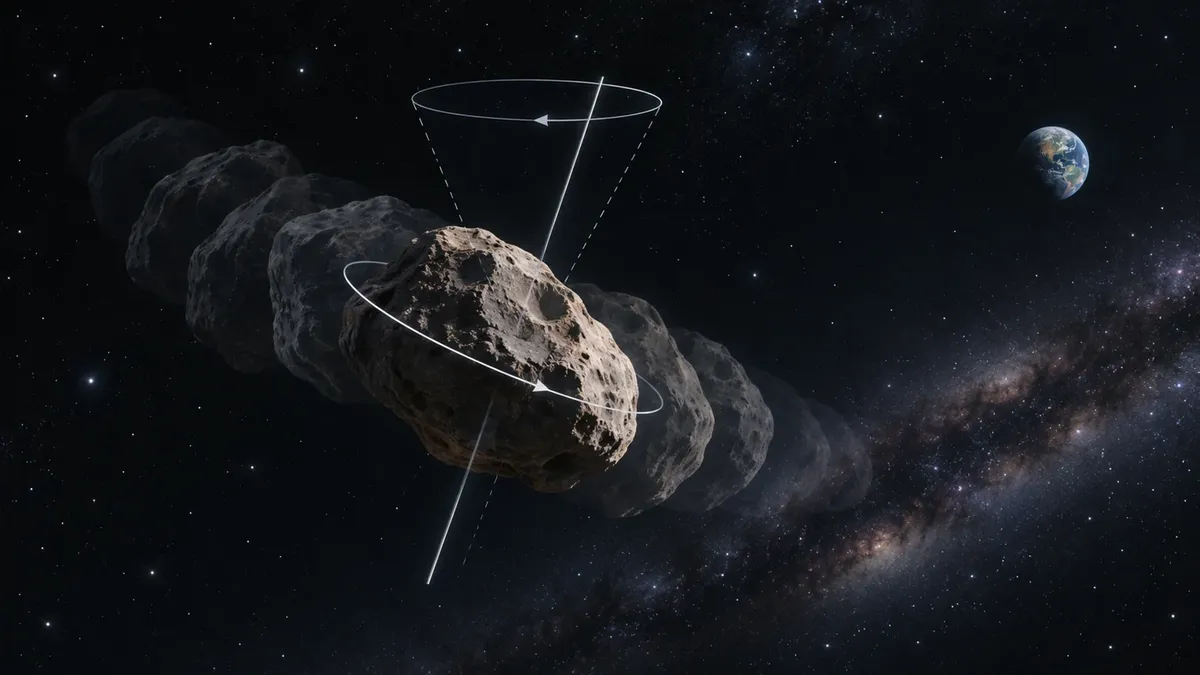
Asteroids do not always spin smoothly around one axis. A survey of small near-Earth asteroids finds that many fast rotators instead tumble, with their motion combining spin and wobble. The observations also leave important questions open about how often tumbling occurs and what sets these bodies in motion.
A small asteroid can spin so quickly that a single rotation takes less than a minute—and it may not be spinning neatly around one axis. Instead, it can tumble: its orientation changes through a combination of rotation and wobble. A new survey finds this motion in dozens of fast-spinning near-Earth asteroids, offering a closer look at a poorly measured population.
The research team analysed observations from the Two-meter Twin Telescope at Teide Observatory in the Canary Islands. The telescope survey, described in an earlier paper in the series, recorded the changing brightness of small asteroids at high cadence. As an asteroid turns, its brightness can vary because its shape presents different surfaces to the observer. For a tumbler, the changing orientation can produce a more complicated pattern than a simple repeating spin.
The researchers first identified light curves whose leftover variations could not be explained well by a model with one rotation frequency. They then fitted those observations with a model containing two independent frequencies, representing the coupled motion. A statistical test was used to assess whether the more complex model improved the fit enough to count as evidence for tumbling.
Of 42 candidate objects, 32 met the study’s criterion for non-principal-axis rotation—the technical term for tumbling. For 14, observations reliably resolved both periods; for the other 18, tumbling was detected but the second period was not well constrained. The shorter fitted periods ranged from about 0.48 to 29.5 minutes, and the longer ones from about 2.15 to 46.4 minutes. Estimated diameters span roughly 7 to 140 metres, with sizes inferred using an assumed surface reflectivity.
One object, 2025 FB8, stands out: its shorter measured period is about 71 seconds, and its estimated diameter is around 7 metres. The authors describe it as the smallest and fastest tumbler characterised with both periods reliably resolved to date. These measurements do not, by themselves, reveal exactly how the asteroid is shaped or which fitted period corresponds to its physical rotation rather than its precession.
How common is tumbling?
In the survey’s comparison sample, 25 of 156 confirmed fast rotators were identified as tumblers, a fraction of 16%. The reported fraction was 13.8% for objects with absolute magnitude below 26 and 22.5% for those at or above 26. Absolute magnitude is a measure of brightness; in this sample, higher values broadly indicate smaller objects.
That apparent increase towards smaller sizes is suggestive, not conclusive. The statistical test did not find a significant difference between the two size groups. There is also a detection bias: observing sessions lasted about 40 to 120 minutes, making tumblers harder to identify when their second period is long compared with the observing window. The researchers note that this could cause tumblers among larger objects to be missed more often, exaggerating the apparent size trend. A larger sample and a careful estimate of detection efficiency would be needed to establish how the true fraction varies with size.
The observations also offer clues—but not a direct measurement—about asteroid structure. Twenty-three of the 32 tumblers fall above the estimated spin limit for a cohesionless rubble pile, a loose collection of material held together mainly by gravity. None exceeds the modelled limit for lunar-regolith-like material. This is consistent with a need for some internal cohesion, but does not require a solid, monolithic interior. Individual interpretations are uncertain because estimated sizes depend on assumed reflectivity, and the shorter fitted period is not necessarily the physical rotation period.
The authors discuss several possible ways to create or sustain tumbling: impacts that break up a larger body, splitting of a spinning rubble pile under YORP—the gradual torque caused by absorbed and re-emitted sunlight—or more complex spin evolution driven by that same effect. The survey does not determine which pathway applies to any particular asteroid. Nor can its single-session observations reliably establish the population’s balance between long-axis and short-axis tumbling: only eight objects met the extra criteria for a tentative mode assignment, and all eight were consistent with long-axis motion.
The work is a preprint presented as an Astronomy & Astrophysics manuscript, not evidence here of peer-reviewed publication. Its findings come from a particular observing sample and model-based classifications; the paper says the underlying photometry and derived parameters are to be made available through public databases. Follow-up observations, especially longer time coverage, could sharpen the periods and test the proposed physical explanations.
- near-Earth asteroids
- asteroid rotation
- tumbling asteroids
- YORP effect
- photometry
- asteroid interiors
Related reading
Automatically matched by shared topic keywords. These links do not imply that the sources agree or establish a consensus.