TRANSMISSION // 2611.31867v1
Teaching quantum circuits to grow
Source published
A hybrid machine-learning workflow extrapolates circuit structure and rotation angles for holographic quantum circuits. In simulations of W states, it generated circuits beyond the training sizes, but broader quantum-simulation benefits remain untested.
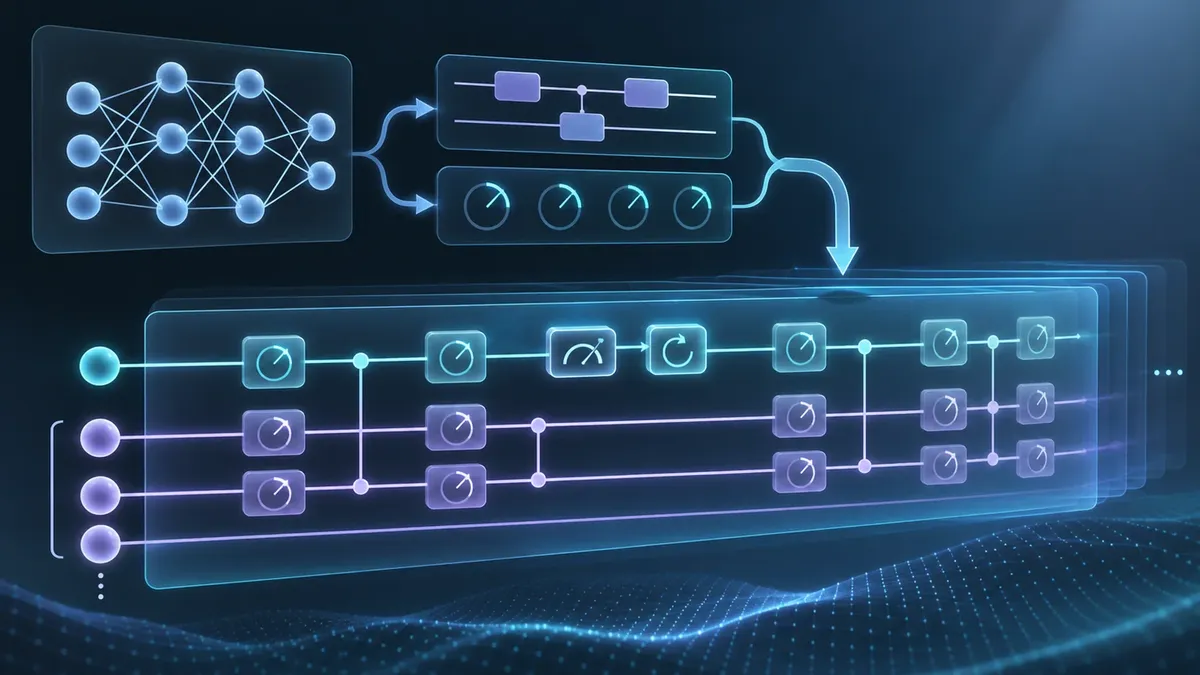
Holographic quantum circuits can represent large quantum states using a small set of repeatedly measured and reset qubits. A new preprint explores whether machine learning can extend these circuits beyond examples used in training, testing the idea on a tractable family of quantum states.
Why try to scale a quantum circuit this way?
Quantum computers can represent complex many-particle states, but designing circuits that prepare those states is difficult. One approach borrows from tensor networks: mathematical structures that describe a large object through smaller pieces connected by shared indices. In a holographic quantum circuit (HQC), physical qubits interact with persistent ancilla qubits. Physical qubits can be measured and reset during the computation, while information is carried forward through the ancillas.
This arrangement can generate samples from a much larger quantum state without requiring a separate physical qubit for every part of that state. The paper asks whether machine learning can extend an HQC’s gate sequence and settings to larger systems, potentially helping with circuit design as targets grow.
Separate the circuit’s recipe from its settings
The authors divide the task into two parts. A circuit’s syntax is its recipe: which gates are applied, to which qubits, and when measurements and resets occur. Its parameters include numerical settings such as rotation angles.
For parameters, they use a Long Short-Term Memory (LSTM) neural network, which processes sequences and predicts how a pattern continues. For syntax, they fine-tune a pretrained large language model to produce an openQASM circuit “skeleton”—a script specifying gates and operations but leaving rotation angles blank. The predicted angles are inserted into that skeleton, and post-processing adds measurement instructions.
The workflow is tested on the standard W state and a generalized version. A generalized W state is a superposition of computational-basis states in which exactly one qubit is 1. For each possible location i, the state’s amplitude is √pᵢ, so measuring the state gives that location with probability pᵢ. The standard W state is the equal-weight case. Because these states have known circuit constructions, they provide a way to check whether generated circuits reproduce the intended measurement statistics.
For the angle-prediction tests, the LSTM was trained on examples up to six qubits and evaluated on larger sizes up to 15. The language model learned circuit syntax from examples up to ten qubits and was tested on sizes up to 15. The end-to-end demonstration combined both models to prepare an 11-qubit generalized W state. The authors compared its simulated measurement distribution with the analytical target.
What the tests showed—and what they did not
In these benchmarks, the LSTM extrapolated rotation-angle patterns beyond its training sizes, and the fine-tuned language model generated circuit structures for longer examples. For the 11-qubit test, the generated circuit’s simulated distribution agreed closely with the analytical target. The paper reports a total-variation distance of 1.3 × 10⁻² and attributes the nonzero difference to finite sampling.
This is a proof of principle for a specific, analytically tractable family of states. It does not demonstrate that the method can design circuits for arbitrary quantum states or enable quantum simulations beyond classical computing. The end-to-end evaluation used the Qiskit Aer simulator; the paper does not report an experiment on quantum hardware. Its results therefore do not establish how the workflow would perform on a device.
The authors identify more complex targets, including correlated ground states of quantum spin chains, as future work. They also point to challenges such as learning more complicated circuit syntax as the number of ancilla qubits increases, and consistently representing ancilla degrees of freedom across states. Success on W states alone cannot show whether the learned patterns will transfer to these harder cases.
The result is best understood as a demonstration of a split strategy: use one model for circuit numbers and another for circuit structure, then combine their outputs. The work is available as an arXiv preprint. Its narrow benchmark supports the workflow in this particular setting; whether it can help scale more complex quantum simulations remains an open question.
- holographic quantum circuits
- quantum computing
- machine learning
- tensor networks
- quantum simulation
- W state
Related reading
Automatically matched by shared topic keywords. These links do not imply that the sources agree or establish a consensus.
When machine learning meets quantum-state preparation
Source published
Shared keywords: machine learning, quantum computing
A tensor-network method targets larger exciton simulations
Source published
Shared keywords: quantum simulation, tensor networks
A cluster-based route to cooler fermion simulations
Source published
Shared keywords: quantum simulation, tensor networks
A hybrid route to longer quantum simulations
Source published
Shared keywords: quantum simulation, tensor networks
When can quantum-state compression preserve an invariant?
Source published
Shared keywords: quantum simulation, tensor networks