TRANSMISSION // 2611.31860v1
Working from home may shift what South Korean households throw away
Source published
A study of South Korean districts finds little change in total household waste after 2020, but different patterns for plastic, textiles and food.
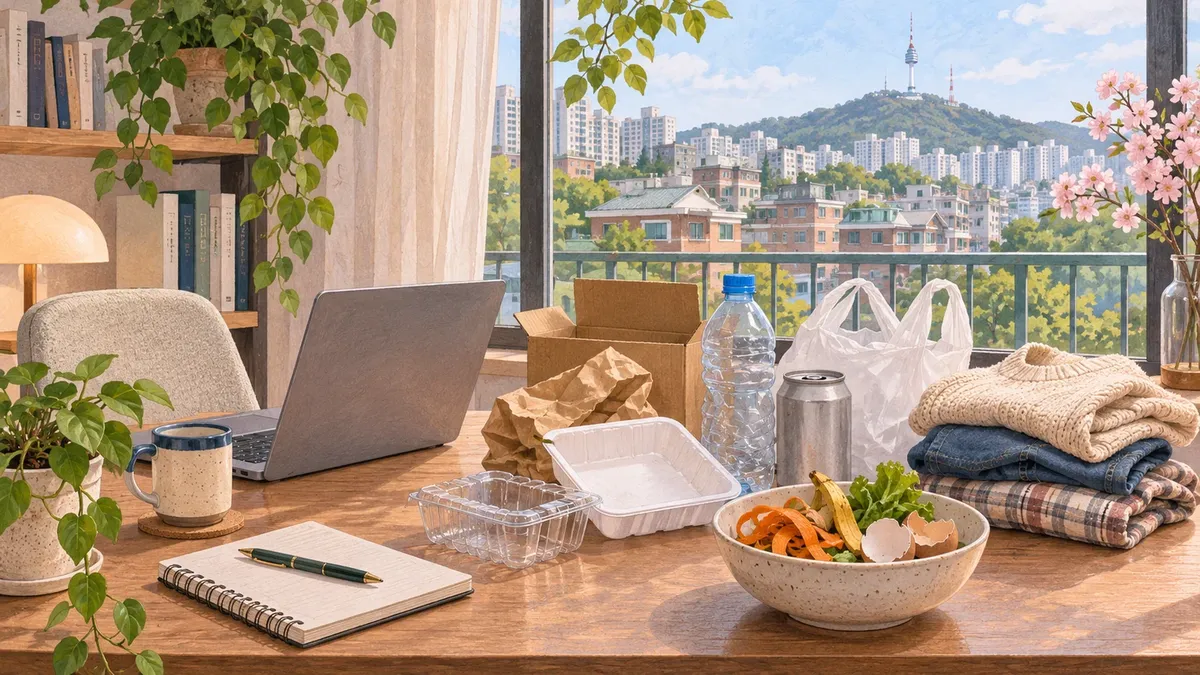
Remote work can change where people spend their day—and potentially what they buy, use and discard. A study of South Korean districts links greater work-from-home eligibility to shifts in several waste categories, even though total household waste did not significantly change.
Remote work moves some daily routines from offices to homes. That shift may affect more than commuting: it can change where people eat, what they consume and the materials they throw away. But does a region with more jobs that can be done from home also show a different pattern of household waste?
Hyoungchul Kim and Hee-Seung Yang examine that question in South Korea. They use the COVID-19 period as a shock in their research design, comparing waste patterns across districts that differ in the share of jobs considered feasible to do remotely. Their analysis suggests that waste categories may shift even when the overall amount per household does not show a statistically significant change.
Comparing districts before and during the COVID-19 period
The researchers assembled annual waste data for 162 South Korean districts from 2016 to 2021. The records cover total household waste and categories including food, plastic and textile waste. To account for differences in district size, the main analysis expresses waste relative to the number of households in 2016.
The study does not directly measure how many people in each district actually worked from home. Instead, it estimates each district’s work-from-home eligibility: the share of local workers employed in occupations considered feasible to perform remotely. The authors combine occupation-specific eligibility estimates with local employment data, using a measure based on job characteristics such as field work, equipment needs and interaction with the public. The district measure is drawn from 2019, before the COVID-19 period.
The authors use a difference-in-differences approach. In broad terms, this compares how waste changed after 2020 across districts with different levels of remote-work eligibility. The specification includes district and year fixed effects, measured district characteristics, and location-specific time trends. For those trends, the authors group districts into 34 travel-to-working areas. The design relies on the idea that, absent the shock, districts with different eligibility levels would have followed sufficiently comparable waste trends.
The total stayed broadly similar; categories moved in different directions
The study reports no statistically significant change in total household waste associated with a district’s work-from-home eligibility. That is not proof that the effect was exactly zero; it means the analysis did not distinguish the estimated change from zero using its statistical criteria.
The category-level results point to a different pattern. Districts with higher remote-work eligibility saw increases in plastic and textile waste and a decrease in food waste. In the paper’s main estimates, a one-unit increase in its eligibility measure corresponds to 0.031 more tons of plastic waste and 0.010 more tons of textile waste per household. The measure ranges from zero to one, so these estimates describe a full-unit change in eligibility—not a one-percentage-point change.
The authors offer possible explanations, not demonstrated mechanisms. More activity at home could mean more household consumption and plastic packaging. A decline in food waste might reflect changes in eating routines, such as preparing food at home or altered lunch habits.
The researchers also draw on a 2022 survey of 3,000 people to compare time use among people who did and did not work from home. They use t-tests to examine reported activities, including commuting and daily routines. This is a separate cross-sectional comparison: it can describe differences between the groups, but does not establish that working from home caused those differences or explain the district-level waste results.
What the design can—and cannot—show
The authors report that the main category-level patterns remain similar under several specification changes. These include using a less detailed occupational measure, excluding Seoul, Daegu and Gyeongsangbuk-do, accounting for regional differences in COVID-19 infections, and changing how waste is scaled. Such checks test whether results are sensitive to those selected choices; they do not establish why the patterns occurred or rule out every other explanation.
A key distinction is between eligibility and actual remote work. The measure captures the occupational composition of a district, not how often its workers worked from home. The causal interpretation also depends on the parallel-trends assumption: without the COVID-19 period, districts with different eligibility levels would have had comparable changes in waste, after accounting for the modeled factors. The authors’ event-study estimates show no statistically significant differences in the pre-period for the outcomes examined, but that is not proof that the assumption holds.
Other pandemic-era changes in shopping, food service, employment or local conditions could also matter. Annual data may conceal short-term fluctuations, and district-level patterns do not show how individual households behaved. The findings concern South Korea during 2016–2021, not every country or later remote-work arrangement.
The paper is dated March 2024 and is available as an arXiv preprint. This article is based on the supplied paper text; the source record does not establish peer-review status. The results are best read as evidence of an association interpreted through the authors’ research design, rather than proof that working from home alone caused each change.
- remote work
- work from home
- household waste
- plastic waste
- textile waste
- food waste
- South Korea
- COVID-19
Related reading
Automatically matched by shared topic keywords. These links do not imply that the sources agree or establish a consensus.
AI Job Ads Promise More Than Higher Pay—but the Benefits Vary
Source published
Shared keywords: remote work
AI-exposed occupations show fewer young workers, not a clear fall in total jobs
Source published
Shared keywords: remote work
When COVID-19 data produce competing causal maps
Source published
Shared keywords: covid 19