TRANSMISSION // 2611.31851v1
Can AI agents model how people react emotionally to events?
Source published
A synthetic social simulation reproduced some broad emotional patterns in social-media data, but its agents differed from people—especially in anger—and should not be treated as human substitutes.
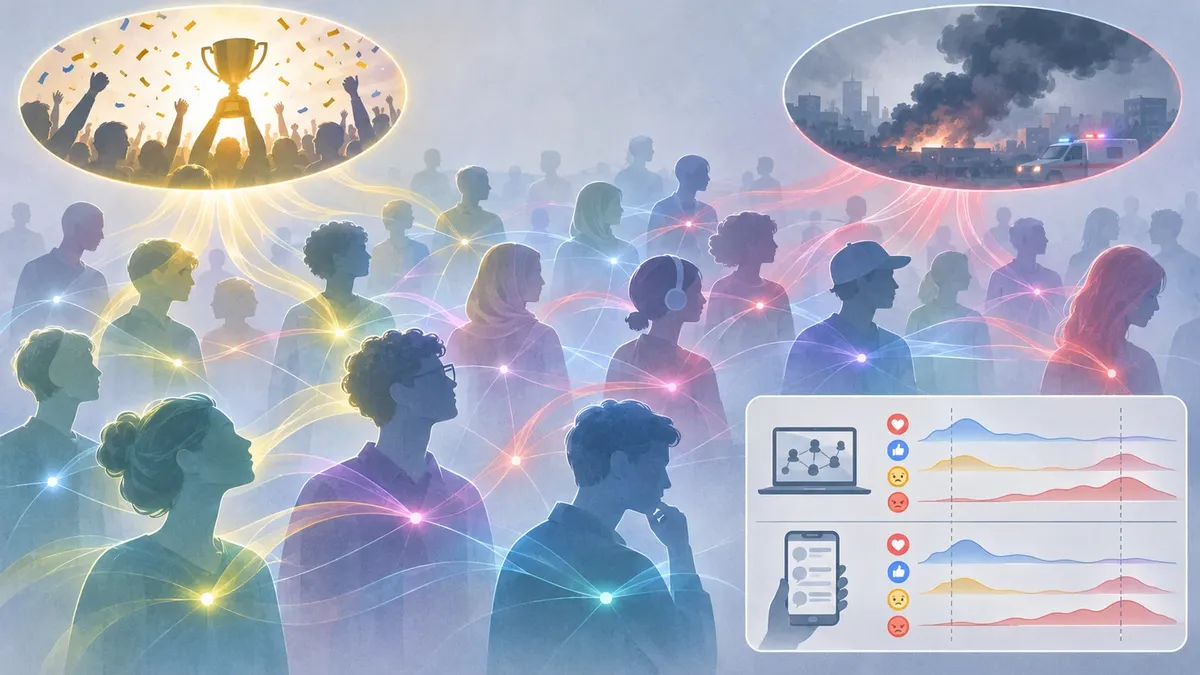
Researchers built language-model agents with demographic, personality and event details, then compared their emotional responses with Facebook reaction data. The results suggest these simulations can capture some population-level patterns, while also revealing important gaps and limits.
Emotions can shape how people interpret events and respond to one another. Yet many computer models of social behavior focus more on changing opinions than on emotional expression. Rebecca Marigliano, Peter Carragher and Kathleen M. Carley explore whether large language model (LLM) agents can help fill that gap—and how closely their responses resemble patterns observed in real social-media data.
Their study, available as a preprint, models synthetic people reacting to public events. The researchers created 537 fictional personas in the United States and Canada. Each was assigned demographic characteristics, a community, personality traits and moral values. Prompts also supplied information about the event, the persona’s stance and how important the topic was to them. The intent was to give the model more structure than a simple instruction to write a post as a particular person.
The agents used GPT-4o-mini to generate social-media-style responses. They reacted to two main events: the 2022 overturning of Roe v. Wade and the expansion of the 988 Suicide & Crisis Lifeline. Responses were shared through a simulated network over ten rounds, so agents could receive other personas’ posts as conversational context. The researchers also ran a supplementary analysis of COVID-19 vaccine discourse.
To test the role of prompting, they compared conditions that added persona details in stages, from demographics alone to combinations of personality, moral values and event-specific emotion cues. Automated tools assessed emotional intensity, relevance to the topic and consistency with the assigned persona. For a separate check against real-world patterns, the team compared the simulation’s aggregate emotional responses with Facebook reactions to event-related links in the Social Science One URL Shares Dataset.
That comparison has an important boundary: Facebook reactions are not direct measurements of what users felt. The study treats them as signs of emotional engagement, and compares patterns across groups—not individual people’s emotions with individual agents’ responses. Reaction labels also do not map neatly onto the emotion categories used to analyze the generated text.
The model produced different emotional profiles for the two main events. The Roe v. Wade scenario was more polarized, while the 988 scenario was more centered on sadness and support. Responses also varied across demographic and political groups. In the prompt comparisons, adding more contextual and psychological details improved the study’s automated scores for intensity, topical relevance and consistency with a persona’s assigned profile.
Those improvements do not show that the most detailed prompt produced the “right” human emotion. Persona consistency measured whether responses fit the researchers’ assigned traits, not whether real people with those traits would have responded the same way. The researchers themselves emphasize this distinction. A fluent post that matches a profile is not proof that the model reproduces human psychology.
The external comparisons found both overlap and mismatch. The synthetic agents reproduced some broad demographic and event-related patterns, but their emotional responses did not match Facebook reactions in every respect. The paper reports that anger was underexpressed relative to human baselines; it also describes simulated responses as smoother and, in some cases, less extreme than the Facebook patterns. For moralized topics, the authors note a different concern: the personas could show amplified polarization. The direction of error therefore depends on the pattern being examined.
These findings are preliminary. The evaluation focuses on a limited set of events and mostly U.S. and Canadian contexts, and all experiments used the same LLM backend. The personas’ political orientations were based on scenario and online-engagement assumptions rather than census measurements. Social-media reactions offer only an indirect comparison, while the automated text classifier and the simulation’s prompt design may also shape the results. The authors call for testing across more cultures, platforms, time periods and event types, and for further calibration before high-stakes use.
The practical takeaway is not that language models can stand in for people. Rather, structured prompts may help create simulations that reproduce some broad emotional patterns, while systematic differences—such as muted anger—show why comparisons with human data matter. The paper is a preprint, and its results should be read as early evidence rather than settled validation or proof that these agents capture human emotional experience.
- large language models
- social simulation
- synthetic personas
- emotion modeling
- social media
- computational social science
Reviewed cross-references
These connections were reviewed by a model, not independently fact-checked by a human. Similarity does not imply agreement; consult the original papers and the evidence below.
When do AI-generated survey answers reflect real patterns?
Supporting evidence: Both studies show why aggregate agreement should not be treated as proof that synthetic outputs match people at the individual level: Marigliano et al. report interpretable emotional and demographic patterns but explicitly reject psychological equivalence, while D’Ecclesiis et al. distinguish distributional and substantive validity from respondent-level prediction. The comparison is limited to different tasks and datasets—event reactions versus Eurobarometer AI-attitude responses—and does not establish that either result generalizes beyond its setting.
Model review: · openai-codex/gpt-6-luna
Evidence and provenance
Selected excerpts, not complete papers. PDF extraction can omit figures or damage equations, tables and reading order; sources may be preprints.
2611.31851v1 — Original paper
Excerpt reference:
static/papers/2611.31851v1.md:185-280
Basis: Paper text
Source SHA-256:79fd17cfe10ea0736340880ccfff605699eed65824bbd5e4d4cd9232b215799e2611.00256v1 — Original paper
Excerpt reference:
static/papers/2611.00256v1.md:66-134
Basis: Paper text
Source SHA-256:46777b88afc4efa0a0ede050e011ecaa6b808b714abe8c9bb8be40dc25aa315c2611.00256v1 — Original paper
Excerpt reference:
static/papers/2611.00256v1.md:135-214
Basis: Paper text
Source SHA-256:46777b88afc4efa0a0ede050e011ecaa6b808b714abe8c9bb8be40dc25aa315c
AI models produce different opinion dynamics under the same discussion rules
Supporting evidence: Both papers report limitations that matter when interpreting LLM social simulations: Marigliano et al. find emotional-expression gaps, including underrepresented anger, and call for calibration; Djurdjevac Conrad et al. find that opinion drift under discussion differs by LLM. Together these findings support checking model-specific behavior rather than assuming simulated outcomes are interchangeable. The studies examine different outcomes and protocols, so they do not show that the emotional-expression gap causes opinion drift.
Model review: · openai-codex/gpt-6-luna
Evidence and provenance
Selected excerpts, not complete papers. PDF extraction can omit figures or damage equations, tables and reading order; sources may be preprints.
2611.31851v1 — Original paper
Excerpt reference:
static/papers/2611.31851v1.md:12-98
Basis: Paper text
Source SHA-256:79fd17cfe10ea0736340880ccfff605699eed65824bbd5e4d4cd9232b215799e2611.31851v1 — Original paper
Excerpt reference:
static/papers/2611.31851v1.md:1852-1956
Basis: Paper text
Source SHA-256:79fd17cfe10ea0736340880ccfff605699eed65824bbd5e4d4cd9232b215799e2611.03980v1 — Original paper
Excerpt reference:
static/papers/2611.03980v1.md:13-42
Basis: Paper text
Source SHA-256:5eeb9775ffa09e40eb9892dba882e32b216e28bcd25a52fc5a8c9449b2c07b832611.03980v1 — Original paper
Excerpt reference:
static/papers/2611.03980v1.md:441-469
Basis: Paper text
Source SHA-256:5eeb9775ffa09e40eb9892dba882e32b216e28bcd25a52fc5a8c9449b2c07b83
Related reading
Automatically matched by shared topic keywords. These links do not imply that the sources agree or establish a consensus.
AI models produce different opinion dynamics under the same discussion rules
Source published
Shared keywords: computational social science, large language models, social simulation
Personality-tuned chatbots did not improve role-play
Source published
Shared keywords: large language models, social simulation
When Is an AI Bias an Interaction?
Source published
Shared keywords: large language models, synthetic personas
Why changing an AI rating scale can change the score
Source published
Shared keywords: computational social science, large language models
AI Twins Can Rehearse a Meeting—but Do They Judge Like You?
Source published
Shared keywords: large language models, social simulation