TRANSMISSION // 2611.31841v1
How “color” algebra reframes unusual particle statistics
Source published
A review explains how graded algebra can describe paraparticles and anyons, and what theoretical signatures might distinguish them from familiar particles.
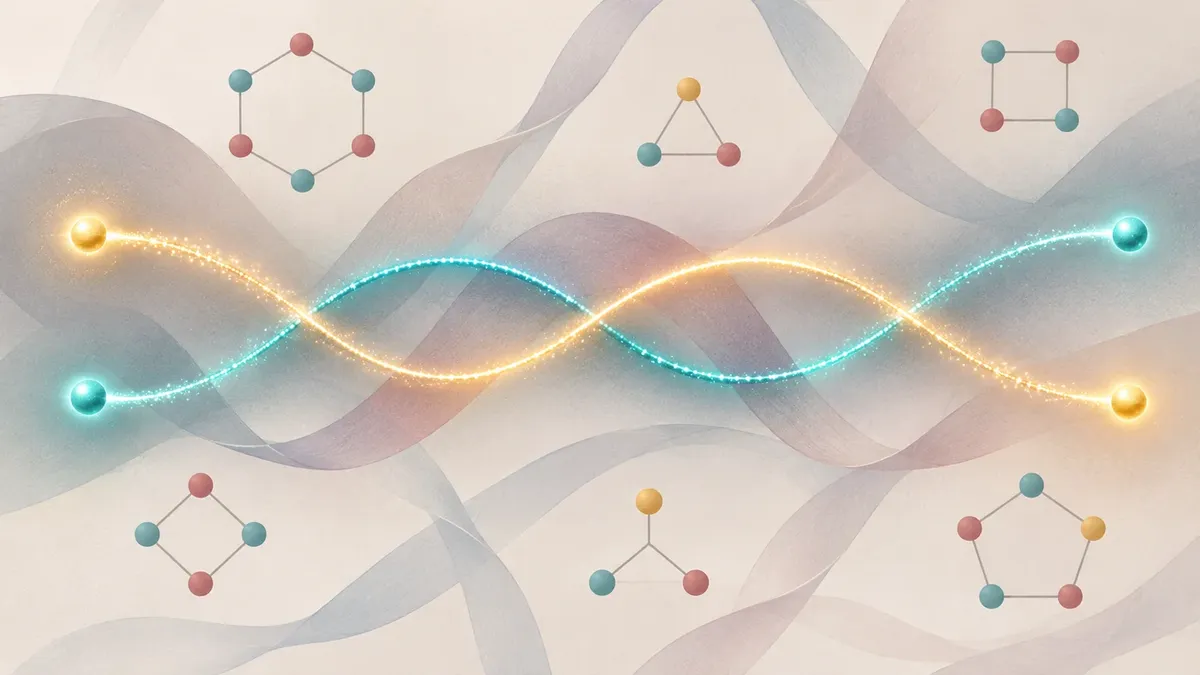
Bosons and fermions are not the only mathematical possibilities for quantum particles. Francesco Toppan’s review introduces “color” Lie (super)algebras as a framework for describing broader exchange rules—and for asking whether those rules could leave measurable signatures.
The exchange of identical quantum particles is usually introduced through two familiar cases: bosons and fermions. But mathematical physics allows other possibilities. This review by Francesco Toppan asks how a family of mathematical structures called color Lie (super)algebras can help describe these alternatives, collectively known as parastatistics, and what physical differences they might produce.
The article is a survey and introduction, not a report of a new experiment. Its central idea is that the algebra used to describe particle operators can be organized by a grading: each operator is assigned a label from an abelian group, and the labels determine how pairs of operators commute or anticommute. In more general cases, exchanging their order can multiply the result by a phase other than plus or minus one. The resulting brackets obey generalized versions of the familiar Lie-algebra rules.
Two kinds of exchange rules
The review distinguishes two broad settings. In permutation-group parastatistics, exchanges are described by the same permutation group used for ordinary particle statistics, but the particles may follow rules beyond bosonic or fermionic ones. The paper describes theoretical models in which such paraparticles could produce observable differences, including changes to measurable position probabilities or energy spectra. It also stresses an important limitation: permutation-group paraparticles have not yet been experimentally detected. Demonstrating that parastatistics can be manipulated in a laboratory is not, by itself, proof that an observation cannot be reproduced by ordinary bosons or fermions.
Anyons involve a different mathematical structure. In two spatial dimensions, the paths made as particles move around one another can form braids. Their exchange rules can therefore be represented by the braid group rather than only by permutations. The review discusses models in which more general abelian grading groups allow color-algebra brackets to encode braid-related behavior. One example is a model whose exchange operations include phases associated with roots of unity. In the model described, those phases can change probability distributions or restrict which energy levels occur.
These are theoretical signatures within specified models, not a general demonstration that every particle with unusual statistics will be detectable. Nor does a formal resemblance to anyons establish that a particular system is an experimentally realized anyon. The article draws on earlier work to motivate its framework and describes the color-algebra approach as a way to organize and extend such constructions.
What the review contributes—and what it does not
Toppan’s method is mathematical synthesis: the paper introduces the graded-algebra definitions, explains how different grading groups lead to different exchange rules, and sketches previously proposed oscillator and quantum-mechanical models. It then connects these constructions to the braid statistics of anyons, including a color-algebra description of braided Majorana qubits developed in earlier work. There is no new laboratory dataset or experimental measurement reported here.
That distinction matters because the evidence has different levels. The algebraic relations establish what follows inside a mathematical model. Calculated spectra and probability distributions can offer possible signatures if the model’s physical assumptions are realized. Whether an actual experiment can isolate those signatures from ordinary particle behavior is a separate question. The review itself says that permutation-group paraparticles remain experimentally undetected and presents practical detection as an open challenge.
The article also makes broad claims about the recent state of the field, including the significance of particular earlier papers. Those claims should be read as the author’s account of a developing research area, not as an independently assessed consensus. The supplied version is an arXiv preprint, and its mathematical presentation is complex; this accessible account focuses on its stated framework and examples rather than independently verifying every technical derivation or historical judgment. As with any preprint, its claims may be revised or evaluated further through peer review.
The useful takeaway is not that a new particle has been found. Rather, the review argues that color Lie (super)algebras provide a common mathematical language for studying exchange behaviors that go beyond the familiar boson–fermion distinction. The next step—especially for paraparticles—is to turn a theoretical difference into an unambiguous experimental signature.
- anyons
- parastatistics
- color Lie algebras
- quantum statistics
- braid group
- quantum physics
Related reading
Automatically matched by shared topic keywords. These links do not imply that the sources agree or establish a consensus.
Quantum nonclassicality is a problem of fitting the pieces together
Source published
Shared keywords: quantum physics
How fast can Yang–Baxter circuits grow in complexity?
Source published
Shared keywords: quantum physics
A broader message-passing method for tensor networks
Source published
Shared keywords: quantum physics
Why Some Thermal Quantum Memories Need Redundancy
Source published
Shared keywords: quantum physics
How Non-Invertible Symmetries Classify Quantum Pumps
Source published
Shared keywords: quantum physics