TRANSMISSION // 2611.31836v1
An AI model predicts where people look—and when they shift
Source published
Gaze World Model combines video prediction with person-specific gaze tracking to detect and forecast shifts on two benchmarks. Its results are promising, but depend on the datasets and annotation rules.
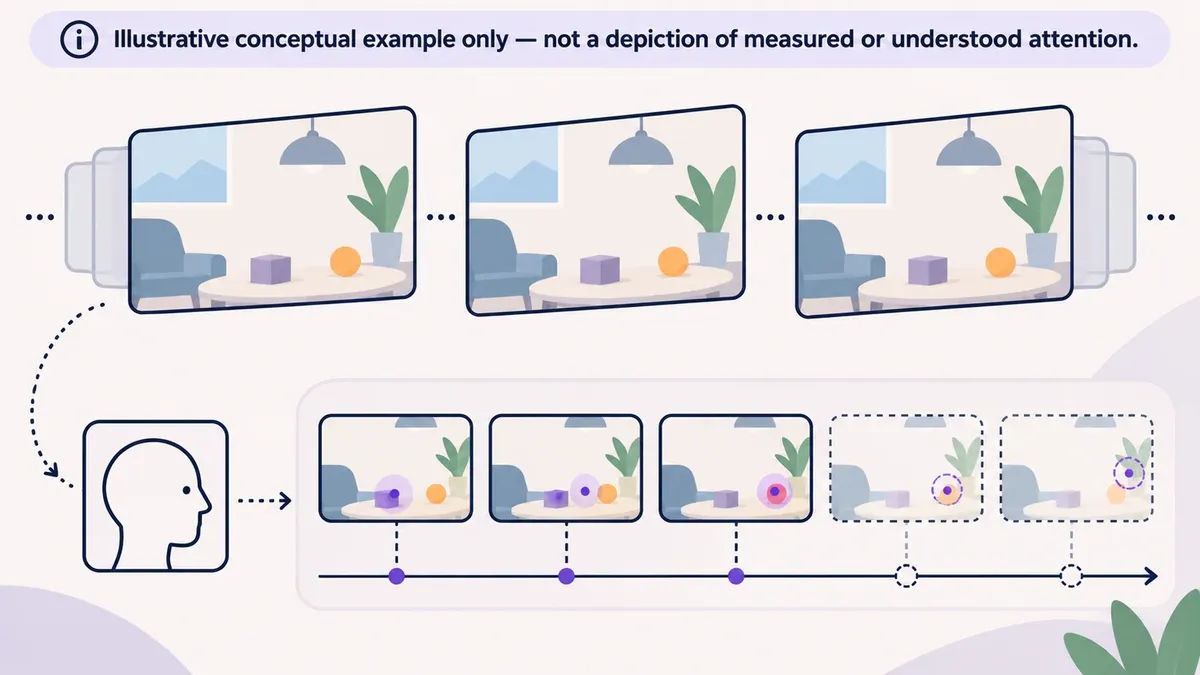
A scene can change without a person making a large head movement. Gaze World Model uses video context to estimate where a specified person is looking and predict whether their gaze will shift—tasks the researchers tested on two existing video benchmarks.
A person’s gaze location offers one clue to what they are looking at. Following how that location changes over time can add information that a frame-by-frame estimate misses. Many gaze-estimation systems focus on locating gaze in individual frames, or use time mainly to improve those estimates, rather than explicitly detecting and forecasting transitions between targets.
The researchers behind Gaze World Model (GWM) ask whether learning how a scene changes can help a model detect how a particular person’s gaze changes in response. The task is subtle: an event elsewhere in the frame may prompt only a slight movement of the person’s eyes or head.
Learning about scenes and gaze
GWM takes a video clip and a bounding box around the specified person’s head. It uses a pretrained video encoder, V-JEPA 2.1, whose visual parameters stay frozen. The model conditions scene features on the person, then estimates gaze locations and detects shifts in the observed clip. A prediction branch forecasts future scene features in the encoder’s representation; the model uses those predicted features to forecast future gaze and shifts.
This is not a system that generates future video frames. During training, its predicted scene features are compared with features extracted from actual future frames. Those future frames are not model inputs when it makes a forecast.
The team also created event-level shift annotations using two existing datasets, VideoAttentionTarget and ChildPlay. A semi-automated process proposes candidate transitions using gaze points and image segmentation, checks them with a multimodal model, and routes cases for human review when they meet specified quality or ambiguity criteria. The researchers also audited a random 15% of annotations. Unresolved cases were excluded. The resulting annotation set contains 6,204 confirmed transitions; training uses 15,086 video windows.
These counts come with an important qualification: the dataset’s labels define a specific kind of shift. The benchmark counts transitions involving a person, such as moving attention between people or between a person and an “other” target. “Other” includes objects, background regions and out-of-frame targets. A shift between two “other” targets is not counted as an in-scope event. The annotation keys for objects also do not guarantee that the same physical object is tracked consistently over time.
Stronger shift detection in these tests
On the two benchmarks, GWM outperformed the compared systems on the reported shift-detection measures. The paper reports a 9.8-point lead in four-class average precision over the strongest baseline. The four classes distinguish three types of person-involving shift from a window with no in-scope shift. GWM’s gaze-location estimates were comparable to the strongest image-based models, rather than clearly better across the board.
For future predictions, GWM also outperformed the compared baselines on future gaze localization and shift forecasting. The researchers compared future gaze estimates with a simple persistence reference: repeat the last observed gaze point. GWM had lower average future-location error than this reference on both datasets. That result suggests its predictions go beyond simply keeping attention at its last estimated location in this evaluation; it does not establish how well the model will forecast gaze in other settings.
Ablation tests—experiments that remove or change components—help clarify the results. Removing the temporal trunk lowered four-class shift average precision and worsened gaze-location error on both datasets, though not every metric moved in the same way. In the reported comparisons, adding the latent scene-prediction objective improved gaze localization and four-class average precision. A three-seed comparison found a statistically significant improvement in four-class average precision, but the difference in four-class F1 did not reach statistical significance. Increasing the objective’s weight did not consistently improve results, underscoring that its effect depends on how the model is trained.
What the findings do—and do not—show
These are benchmark results, not evidence that GWM understands a person’s intentions. The model classifies annotated gaze patterns; it does not determine why someone looked elsewhere. Its shift tasks use video windows: detection does not predict exact event boundaries, and forecasting asks whether a qualifying shift begins in a future interval.
The tests also have practical limits. They use fixed observation and forecast windows, and the authors identify longer context, finer timing, automatically detected head boxes, and more detailed object tracking as areas for future work. Their annotation process includes both automated checks and human review, but they call for broader audits and measures of agreement among independent annotators. One forecasting baseline was reimplemented because its code was unavailable, which is another reason to interpret comparisons in light of the study’s methods.
The work is available as an arXiv preprint, which may not have undergone peer review. Its results support a specific conclusion: on these two benchmarks, combining person-conditioned gaze supervision with predicted scene features improved several gaze-shift and forecasting measures. Whether that advantage transfers to other people, videos or applications remains to be tested.
- gaze estimation
- video AI
- world models
- attention
- gaze shifts
- computer vision
Related reading
Automatically matched by shared topic keywords. These links do not imply that the sources agree or establish a consensus.
Why Video AI Misses Brief, Crucial Moments
Source published
Shared keywords: computer vision, video ai
How a drone can move to get a better look
Source published
Shared keywords: computer vision
A robot's-eye view, generated from outside video
Source published
Shared keywords: computer vision, world models
An RL agent that learns to focus on objects and interactions
Source published
Shared keywords: world models
When AI reviews violent video, simpler evidence can work better
Source published
Shared keywords: video ai