TRANSMISSION // 2611.31819v1
Neutron-star crust vibrations may probe nuclear matter
Source published
An article summarizing earlier models explores how crust-driven oscillations might relate to neutron-star compactness and nuclear parameters, while emphasizing major uncertainties.
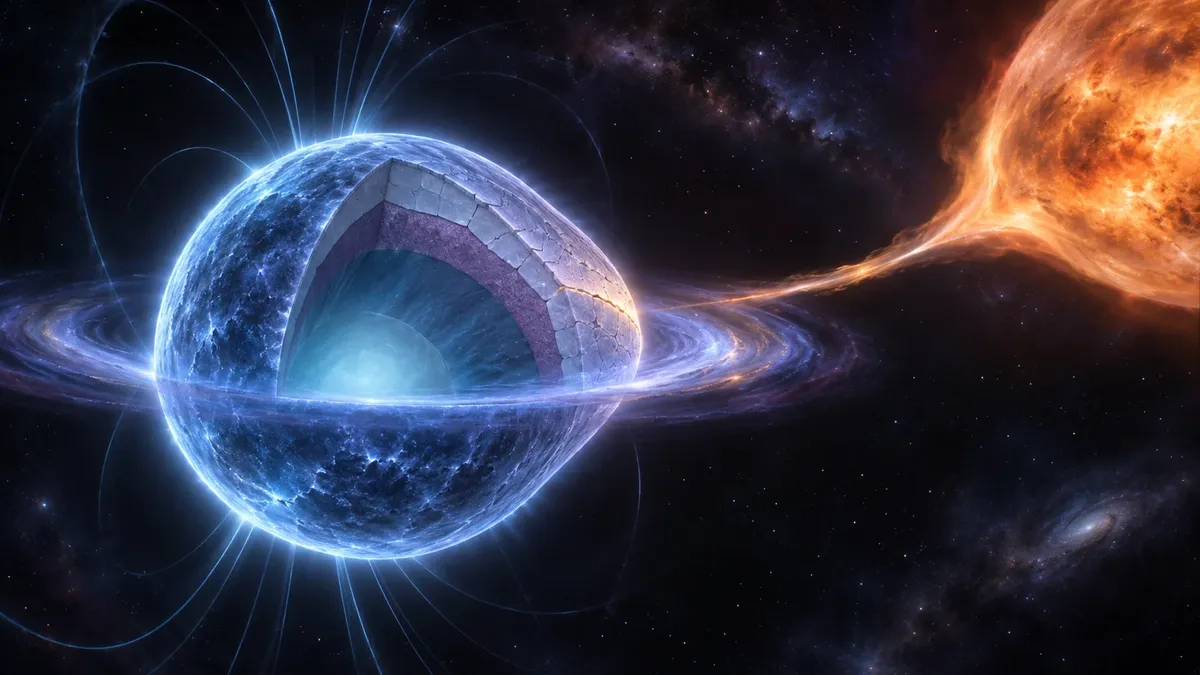
Could vibrations in a neutron star’s elastic crust help reveal properties of nuclear matter? Hajime Sotani’s article reviews earlier modeling of shear and interface modes and fitting formulas linking their frequencies to stellar compactness and selected nuclear parameters. These are theoretical tools, not detected signals or validated measurements of the star’s crust.
What neutron-star vibrations might reveal
Neutron stars are extraordinarily dense stellar remnants, and their internal structure remains uncertain. Asteroseismology—inferring a star’s properties from its oscillations—could offer another way to study them if suitable signals can be observed and identified.
Hajime Sotani’s article focuses on two kinds of polar oscillations associated with crustal elasticity: shear modes, labeled s-modes, and interface modes, labeled i-modes. Interface modes arise at boundaries between regions with and without elastic strength. The article asks how these frequencies relate to a star’s compactness and to two nuclear-matter parameters: the incompressibility of symmetric nuclear matter, K₀, and the slope of the nuclear symmetry energy, L.
The possibility is indirect and prospective. During a binary neutron-star inspiral, tidal forces might excite a mode. In some scenarios, a strong response could help produce an electromagnetic precursor before a short gamma-ray burst. The article reports no new observation of these modes; it reviews earlier theoretical results and discusses their possible use in future measurements.
What the reviewed models found
The article summarizes results from the author’s previous studies. Those calculations used the Oyamatsu–Iida equation-of-state family, which links properties of matter near nuclear saturation to selected parameters including K₀ and L. That connection is specific to the chosen model family: the article cautions that those parameters alone do not determine the full equation of state or the crust’s composition and elasticity.
For the higher-density core, the earlier studies also used a specific prescription in which pressure varies linearly with energy density, corresponding to selected constant sound speeds. Within these models, the radius-scaled shear-mode frequencies and mass-scaled interface-mode frequencies could be fitted as functions of compactness, largely independent of the tested core stiffness. This is a model-dependent result, not a general claim that core properties never matter.
The studies then fitted the frequency relations using compactness and combinations of K₀ and L. The reported accuracy differs considerably by mode. Shear-mode fits were generally within about 1% for the modeled stars, except for unrealistic low-mass cases. For interface modes, the first-mode fit was accurate to a few percent and the third to about 10%; the second- and fourth-mode fits could be wrong by an order of magnitude. The authors also note that the chosen combinations of nuclear parameters are not unique. These figures describe fits within the examined models, not guaranteed accuracy for realistic stars.
Important limits on interpretation
A measured frequency would not by itself determine K₀ and L. The formulas relate frequencies to stellar properties as well as nuclear parameters, so additional information—such as mass and radius estimates—would be needed. Even then, one frequency would generally constrain a combination of parameters rather than determine them separately. Combining independent observations might narrow the possibilities, provided the mode is correctly identified and the model relations apply.
The calculations also simplify the star’s composition. They use a barotropic description, which excludes composition-driven gravity modes. Earlier work cited in the article finds that, in stratified models, the familiar crust-core interface mode can be replaced by modes mixing interface and gravity-mode character. The spectrum may therefore differ when composition gradients are included. The article also identifies neutron superfluidity as an omitted factor that could shift frequencies. In its crust model, slab-like nuclear matter is assigned zero shear modulus; giving that region nonzero elasticity could change the number of interface modes and shift shear-mode frequencies.
Another caution concerns the Cowling approximation, which neglects changes in the gravitational field while matter oscillates. Comparisons that include spacetime metric perturbations found shear-mode frequencies agreeing to about 1%, but interface-mode frequencies differed by roughly 20%. The first interface mode was higher in the Cowling calculation and the second lower. The cause of this discrepancy was not established. The article says interface-mode fitting formulas should be recalculated with metric perturbations included before realistic parameter extraction.
Finally, the manuscript identifies itself as a summary of earlier work and displays placeholder journal information, including “Journal Not Specified.” It should not be taken as peer-reviewed evidence or as proof that the relations hold across realistic equations of state. The proposed route from future oscillation measurements to crust physics remains conditional on better observations and broader, more realistic modeling.
- neutron stars
- asteroseismology
- crust elasticity
- shear modes
- interface modes
- nuclear equation of state
Reviewed cross-references
These connections were reviewed by a model, not independently fact-checked by a human. Similarity does not imply agreement; consult the original papers and the evidence below.
Nuclear pasta may reshape a young neutron star’s crust
Supporting evidence: Both studies make the symmetry-energy slope L relevant to neutron-star crust properties: Sotani relates elastic-mode frequencies to saturation parameters within a restricted EOS family, while Zhou et al. find that changing L in their RMF models changes the predicted pasta phases. This is complementary model-based context, not a direct test of the frequency relation; the pasta study does not calculate oscillation modes, and Sotani notes that correlations may not survive more flexible EOS variations.
Model review: · openai-codex/gpt-6-luna
Evidence and provenance
Selected excerpts, not complete papers. PDF extraction can omit figures or damage equations, tables and reading order; sources may be preprints.
2611.31819v1 — Original paper
Excerpt reference:
static/papers/2611.31819v1.md:1563-1626
Basis: Paper text
Source SHA-256:4c592b911a08e9b3367853c1603836612cf85c0cff7e20fb1ad3f406f59f18732611.31819v1 — Original paper
Excerpt reference:
static/papers/2611.31819v1.md:443-492
Basis: Paper text
Source SHA-256:4c592b911a08e9b3367853c1603836612cf85c0cff7e20fb1ad3f406f59f18732603.16220v2 — Original paper
Excerpt reference:
static/papers/2603.16220v2.md:2420-2510
Basis: Paper text
Source SHA-256:4ea62559163ba8ab4178554b2bc036837ee6727ef2ca0b7da5ccaf05f0f69766
Related reading
Automatically matched by shared topic keywords. These links do not imply that the sources agree or establish a consensus.
How Neutron-Star Vibrations Shape Gravitational Waves
Source published
Shared keywords: neutron stars
Neutron-star tides may matter more near merger
Source published
Shared keywords: neutron stars
Magnetar Crust-Shock Simulations Find Little Heavy-Element Production
Source published
Shared keywords: neutron stars
Nuclear pasta may reshape a young neutron star’s crust
Source published
Shared keywords: neutron stars
Simple patterns emerge in models of magnetic neutron stars
Source published
Shared keywords: neutron stars