TRANSMISSION // 2611.31817v1
The Hidden Directions That Make a Neural Network Work
Source published
A study of vision networks finds that a small, task-sensitive part of their internal representations can preserve much of their performance. The approach also shows promise for analyzing task-specific features, adversarial vulnerability and continual learning, though its results have important limits.
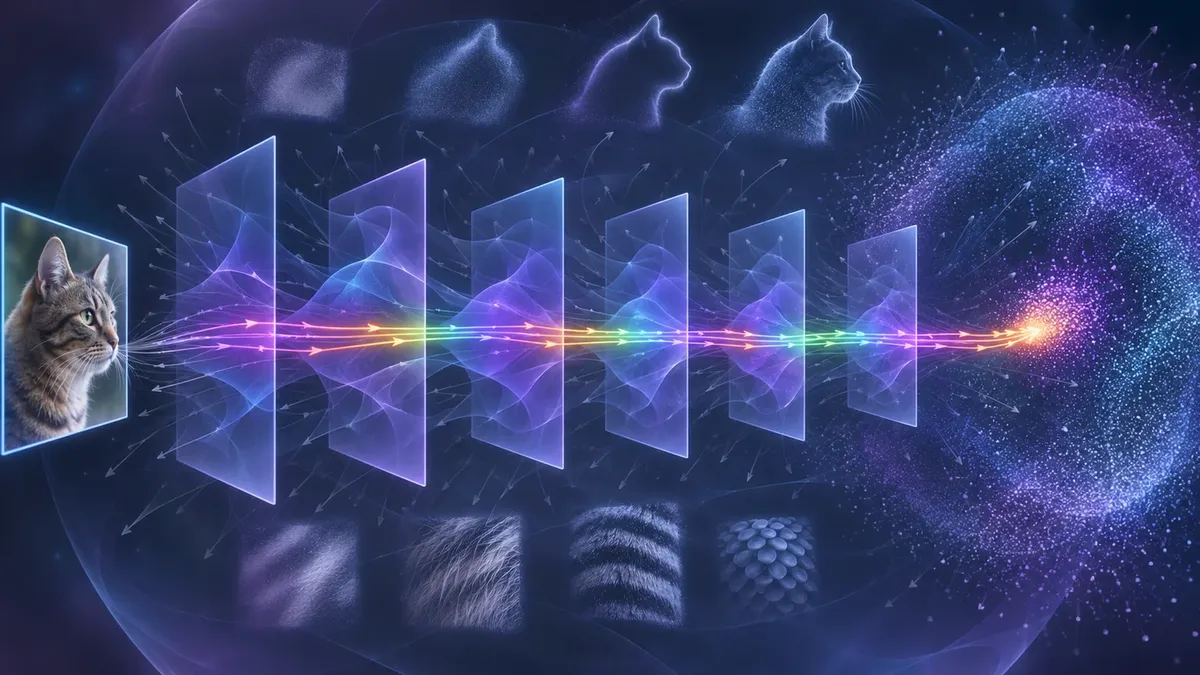
A neural network may represent an image using hundreds of numbers at each layer. But does its decision depend equally on all those directions? A new study proposes a way to identify which changes to a network’s internal representation most affect what it computes—and tests whether keeping those directions can preserve performance with fewer dimensions.
Finding the directions that matter
Deep networks turn inputs into layers of numerical representations. These can be high-dimensional, but high dimensionality alone does not tell us which parts of a representation actually matter for a model’s output. A direction may vary greatly across images yet have little effect on the answer; another may vary less but strongly influence the result.
Niranjan Rajesh and Meenakshi Khosla introduce a method for distinguishing those cases. At each layer, they calculate a task-sensitivity matrix using how changes to the hidden representation affect downstream outputs. In everyday terms, it estimates how much the model’s later computation responds to a small nudge in each direction. The researchers then keep the directions with the greatest estimated influence and project the representation into that smaller subspace.
They compare this behavior-focused approach with alternatives that preserve other properties: overall variance (PCA), local neighborhood relationships, or a summary of intermediate-scale geometric structure. The central test is practical: after reducing the representation’s dimensions, does the network still perform its task?
Compression depends on what is preserved
In a pretrained Vision Transformer evaluated on ImageNet, a middle layer could be reduced from 768 dimensions to 77 task-sensitive directions while retaining 94.1% top-5 accuracy, compared with 95.1% for the uncompressed model. Top-5 accuracy counts a prediction as correct when the right class appears among the model’s five highest-ranked choices.
The advantage over geometric methods varied with depth. Early in the network, PCA could do as well as or better than task-sensitivity-based compression. At middle layers, however, preserving variance or geometric structure could lose much more accuracy. For example, at one tested middle layer with 10% of dimensions retained, task-sensitive compression achieved 93.8% top-5 accuracy; PCA achieved 27.9%. The authors suggest that some low-variance directions can still matter to the network’s later computation.
The study also compressed all layers under a shared dimension budget. At 30% of the total dimensions, task-sensitive compression reached 89.5% top-5 accuracy, compared with 15.3% for PCA. These are results from particular models and evaluation setups, not a guarantee that the same compression will work across architectures or tasks.
A tool for studying different kinds of influence
The authors apply the method to more than compression. In experiments using images that combine one object’s shape with another’s texture, they identified shape-sensitive and texture-sensitive directions in vision models. Removing the shape-sensitive directions selectively harmed shape classification, while removing texture-sensitive directions selectively harmed texture classification. The two subspaces were substantially distinct, though the paper reports some overlap rather than complete separation.
For continual learning—where a model learns new tasks in sequence and may forget earlier ones—the team used task-sensitive directions to guide gradient updates away from subspaces important to previous tasks. Their method, called Fisher Gradient Projection Memory, matched or outperformed a variance-based projection baseline on six of eight architecture-and-dataset combinations. It did not win in every case: the variance-based method retained an advantage for ResNet-18 in both CIFAR settings. The paper notes that its Jacobian-based estimate may interact poorly with batch normalization in that architecture.
They also report that compressed representations performed better under a specific adversarial test in some settings. There is an important caveat: the adversarial images were generated against the original, uncompressed networks and then tested on compressed versions. Some of the apparent benefit may therefore reflect that those attacks transfer less effectively, rather than greater resistance to newly tailored attacks. In addition, compression of the final layers could increase vulnerability.
What the results do—and don’t—establish
The method provides a useful distinction: the directions that preserve a representation’s geometry are not necessarily the directions that preserve a model’s behavior. But the task-sensitivity matrix estimates local, linear sensitivity. It does not capture all nonlinear interactions across layers, and estimates may be less reliable farther from the output. The experiments focus mainly on pretrained vision networks and specified ImageNet and CIFAR benchmarks; broader tests are needed before applying the conclusions to other model types or tasks.
The paper identifies itself as a NeurIPS 2026 submission and reports publicly available code. That status is not, by itself, evidence of peer review or acceptance. The authors also note in the paper’s checklist that compute-resource details are incomplete. As with any preprint, the results should be read as research claims to assess, not settled conclusions.
For now, the study’s “functional spine” is best understood as a practical way to locate directions that seem especially important to a model’s current task. It offers a route to testing what a network relies on—but does not show that the remaining dimensions are useless for every purpose, including future tasks or changes in behavior.
- neural networks
- representation compression
- computer vision
- task sensitivity
- continual learning
- adversarial robustness
Reviewed cross-references
These connections were reviewed by a model, not independently fact-checked by a human. Similarity does not imply agreement; consult the original papers and the evidence below.
A Two-Way Projection to Help AI Learn Without Forgetting
Supporting evidence: Both papers report benefits from subspace-based constraints in continual learning: Rajesh and Khosla say constraining updates orthogonal to prior tasks’ task-sensitive representation subspaces outperformed variance-based projection, while Tan et al. report DUET’s bidirectional Jacobian-null-space projection outperformed unidirectional methods on their benchmarks. These are different constraints and experimental settings, so the results are compatible but do not directly validate one another.
Model review: · openai-codex/gpt-6-luna
Evidence and provenance
Selected excerpts, not complete papers. PDF extraction can omit figures or damage equations, tables and reading order; sources may be preprints.
2611.31817v1 — Original paper
Excerpt reference:
static/papers/2611.31817v1.md:13-74
Basis: Paper text
Source SHA-256:149b2cd9e63fa126b81c3d940e630eddb94845c49233c4d346d457148e2182d62611.29269v1 — Original paper
Excerpt reference:
static/papers/2611.29269v1.md:1165-1214
Basis: Paper text
Source SHA-256:e05369052774970982e75bb1e6d4d54be62a2c2b153c917704fad1baceebd7b1
Related reading
Automatically matched by shared topic keywords. These links do not imply that the sources agree or establish a consensus.
How normalization can hide extreme sensitivity in deep neural networks
Source published
Shared keywords: adversarial robustness
Can Fixed Reservoir Features Support Continual Learning?
Source published
Shared keywords: computer vision, continual learning
A Two-Way Projection to Help AI Learn Without Forgetting
Source published
Shared keywords: computer vision, continual learning
A compact vision model for defects across product lines
Source published
Shared keywords: computer vision, continual learning
Teaching Motion-Prediction Models the Near Future First
Source published
Shared keywords: computer vision, continual learning