TRANSMISSION // 2611.31797v1
An AI Agent Models Drivers’ Blind Spots at Intersections
Source published
A preprint describes a traffic-simulation agent designed to reproduce how human-driven vehicles interact when other vehicles block their view.
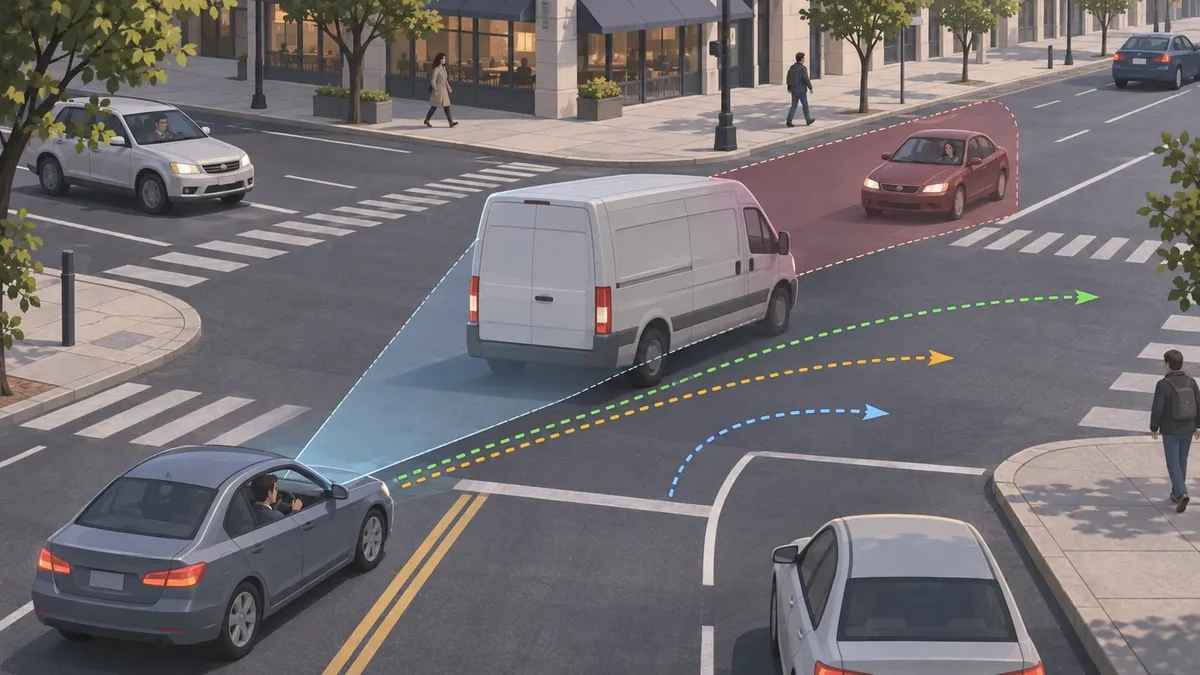
Automated-driving tests depend on how simulated human drivers react to nearby traffic. A new agent aims to model those interactions while accounting for vehicle occlusion and different driving styles. Its evidence comes from trajectory data at two intersections, with the main evaluation focused on one of them.
A simulated driver with a complete view of every nearby vehicle might react in ways a real driver could not. In traffic, one vehicle can block another from view, changing what a driver knows and how they respond. That makes modeling visibility relevant to testing automated-driving systems in complex urban scenes.
Jia Hu and colleagues present a generative AI agent designed to emulate human-driven vehicles (HDVs) in interactive traffic. The question is whether it can reproduce the patterns of safety-critical encounters—not just vehicle paths—while accounting for occlusion and allowing different styles of response.
How the agent works
The agent uses a field-of-view mask to model which surrounding vehicles are visible to the target driver. Its method accounts for vehicle occlusion: traffic hidden behind another vehicle is excluded from the information used to generate a response. The paper’s described implementation focuses on vehicle-based occlusion; it does not establish that the system models every source of blocked sightlines, such as buildings.
To capture varied responses, the model uses a dynamic mixture-of-experts network. In plain terms, it learns multiple trajectory experts and activates them according to the interaction context. The authors show that selecting different learned styles can produce different driving responses in the same maneuver, including turns.
A reinforcement-learning stage then makes bounded adjustments to the generated motion. Its rewards are tied to five interaction characteristics: time-to-collision and relative speed at the beginning and end of a speed adjustment, and the adjustment’s duration. These describe aspects of how an encounter unfolds. They are not direct crash counts or proof that an automated vehicle is safe.
What the tests found
The study uses the INTERACTION dataset. The main evaluation, including a subset of encounters with partially occluded traffic, uses the GL intersection. The MA intersection supplies training data for transfer experiments that test the model on GL. The authors compare their system with SMART, which they identify as the baseline, and use Jensen–Shannon divergence (JSD) to measure how closely generated interaction-characteristic distributions match those in recorded data. Lower JSD indicates closer agreement.
On the full set of interacting encounters at GL, the authors report JSD reductions of 39.9% to 87.1% across the five characteristics compared with the baseline. The largest reduction was for final relative speed. They also report similar trajectory-accuracy scores between the methods, despite differences in interaction-distribution scores. This highlights a distinction in their evaluation: similar paths do not necessarily imply similar interaction timing or dynamics.
Ablation tests examine components separately. Adding field-of-view modeling reduced JSD for four of the five characteristics in the occlusion subset, while slightly increasing the score for initial relative speed. The style module reduced JSD across all five characteristics in its test. Residual refinement also reduced JSD compared with imitation learning alone. In the comparison between reinforcement-learning approaches, GRPO had lower JSD than PPO on four of the five characteristics, while PPO scored better on initial relative speed. The paper reports an average JSD reduction of more than 48% for GRPO across the five measures compared with PPO.
For transfer, the authors trained on MA and evaluated on GL. Fine-tuning the transferred model for one epoch brought its scores closer to those of a model trained directly on GL. This is evidence of adaptation in this experiment, not a guarantee of performance across other intersections or driving environments.
What remains uncertain
The work evaluates trajectory data at two intersections; it does not test a deployed automated-driving system on public roads. Similarity to recorded interaction distributions does not show that the agent reduces crashes, makes vehicles safer, or reproduces every relevant real-world encounter. The reported results are bounded by the dataset, selected metrics and evaluation setup.
The authors describe integrating the agent into a closed-loop driving world model as future work. The current study therefore focuses on generating vehicle trajectories and evaluating interaction statistics, rather than a complete visual simulation or end-to-end safety test.
This article is based on an arXiv preprint. The supplied source does not establish that the manuscript has undergone independent peer review. Its results offer a dataset-based test of an approach to modeling vehicle occlusion and interaction styles, not a demonstration of road-ready safety.
- autonomous driving
- traffic simulation
- human-driven vehicles
- vehicle occlusion
- reinforcement learning
- INTERACTION dataset
Related reading
Automatically matched by shared topic keywords. These links do not imply that the sources agree or establish a consensus.
CoSafe coordinates safety interventions across self-driving cars
Source published
Shared keywords: autonomous driving, traffic simulation
A Driving AI That Weighs What Might Happen Next
Source published
Shared keywords: autonomous driving, traffic simulation
Why Accurate Ship Tracking Can Still End in a Collision
Source published
Shared keywords: reinforcement learning
How AXE Selects Driving Paths in Simulation
Source published
Shared keywords: autonomous driving, reinforcement learning
When Should a Driving AI Admit It Hasn’t Seen Enough?
Source published
Shared keywords: autonomous driving