TRANSMISSION // 2611.31766v1
RoMo Hands Builds a Large Text-Paired Hand-Motion Dataset
Source published
RoMo Hands pairs hand-motion sequences with layered captions and benchmarks several kinds of motion generator. Its abstract reports a sharp divergence between semantic alignment and kinematic plausibility, without detailing which models fare better on either measure.
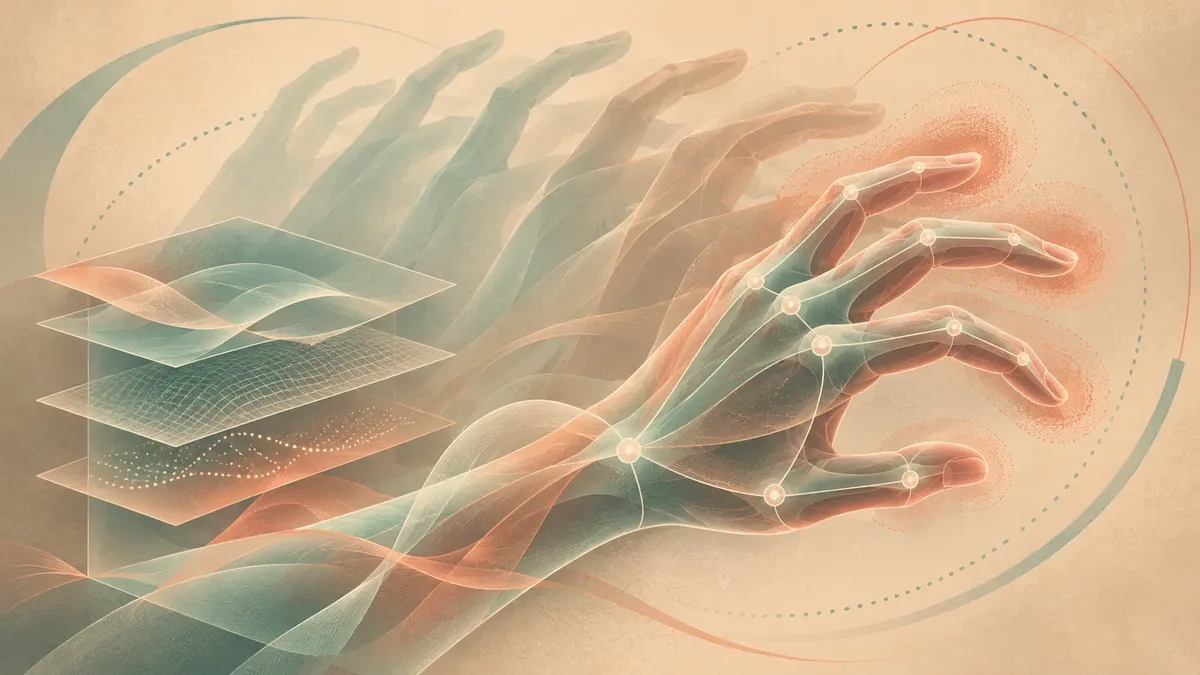
How can an AI system turn a text description into detailed hand movement? The RoMo Hands preprint introduces a large collection of hand-motion sequences paired with descriptions at several levels of detail, along with a shared representation and model benchmarks. Its abstract also highlights a challenge: measures of semantic alignment and kinematic plausibility can diverge.
Generating hand movement from text asks a model to connect language with motion involving many small, coordinated parts. The authors of RoMo Hands argue that progress has been held back by datasets that treat hands as rigid endpoints, lack detailed captions, or are too limited in scale to support robust generalization. Their proposed resource combines motion data, layered descriptions and a benchmark for generative models.
The work is an arXiv preprint. The findings described here come from its abstract, not a full assessment of the paper or independent confirmation.
A large collection with layered captions
The authors report about 542,000 motion sequences, totaling 884 hours and 95.5 million frames recorded at 30 frames per second. They describe the dataset as text-paired and collected “in the wild.” Each clip has five captions at increasing levels of detail, organized in a hierarchy ranging from global semantic tags to more specific finger states.
The dataset is shaped by a dexterity filter: the authors say it discards sequences with little hand articulation, focusing the collection on complex bimanual movement. This describes the filter’s goal; the abstract does not say what proportion of the final sequences are bimanual or provide details about how the filtering was carried out.
The paper also proposes a 393-dimensional representation for both hands. The abstract says this adapts ideas from body-motion representations to the high number of degrees of freedom in hand movement. It does not specify the representation’s precise structure or how it is used within the models.
What the benchmark examines
The authors report systematic benchmarks of three model families: diffusion, masked-token and autoregressive generators. They say their adaptations for hand motion reveal distinct trade-offs, including a “sharp divergence” between semantic alignment and kinematic plausibility.
Those terms point to different evaluation concerns: how generated motion relates to its text description, and how plausible the motion is in kinematic terms. The abstract does not define the measures, give their scores, identify which models show the divergence, or say which measure is higher. So the finding signals that the two evaluation dimensions do not simply move together in the reported results; it does not establish that a particular model matches text well while producing implausible motion.
This distinction matters because a single measure may not capture every aspect of generated movement. The abstract’s reported divergence is a reason to consider both dimensions when evaluating systems, but the supplied evidence is not enough to judge how large the difference is or what causes it.
What remains unclear
RoMo Hands brings together a large reported volume of data, multiple levels of text description, a bimanual representation and comparisons among generator families. These are the contributions described in the abstract, not evidence that hand-motion generation is solved.
The abstract does not provide collection or annotation procedures, benchmark scores, or detailed analyses. Readers would need the full paper to assess those particulars. More broadly, questions about how well the data represent different motions and how benchmark results extend beyond the dataset are questions for further scrutiny, not limitations established by the abstract presented here.
Because the available evidence is abstract-only, this account cannot evaluate the methods in depth or verify the reported findings independently. The source is an arXiv preprint, and the supplied information does not establish whether it has undergone peer review. RoMo Hands is best understood here as a proposed dataset and benchmark, with an abstract-level result pointing to a difference between two ways of assessing generated hand motion.
- RoMo Hands
- hand motion generation
- motion datasets
- text-to-motion
- dexterous movement
- artificial intelligence
Related reading
Automatically matched by shared topic keywords. These links do not imply that the sources agree or establish a consensus.
AI assembles physical mechanisms from equations
Source published
Shared keywords: artificial intelligence
AI is entering big business—but productivity gains remain unproven
Source published
Shared keywords: artificial intelligence
How AI Agents Schedule Useful Information
Source published
Shared keywords: artificial intelligence
AI may reshape public-service work task by task
Source published
Shared keywords: artificial intelligence
When one dominant signal distorts sparse autoencoder scores
Source published
Shared keywords: artificial intelligence