TRANSMISSION // 2611.31746v1
A Shared Framework for Turbulence and Cosmic Halos
Source published
A theoretical preprint proposes scale-space random walks to describe turbulent spectra, halo abundances and halo density profiles. Its reported results are model claims, not observational confirmation.
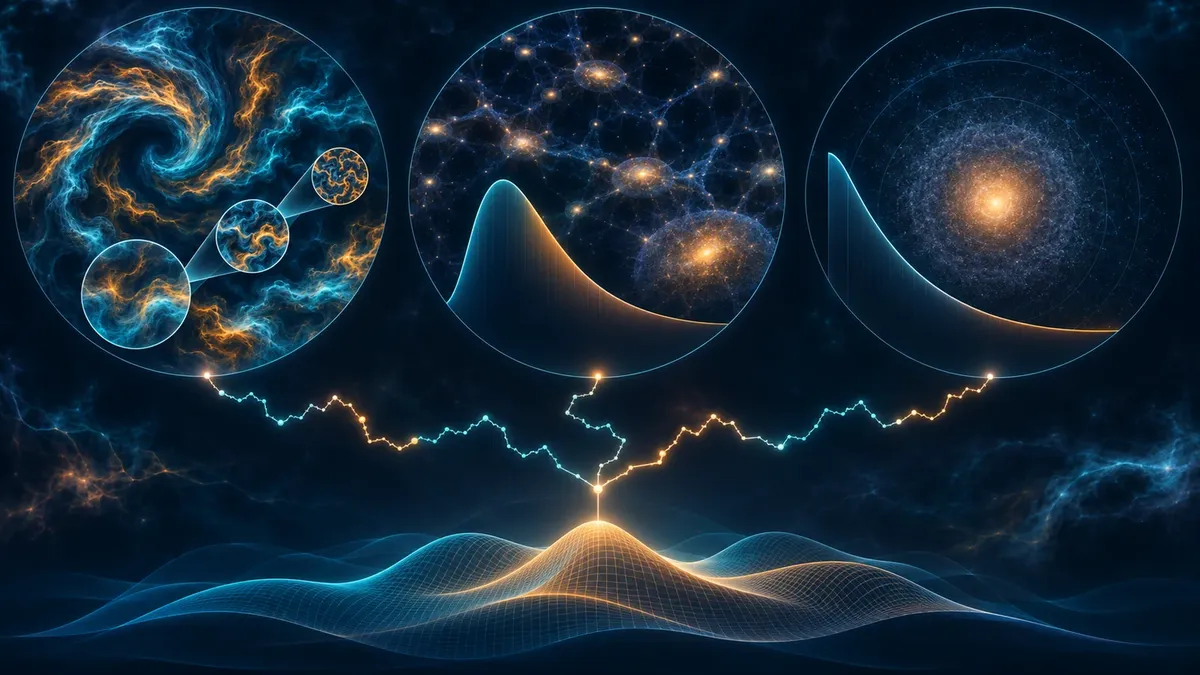
Could a common mathematical framework describe patterns in both turbulent flows and cosmic structure? Zhijie Xu’s preprint proposes scale-dependent random walks for three settings: turbulent wavenumbers, halo masses and radii within individual haloes.
Turbulence and the growth of cosmic structure involve very different physical systems. This theoretical preprint asks whether their changing patterns can be described within a shared stochastic framework: random walks that transport spectra and distributions through “scale space.” The proposal uses distinct walks for each application; it does not claim that the systems follow one identical physical process.
Three applications of scale-space walks
The abstract describes a framework in which the characteristic waiting time for a change depends on scale. It applies this idea to a turbulent cascade in wavenumber space, halo formation in mass space, and the density profile inside an individual halo as a function of radius. The available evidence here is the paper’s abstract, which reports the method and its claimed results but does not provide enough detail to independently assess the derivations or tests.
For turbulence, the author fixes the waiting-time exponent at 2/3 using a self-consistency condition. The model is reported to recover the Kolmogorov −5/3 energy spectrum. It also yields an inertial–dissipation crossover, an exponential cutoff and a spectrum constant, according to the abstract, without applying dimensional analysis directly to the spectrum.
For cosmic structure, the mass-space walk produces what the author describes as a stretched-Gaussian halo mass function that reproduces the Press–Schechter form. The reported small-mass scaling is f_M ∝ m_h^−λ, with an exponential cutoff above the characteristic mass m_h*. The abstract describes “double-λ” behavior: λ reflects the primordial spectrum at low masses and approaches 2/3 near m_h*, where gravity dominates in the model.
A separate radial walk produces a “double-γ” halo density profile that the author says reproduces the Einasto profile. Its reported inner scaling is ρ_r ∝ r^−2γ, with an exponential cutoff beyond the scale r_s. The abstract says γ is set by the initial spectrum in the inner core and approaches 2/3 in gravity-dominated outskirts, corresponding there to ρ_r ∝ r^−4/3.
The author’s interpretation is that low-mass haloes collapse early and retain primordial imprints, while prolonged assembly near m_h* erases some of that memory and establishes a universal spectrum proportional to k^−1. This is presented as part of the proposed framework, not as an observational finding.
What the evidence can—and cannot—show
These are results reported by a theoretical model, not detections or observational confirmation. Because this account is based only on the abstract, it cannot evaluate the full derivations, parameter choices, validation procedures, or the conditions under which the reported forms apply. The claims of reproducing Press–Schechter and Einasto are the author’s descriptions of model outcomes, not independently assessed comparisons here.
The source is an arXiv preprint, and the available record does not establish whether it has been peer reviewed. The shared framework is therefore best understood as a proposal. Assessing how robustly it accounts for the stated spectra and profiles would require examining the full paper and its evidence—work that cannot be done from the abstract alone.
- turbulence
- Kolmogorov spectrum
- dark matter haloes
- scale-space random walks
- halo mass function
- cosmology
Reviewed cross-references
These connections were reviewed by a model, not independently fact-checked by a human. Similarity does not imply agreement; consult the original papers and the evidence below.
Could ancient magnetic fields have brought forward cosmic reionization?
Supporting evidence: Both studies connect the initial matter spectrum to low-mass halo abundance: Xu’s stochastic framework says the low-mass mass-function exponent reflects the primordial spectrum, while the PMF simulations report enhanced small-scale power and more early low-mass haloes. This is a bounded, qualitative connection, not a direct validation: the PMF study compares specified magnetic-field models using collisionless simulations and fixed source prescriptions, whereas Xu presents a theoretical framework.
Model review: · openai-codex/gpt-6-luna
Evidence and provenance
Selected excerpts, not complete papers. PDF extraction can omit figures or damage equations, tables and reading order; sources may be preprints.
2611.31746v1 — Original paper
Excerpt reference:
static/papers/2611.31746v1.md:15-81
Basis: Paper text
Source SHA-256:6fff86fb29e8ceb4c005d7b593f358c9eda7b2920194e56fe7cd4fb8ebd258d62611.13806v1 — Original paper
Excerpt reference:
static/papers/2611.13806v1.md:17-76
Basis: Paper text
Source SHA-256:af933e7fa8af4e6becd3e0fbdb02fff300337044bf94516a9b672b0baaa69362
Related reading
Automatically matched by shared topic keywords. These links do not imply that the sources agree or establish a consensus.
A cosmic census of dark matter halos, from planets to clusters
Source published
Shared keywords: halo mass function
A faster way to weigh dark matter halos in simulated universes
Source published
Shared keywords: halo mass function
Could ancient magnetic fields have brought forward cosmic reionization?
Source published
Shared keywords: dark matter haloes
A flexible toolkit for modeling galaxy clustering
Source published
Shared keywords: dark matter haloes
Where cosmic gas stays—and how feedback shapes it
Source published
Shared keywords: dark matter haloes